
To organize your week on Sunday night, run one 30-minute routine: review what last week left unfinished, pick three priorities, put them on the calendar as real time blocks, prep what Monday morning needs, then stop. That is the whole method. Everything below is just the detail on how to do each part without turning your evening into a second work shift.
I have run this routine on and off for years, and the version that sticks is the boring one. Thirty minutes with a timer, a notebook, and a calendar. Longer sessions do not produce better weeks; they produce Sunday nights you start dreading by February.
One thing worth naming early: the goal is not to squeeze more into your week. The goal is to remove guesswork. When Monday arrives and you already know where the two hardest things live on the calendar, you start the day instead of deciding what the day is.
Table of Contents
- What You Need
- How to Organize Your Week on Sunday Night, Step by Step
- How to Review the Week Ahead: Fixed Items First
- Choose Three Priorities for the Week
- How to Organize Your Week on Sunday Night: Block Time on Your Calendar
- Plan for Interruptions and Unexpected Tasks
- Prepare Monday and Close Sunday Night
- Common Mistakes
- Frequently Asked Questions
- How long should Sunday night planning take?
- Why do I feel so anxious on Sunday nights?
- What is Sunday Scaries versus Sunday syndrome?
- What do I do with tasks that keep rolling over?
- How do I plan a week when my schedule is unpredictable?
- Is a paper planner or a digital calendar better for this?
- Conclusion
What You Need
You need less than most guides suggest. The trap is buying a system. A functioning setup is a calendar, a list of everything you have committed to, and roughly half an hour.
- A weekly calendar, paper or digital. Either works. The only real difference is how fast you can glance at it on Monday morning.
- Your fixed commitments: work meetings, school events, appointments, medical visits, deadlines you cannot move, and the date range of anything recurring like rent or a subscription renewal.
- A master task list: everything floating in your head that does not have a date yet. This is the source material for the week, not a separate project.
- Last week’s list, if you kept one. It is the only honest data you have about how your week actually runs.
- Family and household responsibilities, including the invisible ones: who drives whom, who cooks, what has to be bought before Wednesday.
- An honest read on your available time. Look at last week’s calendar and count the hours that were genuinely yours. Most people guess high.
If someone else in your home also plans, agree on a shared surface before you start. Two separate calendars and two separate to-do lists is how the 7 p.m. conversation about Tuesday’s soccer practice happens every single week.
How to Organize Your Week on Sunday Night, Step by Step
Here is the routine in the order it works best, with the time each block should take. The weekly review comes first, before any planning, and almost every version of this advice online skips it.
- Review last week (5 minutes). Look back at what moved, what stalled, and what you said yes to and regret.
- Add the fixed items (5 minutes). Put every non-negotiable on the calendar: appointments, deadlines, school, deliveries, birthdays.
- Choose your top three (5 minutes). Pick three outcomes the week only counts as successful if they happen.
- Block the time (8 minutes). Schedule those three plus family time, movement, meals and recovery.
- Add buffer (3 minutes). Mark the flexible tasks and leave two open hours for the week going sideways.
- Prep and stop (4 minutes). Set out clothes, bag and first task, pick a start time, close the notebook.
How to Review the Week Ahead: Fixed Items First
Review means looking backward, and it takes about five minutes. What did you finish? What rolled into this week without a decision being made about it? What did you avoid for three weeks running while it sat on the list pretending to be manageable?
Every task you carry into a new week needs one of two decisions: it gets a time, or it gets deleted. Not deferred, not moved to a someday list you never look at. Deleted. The tasks that keep rolling over are almost never the ones that matter most; they are the ones that are vague. “Look into the school thing” has rolled over in more households than I can count, and it will keep rolling until it becomes an actual appointment with a real time on it.
Then move forward. Put the fixed, immovable stuff down first: the Tuesday review meeting, Thursday’s dentist, Friday’s submission, the school concert, your mother’s birthday on Saturday. Once those are on the calendar you can see what space is genuinely left, and only then does prioritization mean anything.
Choose Three Priorities for the Week
Three is the number that works because it is small enough to be honest. Ask one question: if the week goes sideways and only some of this happens, which three would I still call a good week? Those are your priorities. Everything else on the list is supporting work, not a priority, no matter how loudly it has been on that list since March.
Write each one as an outcome, not an activity. “Send the proposal” is an activity with an obvious finish line; “Finish the proposal so it goes out Friday” tells you which block it belongs in and how long it needs. Vague priorities are where planning goes to die, because they cannot be scheduled and they never feel done.
How to Organize Your Week on Sunday Night: Block Time on Your Calendar
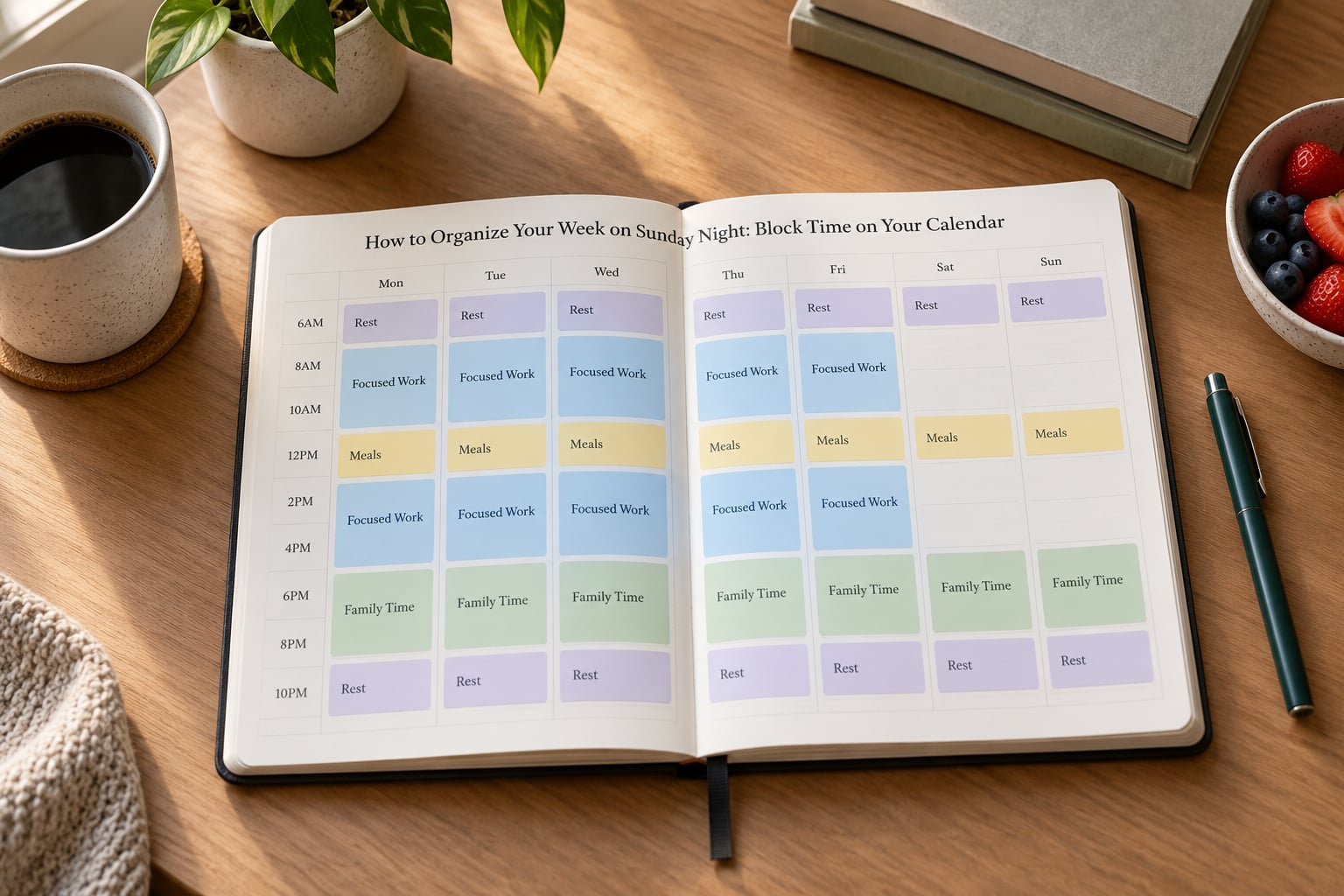
Time blocking is the step that does the actual work. Anything not placed in a specific hour is a wish. Open eight hours, and the calendar is no longer a record of your intentions but a record of where your attention went.
Block in this order:
- The three priorities, each in a realistic block. Most tasks people avoid take two to three times as long as the first estimate, so block for the second estimate, not the first.
- One block for the admin pile: email, forms, the pharmacy run, the call you have been avoiding. Batching it beats sprinkling it across five days.
- Family time as a fixed block, not as the leftover space around everything else. If dinner and a walk are not on the calendar, they do not happen.
- Movement, even if it is a 20-minute walk on three days. Energy drops in the early evening and it is easier to skip something that was never on the page.
- Meals and errands. Deciding Sunday what you are cooking Monday removes a decision from the part of the day when you have the least of them left.
- Recovery space, unmarked and unclaimed. This is the buffer step, and it is the one people skip.
A few popular frameworks get attached to this step, and you will see them recommended constantly. The 3-3-3 rule is roughly three hours of focused work, three tasks, and three non-urgent personal items in a day. The 1-3-5 rule is one must-do, three should-dos, five nice-to-haves. Both are useful as a sanity check on a full day. Neither replaces deciding what this particular week is actually for.
Plan for Interruptions and Unexpected Tasks
A realistic week has about two hours of slack in it, and an unrealistic one has none. Leave two open blocks unfilled. These are not wasted space; they are where the sick kid, the deadline that moved, and the phone call you were dreading will go.
When something does not fit, do not push everything forward by a day. Drop the lowest-priority item on the affected day and move on. And set one re-plan trigger for yourself: if by Wednesday evening two or more days have visibly diverged from the plan, spend ten minutes re-blocking the rest of the week. Ten minutes on Wednesday is cheap. Three hours of guilt-clearing on Friday is not.
Prepare Monday and Close Sunday Night
The last four minutes remove friction from the morning. Set out what you are wearing. Put your keys and bag where they are. Lay out the first task’s materials so the first ten minutes of Monday has no decisions in it. Write one line on paper: what this week is about. One line, not a mission statement.
Then hard stop. Close the notebook, put it in a drawer, and start the wind-down. If you are still reorganizing at 10 p.m., the session ran long, and next week you will cut a step rather than push through. Protecting sleep is not a reward for finishing planning; it is the thing that makes Monday bearable.
Common Mistakes
Overplanning. Most people treat Sunday planning like a project that should get done properly, and proper takes three hours. Nobody has ever needed three hours. Cap it at 30 and let the rest go.
Scheduling every open minute. A calendar with no white space is a calendar that is already broken, and you will be the first to know it Monday at 11 a.m. Leave gaps on purpose.
Ignoring energy levels. Everyone puts their hardest task at 4 p.m. on Thursday. Put demanding work where your focus actually peaks and shallow work where it does not. Track it for two weeks before you decide.
Postponing the unpleasant task. The dentist, the email to your landlord, the difficult conversation. Every one of them costs more the longer it sits on the page. Give it a 30-minute block early in the week and stop reopening it.
Protecting no rest. Planning that runs to 11 p.m. on Sunday produces a wrecked Monday. The planning is supposed to end before the evening starts.
If your Sunday night is genuinely already full, here is the same method at three sizes. The 10-minute version: pick three priorities, put them on the calendar, close it. The 30-minute version above is the full routine. The 60-minute version adds reviewing last week’s notes for patterns, planning meals, and prepping Monday’s clothes and bag the night before. If you only have ten minutes, do that one. Nobody has ever lost a week to a ten-minute version.
Here is the checklist to copy. Most people keep this on a sticky note on the fridge and fill it in each Sunday.
- What finished last week? What rolled over?
- Delete or schedule every rolled-over task. No deferring.
- All fixed commitments on the calendar: meetings, appointments, school, deadlines, birthdays.
- Three outcomes written as finishable things.
- A time block for each one.
- One admin block, one family block, one movement block.
- Two hours left open for interruptions.
- Meals decided for the first two days.
- Monday’s first task has a start time and its materials are out.
- Notebook closed. Wind-down starts now.
Frequently Asked Questions
How long should Sunday night planning take?
Thirty minutes for most people, with a hard stop. Five minutes reviewing last week, five for fixed commitments, five choosing three priorities, eight blocking time, three for buffers, four to prep Monday and close. If you have less, do the 10-minute version. If you have more, spend the extra on next month, not on re-sorting this week.
Why do I feel so anxious on Sunday nights?
Sunday anxiety usually shows up as dread about a specific hour, not about your life in general. That points at uncertainty: you do not know yet what Monday asks of you, and an open question takes up more attention than a hard one. Writing the fixed items down and naming three outcomes converts it into a known quantity, which is why the feeling drops after step two.
What is Sunday Scaries versus Sunday syndrome?
Sunday Scaries is the common informal name for that pre-weekend restlessness. Sunday syndrome is the clinical-sounding label for a recurring pattern of low mood and anxiety in the days before and after a workweek. One is a mood most people recognise; the other describes something persistent enough to affect sleep, appetite or concentration for weeks.
What do I do with tasks that keep rolling over?
Give every one of them a date or delete it. A task that has moved three weeks in a row is usually too vague to schedule, not too important. Rewrite it so it has a finish line and a next action, then it either earns a block or gets dropped. Keeping a someday list that you never read is the reason the same task follows you around.
How do I plan a week when my schedule is unpredictable?
Plan the shape, not the days. If you work shifts or freelance, block around the anchors that do not move: sleep, meals, exercise, one family block, and a daily 30-minute slot for administration. Put your three priorities into the first three working windows you get rather than specific clock times, and treat the calendar as a container you fill each morning, not a finished document.
Is a paper planner or a digital calendar better for this?
Paper is faster to scan and easier to write messy thinking on, which matters during the review step. Digital is better at recurring events, reminders and sharing a schedule with a partner. Plenty of people use both: paper for the weekly plan and review, digital for appointments and shared family logistics. Consistency matters more than which one you pick.
If the Sunday dread is not settling after a few weeks of a calmer routine, or it is showing up alongside disrupted sleep and appetite, that is worth raising with a doctor or therapist rather than planning harder. Same goes for any anxiety that is constant rather than specifically tied to Sunday evenings.
Conclusion
Start with ten minutes on the next Sunday evening. Open last week’s list, delete or schedule everything on it, put the fixed commitments down, and pick three outcomes. Block time for those three and stop.
That is how to organize your week on Sunday night without it taking over the evening. The calendar does the reminding so your head does not have to, and Monday starts with a plan instead of a question.