
How to manage time as a single parent comes down to two things: protect the hours that cannot move, and cut the number of decisions you make on a tired brain. You will not find twenty spare hours in your week. You will find ten to fifteen minutes you already spend deciding things that could have been decided on Sunday.
That is the honest version. Most single parents are not short on effort, they are short on slack. One sick kid, one deadline, one school closure and the whole week tips over, because there is no second adult standing behind it. Structure is not the cure for that. Structure just decides in advance what gives first, so the rest holds.
Everything below runs about 30 minutes of setup in the first week. If a tip here does not fit your household, skip it without a second thought. A system you keep at 70 percent beats a perfect one you abandon in a month.
Table of Contents
- What You Need
- Step-by-Step: How to Manage Time as a Single Parent
- 1. Identify your nonnegotiable time
- 2. Set three priorities for the week
- 3. Build a weekly time plan
- 4. Plan each day in two short blocks
- 5. Use a triage system for interruptions
- 6. Create repeatable family routines
- 7. Protect rest and ask for help
- Common Mistakes
- Frequently Asked Questions
- How do I manage my time with a toddler and a full-time job?
- What is the best daily routine for a single parent with school-age kids?
- How do single parents manage time when the job is demanding?
- How do you handle time when co-parenting makes the schedule messy?
- How do I plan a week when my shifts keep changing?
- How do I manage time when I have no family or friends nearby?
What You Need
Five things, and only five things. If you gather them before you plan anything, the planning itself takes half the time.
- One calendar that everybody can see. A paper one on the fridge or a shared digital one. The important part is that it is visible, because a schedule in your head is not a schedule.
- A weekly planning window of 30 to 60 minutes. Sunday evening or Monday morning, before the week starts rather than during it. Set a deadline for finishing it, or it will quietly expand to fill the morning.
- A three-item priority list. Three. Not fifteen. The list exists to tell you what to drop when everything competes for the same hour.
- Backup care, even tentative. One name of a person who could watch your child for two hours on a Saturday. If you have none yet, building one is step seven, not a someday project.
- One place for captured information. School newsletters, appointment dates, permission slips, deadlines. A single notebook or a single note on your phone. Information you have to remember is time you lose twice.
Step-by-Step: How to Manage Time as a Single Parent
1. Identify your nonnegotiable time
Before you schedule anything, list what is already fixed. Work hours, school start and end, the school run, medical appointments, meals, sleep, transport, caregiving. Most people discover their fixed time totals 48 hours or more, which is a useful thing to know before you start adding anything.
The move here is to separate anchors from flexible blocks. Anchors do not move: the school run happens, work happens, sleep happens. Flexible blocks are whatever fits around them, and they are where chores, errands, exercise and your own time get placed.
Keep a running list for one week. Parents who do this often find their commute and their transition time were never on the calendar at all, which is where the missing hour tends to live.
2. Set three priorities for the week
Sort everything on your plate into three piles: essential, important, optional. Essential means the consequences of skipping it are real, a missed shift or an expiring form. Important means you will regret not doing it. Optional means you enjoy it, which is not the same as needing it.
Then choose only three outcomes for the week, and write them down. One essential, one important, one optional. That balance matters more than it looks: a week with three essential tasks and nothing optional produces the guilt spiral, because your brain files enjoyment as a debt.
How to manage time as a single parent in practice means this list does the hard arguing for you. When the school calls about an early day, you are not deciding from scratch in the moment. You are comparing against a list you already wrote.
3. Build a weekly time plan
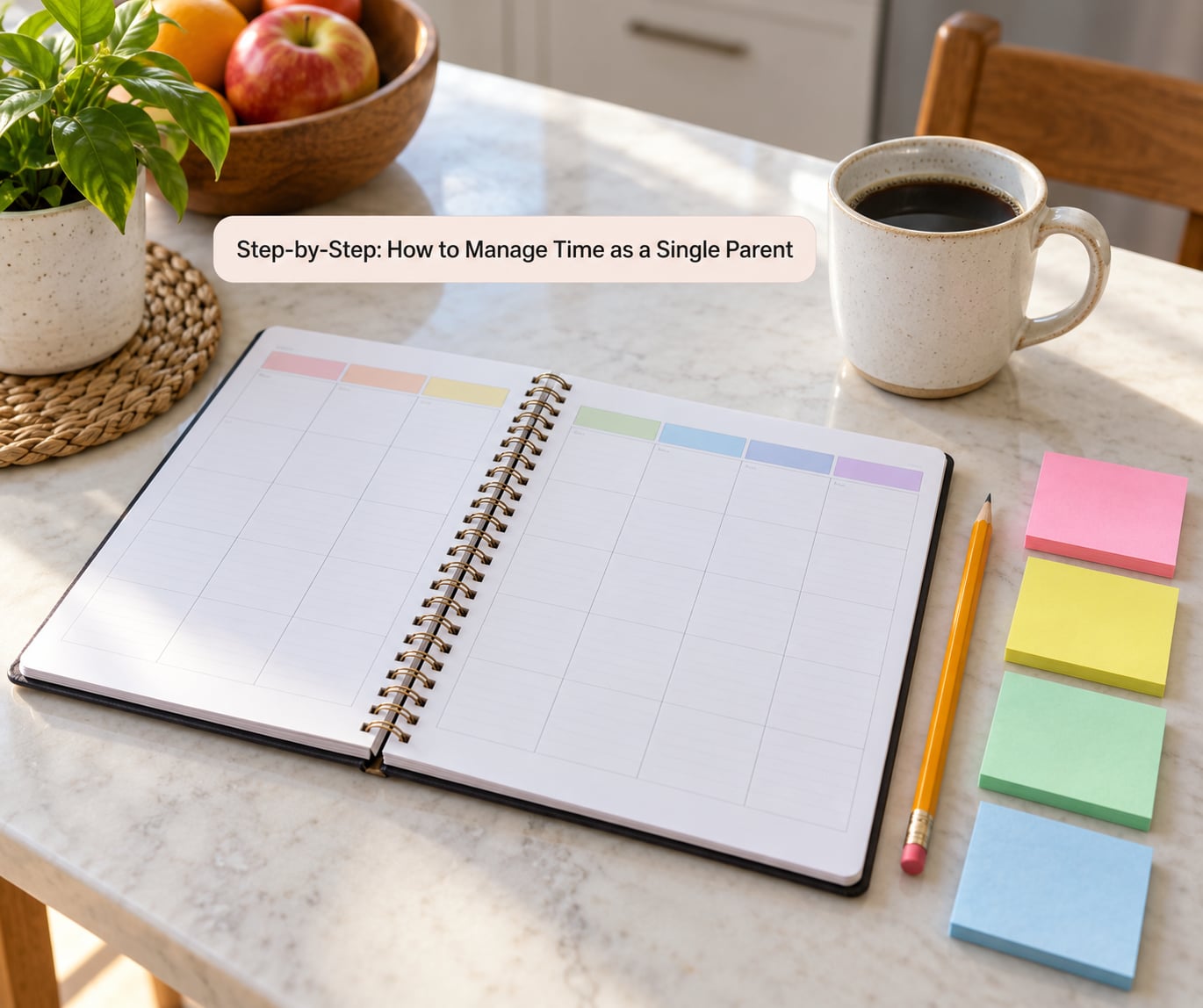
Now put it on the grid. One row per day, with your anchors fixed and your flexible tasks placed around them, including the travel time you normally forget to count.
| Day | Fixed anchors | One flexible task | One self-care block |
|---|---|---|---|
| Monday | Work, school run, dinner | Laundry, one load only | 20 minutes before bed |
| Tuesday | Work, school run, dinner | Grocery shop on the way home | Walk at lunch |
| Wednesday | Work, school run, dinner | Bathroom clean, 15 minutes max | Call a friend |
| Thursday | Work, school run, dinner | Batch cook for the week | 30 minutes offline |
| Friday | Work, school run, dinner | Nothing scheduled on purpose | Whatever you want |
Two details do most of the work here. First, leave buffer space, roughly 15 percent of the day unplanned, because the day that runs to the minute is the day that collapses. Second, write down your rest and your unstructured family time in the same pen as the chores. Rest that is not on the calendar gets treated as leftover, and leftover never survives contact with a busy week.
4. Plan each day in two short blocks
A weekly plan is useless if Tuesday has no shape. Use two short touchpoints instead of a nightly planning marathon.
The morning check-in takes three minutes. Look at the day, confirm the first task, and decide the one thing that would make today a win if nothing else happened. The evening reset takes five minutes: clear the kitchen, put out tomorrow’s clothes, check tomorrow’s calendar, put the bag by the door.
That is the whole daily system. Parents running this report the same thing: the reset is what makes the morning possible, because at 6:45 in the morning nobody has decisions left to spend.
5. Use a triage system for interruptions
Something will land mid-day: a message from school about a forgotten jumper, a work change, a child who feels unwell. Do not abandon the day. Sort it into three answers.
- Urgent and yours: deal with it now, and let one flexible task go to pay for it.
- Urgent but not yours: delegate, or defer to the evening block.
- Loud but not urgent: write it down and move on. Most school messages fit here.
The third pile is where most single-parent time disappears. A message feels urgent, so you answer it, and then the task you planned gets squeezed into whatever gap survives. Writing it down costs five seconds and buys back the block.
6. Create repeatable family routines
Routines work better when they attach to something that already happens than when they depend on a clock time. Attach the bedtime checklist to dinner ending. Attach the homework check to arriving home. Attach the bath to the school run finishing, not to 7:30 on a good day.
On meals, keep a backup dinner you can make without thinking: pasta, frozen nuggets, a tin of soup and bread, leftovers. A parent who knows what dinner is before the afternoon is not calmer because of yoga, they are calmer because they removed a decision.
On chores, chunk anything large. “Clean the kitchen” becomes wiping surfaces, loading the dishwasher, clearing the table, fifteen minutes on the floor. Set a timer. A task with an end time can be started by a tired brain; “clean the house” cannot.
Two more that pay off quietly. Sort laundry by person or bedroom instead of colour, so putting it away is one step instead of two. And have children do what they can at their age, even badly, because a half-sorted sock drawer is still a sorted sock drawer.
7. Protect rest and ask for help
Put your sleep on the calendar like an appointment, because it is one. Losing one hour of sleep affects your patience more than losing an hour of housework, and parents who start functioning again tend to point at the same three things: being tired, being hungry, and money worry.
Then ask for help with specifics. “Could you take my kids Saturday from 2 to 5” gets a yes far more often than “I could really use a hand.” Defined times stop people from feeling taken advantage of, which is the wall most single parents hit.
Reciprocal arrangements are the ones that last. A childcare swap with another parent, a playdate where you host one week and they host the next, a neighbour who will take a school pickup when you cannot. If you do not have anyone nearby, start small: a standing weekly playdate at the library, a message in a local parents group, a teen sitter someone recommended. One hour of cover, repeated monthly, is worth more than a whole weekend you never get.
And when you do get time, do not spend it on the house. Go outside.
Common Mistakes
Scheduling no buffer. A plan with nothing spare guarantees that the first delay eats the rest of the day. Fix: leave about 15 percent of each day unplanned.
Putting every task on the calendar. A calendar full of fifteen items is a to-do list with timestamps, and it guarantees the sense of failure. Fix: three priorities per day, everything else is a maybe.
Forgetting transition and travel time. This is where the missing hours actually go. Fix: write travel time on the calendar as its own block, then check the week again and see what has to move.
Measuring your worth by output. A day with a clean kitchen and a patient parent is not more successful than a day of survival. Fix: judge the week by whether you were present, not by how much got ticked off.
Treating self-care as a reward you have not earned. It goes at the bottom of the list and never happens. Fix: put one small block in the weekly plan before the week starts, at the same level as the school run.
Trusting memory instead of writing things down. Fix: one notebook or note for everything, and check it at the evening reset.
Frequently Asked Questions
How do I manage my time with a toddler and a full-time job?
Anchor your day around the fixed pieces first: sleep, the childcare drop-off and pickup window, your work hours and meals. Toddler time is unpredictable, so build the flexible tasks around a nap or quiet period rather than against it. Keep meals simple with a two-option rotation you already have the ingredients for, and batch laundry on one day only. Most importantly, decide in advance what gives first when the day goes sideways, usually the housework, so you are not negotiating it at 6pm when you have nothing left.
What is the best daily routine for a single parent with school-age kids?
A four-part day works well: a short morning block before the school run, a midday block for work with one small task set aside, an after-school block for pickup, snacks and homework, and a bedtime block that ends on a fixed time. Two touchpoints a day are enough to keep it running, a three-minute morning check-in and a five-minute evening reset. The routine should flex, because a day with an extra sport or a missed pickup will happen, and a routine that cannot bend is the one that gets abandoned.
How do single parents manage time when the job is demanding?
Protect your boundaries before your tasks, because a demanding job will take every gap you leave open. Tell your team clearly when you are unavailable in the evenings, and treat that as a fixed anchor rather than something to apologise for. Then take self-care out of the leftovers and put it in the weekly plan, even twenty minutes. Working single parents who report functioning best tend to be the ones with the smallest, most protected rest block and the fewest commitments beyond work and home.
How do you handle time when co-parenting makes the schedule messy?
Put the handover times, the school run on your days and any activity that has to travel between homes directly on one shared calendar, not in conversation. Build transition time into each handover, since a ten-minute exchange usually becomes thirty. Keep bags, medication and school paperwork prepared the night before so nothing is negotiated at the door. And plan your weeks around your custody days rather than your work weeks, since the custody pattern sets the limits your job has to fit inside.
How do I plan a week when my shifts keep changing?
Skip the weekly ritual and plan in rolling two-day cycles instead, so you only commit as far ahead as your rota is firm. Keep your anchors on a physical calendar that moves with you rather than an app calendar, since a printed grid survives a roster change better. Two things are worth doing regardless of shift: batch cooking on your longest run of days, and keep the backup dinner option stocked at all times. Sleep on shift days is the other priority, because it protects everything else.
How do I manage time when I have no family or friends nearby?
Start with the library and local groups, since standing playdates at story time cost nothing and give you something scheduled each week. Reciprocal childcare swaps are the most reliable arrangement, because the favour balances and nobody is being exploited. Post in local parents groups with a specific request and defined times. And ask your children’s school about any before or after care they offer, plus check whether a local children’s centre or YMCA runs a parent and child session you can rely on weekly.
Start with one change tonight: do the five-minute evening reset, put tomorrow’s clothes out, and write down your three priorities for the week. Everything else in this guide is a refinement of that habit. And when the week falls apart anyway, which it will, that is the schedule working as designed rather than you failing.