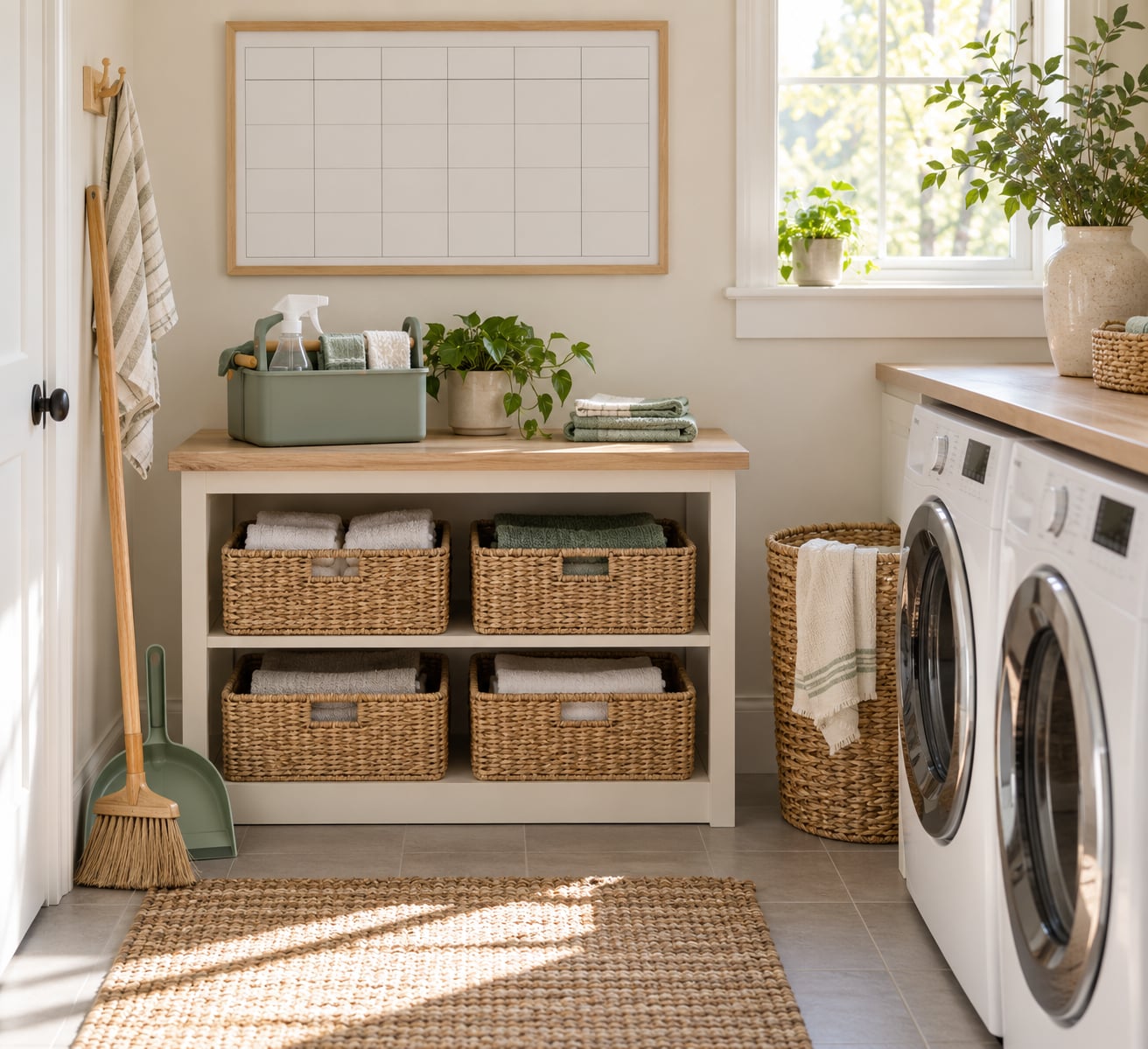
To get kids to help with chores without a daily fight, three things have to be true at once: the job is attached to a routine they already have, you show them how it is done instead of describing it, and the consequence for skipping it is calm, predictable, and already known. Take away any one of those and you are back to negotiating at 6 p.m.
Most parents who struggle with this are not doing it wrong. They are carrying the whole load, doing the chore themselves after a rough evening, and then wondering why nothing changes. The fix is usually smaller than it feels: fewer chores, clearer standards, a fixed time, and a script for the moment they say no.
Here is how to get kids to help with chores in a way that holds up over weeks instead of days. It takes about an hour to set up and two to three weeks before it stops feeling like supervision.
Table of Contents
- What You Need
- Step-by-Step: How to Get Kids to Help with Chores
- Step 1: Choose Chores That Match Your Child’s Age and Ability
- Step 2: Explain the Reason and the Finished Standard
- Step 3: Create a Predictable Chore Routine
- Step 4: Start With Participation, Not Perfection
- Step 5: Follow Up With Specific Feedback and Fair Rewards
- Step 6: Handle Refusal Without a Power Struggle
- Common Mistakes to Avoid
- Frequently Asked Questions
- At what age should kids start helping with chores?
- What to do when a child refuses to do chores?
- Should you pay kids for chores?
- What is the 3-3-3 rule for children?
- What is the 7-7-7 rule for kids?
- How do I restart a chore system after it falls apart?
- Conclusion: Start With One Chore Today
What You Need
Before you assign anything, gather four things. Without them, every request turns into a negotiation because nothing is written down and nothing is ready.
- A short list of real jobs. Three to five tasks for a young child, six to eight for a school-age kid. More than that gets skipped.
- A visible chart or schedule. Paper on the fridge or a whiteboard works. If it lives in an app nobody can see, it does not count.
- Supplies within reach. The broom, the wipes, the trash bags. A job that requires a trip to find supplies gets abandoned halfway.
- A fixed check-in time. Pick one window, like the 20 minutes after dinner, and protect it.
Then hold one short family conversation, ten minutes at most, about how requests and rewards will work. Say it plainly: this is what happens before dinner, this is what we do every day, this is what we celebrate at the end of the week. Write the agreement down and let your child add something to it, even if it is only which song plays during cleanup.
Step-by-Step: How to Get Kids to Help with Chores

Step 1: Choose Chores That Match Your Child’s Age and Ability
Match the job to what they can finish alone and safely, not to what you wish they could manage. A three-year-old can put toys in a basket and wipe a sticky table. A seven-year-old can sort laundry and empty the dishwasher. A twelve-year-old can be trusted with the bathroom counter and taking out the trash.
Keep the jobs with real risk out of reach no matter how eager the child is. Cleaning products, the stove, and anything needing a sharp blade stay with grown-ups. I get the argument that the house would be cleaner with help, and I am still the one holding the bleach.
You will know the fit is right when the job gets finished without you redoing it.
Step 2: Explain the Reason and the Finished Standard
Kids argue about chores when the finish line is fuzzy. Instead of describing a job, show it once and then name what done looks like. Take your child to a full sink and say, this is the level: empty, wiped, put away. Then walk away.
Connect the job to something real rather than to obedience. Say the honest version: I am tired after work, this kitchen is not going to clean itself, and I need you to hold this end. Children can handle a real explanation better than a vague appeal to being a good helper.
Step 3: Create a Predictable Chore Routine
Anchor chores to something that already happens. A five-minute reset after dinner, laundry folded while the dryer runs, one chore before screen time on school nights, a bigger Saturday morning block for floors and bathrooms. Predictable beats flexible almost every time, because you are no longer deciding in the moment and your child is not bracing for a surprise ask.
A useful time budget: roughly ten minutes of chore time a day at age six, up to twenty to thirty minutes for a teenager. If you are scheduling an hour for a nine-year-old, you are going to lose the schedule by Wednesday.
Two popular systems are worth knowing. The 3-3-3 rule sets a simple daily quota: three minutes of tidying, three minutes of putting things away, and three minutes of wiping or sweeping a surface. The 7-7-7 rule applies to bigger jobs: spend seven minutes on it, come back seven minutes later, and check it again in seven minutes. For a stubborn stain, a long closet, or a messy car, that second visit does most of the work.
Step 4: Start With Participation, Not Perfection
Ask once, plainly, then stop negotiating. Do not ask three times, because the third ask is where every chore battle actually lives.
Offer a choice inside the request. Not whether, but which: laundry or dishes, sweeping or taking out the trash. Parents report the single biggest shift in their homes came from moving off a list you assigned to one your child picks from.
Do one step beside them the first few times. Then hand over the rest. Start with five to ten minutes of practice and let the job go unfinished if it has to, as long as you do not step in and finish it for them.
Step 5: Follow Up With Specific Feedback and Fair Rewards
Swap good job for something that names what actually happened. You folded every shirt straight and stacked it by type. You noticed the counter was empty before dinner. Specific praise tells a child what to repeat tomorrow, and it costs you nothing.
If you use a reward system, keep it small and predictable. Stars, a family goal for the week, choosing Friday dinner, ten extra minutes of screen time. Rotate the jobs nobody wants, like the cat box or the trash, so the same child is not always stuck with the worst one.
Have a family meeting every Sunday or the first of the month. Everyone can swap a job, name one thing that felt unfair, and raise one thing they want to change. Ten minutes of that prevents weeks of simmering resentment.
Step 6: Handle Refusal Without a Power Struggle
A refusal is information, not disrespect. It usually means the job is too big, too unclear, or the timing is bad. You can check all three in under a minute before you raise your voice. Knowing how to get kids to help with chores is half the job; the other half is what you do in the ten seconds after they say no.
Use a when-and-then statement. When the dinner dishes are finished, then screen time starts. When the trash goes out on Tuesday night, then you choose Friday’s movie. These are not threats, they are tradeoffs you get to make as the adult who runs the house.
Then stay flat. Say, I hear that you do not want to. The chore still happens at 7. I will be in the kitchen. You can complain, complain, then start, or start and complain at the same time. That last part usually gets a laugh, and laughter breaks more of these standoffs than lecturing does.
If a child refuses to start, do not stand over them. Start the job yourself and hand them a sponge. Nobody argues about a sponge. Give a two-minute reset when everyone is loud, then come back to the same task without renegotiating it.
Do not pay, punish, or take away a big thing like a birthday treat for one missed chore. Logical consequences are ordinary and immediate. If the room was not tidied, the room is still untidy tonight. A weekly allowance is a separate system that does not rise and fall with whether the trash went out.
Common Mistakes to Avoid
Assigning too many jobs. Three to five real chores beat a list of fifteen. Cut the list until you know every item on it actually gets done, then add slowly.
Giving vague instructions. Clean your room is not a task, it is a mood. Say make the bed, put the books on the shelf, clothes in the hamper, and walk away.
Adding jobs every time you are annoyed. Do not hand out extra work mid-argument. New tasks go on the chart at the family meeting, never as a punishment.
Comparing siblings. Saying your sister does more gets you a sibling feud, not a willing child. Compare each child to their own last week instead.
Paying for the basic stuff. Tying every dish to money trains kids that contribution is a transaction. Pay for extra jobs, or set a flat allowance that is unrelated to whether the sink got done.
Arguing at the moment of conflict. A discussion during the standoff teaches nobody. Table the complaint for the meeting and hold the boundary in the moment, quietly.
Doing it yourself just once. This is the trap that resets the whole system. The first time you rescue them after they skipped it, you taught them that skipping works. Let the consequence land, however uncomfortable the mess is.
Also worth knowing: if your child has ADHD, sensory sensitivities, or a developmental difference, shorter tasks with a timer and a written checklist usually outperform long instructions. Many neurodivergent kids do fine with the chore and cannot hold four steps in working memory.
Frequently Asked Questions
At what age should kids start helping with chores?
Start around age two with jobs that take under a minute: putting toys in a basket, wiping a table, carrying a sock to the hamper. By three or four they can handle sorting laundry and feeding a pet. Ages six to eight manage dishes, a room reset, and sweeping one room. Tweens take on real household jobs and younger siblings. Wait until a task can be finished safely without an adult redoing it.
What to do when a child refuses to do chores?
Check three things before you react: is the job too big, is done clearly defined, and is the timing terrible. Shrink the task, show one step, and use a when-and-then statement. If they still refuse, say the chore still happens at 7 and walk to the next room. Do not negotiate, raise your voice, or rescue them by finishing it yourself.
Should you pay kids for chores?
Treat them as two separate systems. Chores are contribution to the family and are not paid. Allowance is a flat, regular amount for teaching money management. If you pay per chore, kids often do only the jobs they want and slow down the rest. Some families pay for above-and-beyond jobs like washing the car or organizing a closet, and that works well once the basic ones are consistent.
What is the 3-3-3 rule for children?
The 3-3-3 rule is a quick daily reset: three minutes tidying loose items, three minutes putting things back where they belong, and three minutes wiping or sweeping one surface. It works well for ages five to nine because it is small enough to finish and specific enough to start. Skipping it on a busy night is better than skipping it for three weeks.
What is the 7-7-7 rule for kids?
The 7-7-7 rule splits a bigger job into short passes: work for seven minutes, leave it, come back seven minutes later, and check it again after another seven. It suits tasks that feel overwhelming, like scrubbing a stovetop, cleaning out a car, or sorting a closet. The pause makes the next stretch easier to start, which is usually the real problem.
How do I restart a chore system after it falls apart?
Do not restart with a big speech. Sit down, cut the list down to what actually works now, and pick two chores your child can finish without help. Run that for two weeks before adding anything. Most systems collapse because the list grew faster than the child could carry it, and it is fine to start smaller than feels generous.
Conclusion: Start With One Chore Today
Pick one job you would be genuinely glad to stop doing yourself. Show your child the finished standard once, put it on a chart where they can see it, and set a specific time, like 6:40 every evening after dinner. Then close the loop: when they finish it, say exactly what they did well.
Do that one thing for two weeks before you touch anything else. Most homes that get past the chore battle did not add more structure, they added less and made it stick.