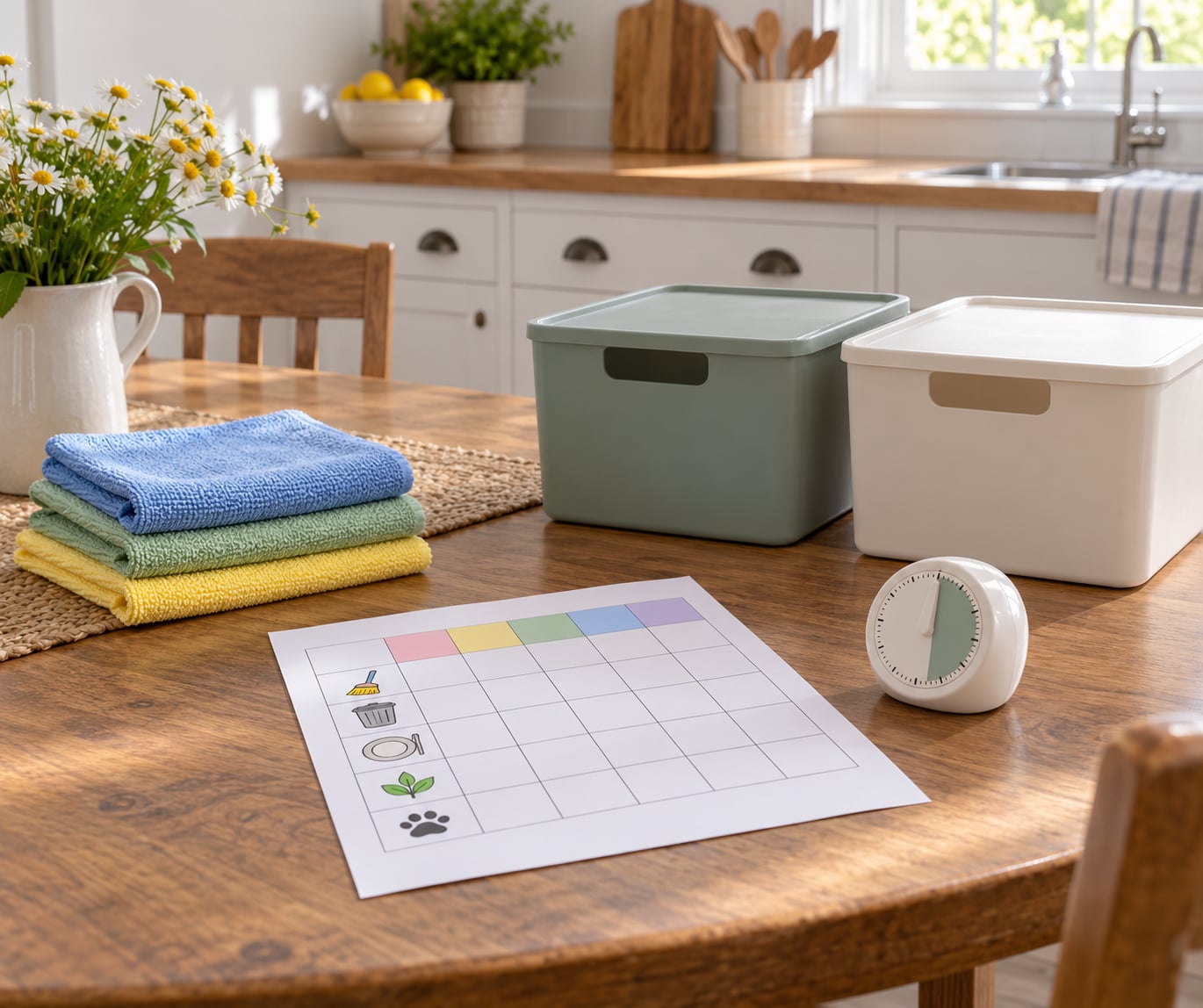
Fairly dividing household chores comes down to this: write down every recurring task, including the planning nobody sees, then give each task to one person who owns it from start to finish and agrees on how often and what done actually means. The goal is an equal workload, not an identical task list. One honest conversation and about an hour of setup gets you there.
The reason most chore arguments fail is that both people are counting different things. One counts the dishes they washed; the other counts the dinner they planned, the shop they ordered from, and the birthday they remembered. Put it all on paper and the picture usually changes within ten minutes.
What follows works for couples, roommates, and families sharing a home. Adjust the examples to your week and it still holds.
Table of Contents
- What You Need
- Step-by-Step: Create a Fair Chore System
- Step 1: List Every Recurring Household Task
- Step 2: Estimate Time and Workload
- Step 3: Match Tasks to Time, Skills, and Preferences
- Step 4: Agree on Ownership and Standards
- Step 5: Build a Weekly Routine and Review It
- Common Mistakes and How to Fix Them
- Frequently Asked Questions
- How do we split chores when one person earns more?
- What if we have different standards of clean?
- Should chores be split equally or equitably?
- How do we divide chores with very different schedules?
- How do we share childcare and housework fairly with a baby?
What You Need
You need about 45 minutes, a notebook or a shared notes app, and a real conversation. Before you write a single task down, gather five things.
Schedules. When is each person actually home, and which hours are busiest? Someone working nights and someone working days will need a different split than two people home on the same days.
Paid and unpaid hours. Note the paid work hours, plus school, commute, and care of parents or pets. Fairness does not mean split everything in half, and knowing the real load stops the comparison from turning into a contest over who is tireder.
Ability and health. Bad backs, bad knees, fatigue, and pregnancy all change what a person can reasonably take on. So does a job that already uses the whole body or the whole attention span.
Preferences. Who enjoys cooking, who hates it, who does not care about laundry and would happily do it every week. Preference is a legitimate reason to hand over a task, not a favor you owe someone.
The standard of clean each person expects. Two people can do the same bathroom and one still say it was missed. Talk about this directly, because it is usually the real reason a chore feels unfairly divided.
Step-by-Step: Create a Fair Chore System
Step 1: List Every Recurring Household Task
List everything that happens in your home on a repeating cycle, not just the cleaning.
Cleaning is the obvious group: dishes, sweeping, mopping, bathrooms, dusting, taking out trash, changing sheets, cleaning the fridge and the oven, the gutters, the filter in the furnace.
Cooking and food cover planning meals, shopping, unpacking, prepping, cooking, and washing up. Laundry covers sorting, washing, drying, folding, putting away, ironing, and remembering to run the dryer.
Then add the ones people rarely name. Restocking paper towels and soap, refilling the water filter, scheduling the dentist, chasing the school form, arranging the car service, keeping birthdays and refill dates in your head. That last category is the mental load, sometimes called invisible labor: the planning and tracking that never shows up in a list of chores but quietly runs the household. If only one person holds it, add it to the page before you start dividing anything.
Write each task on its own line. Most people find the running total surprising.
Step 2: Estimate Time and Workload
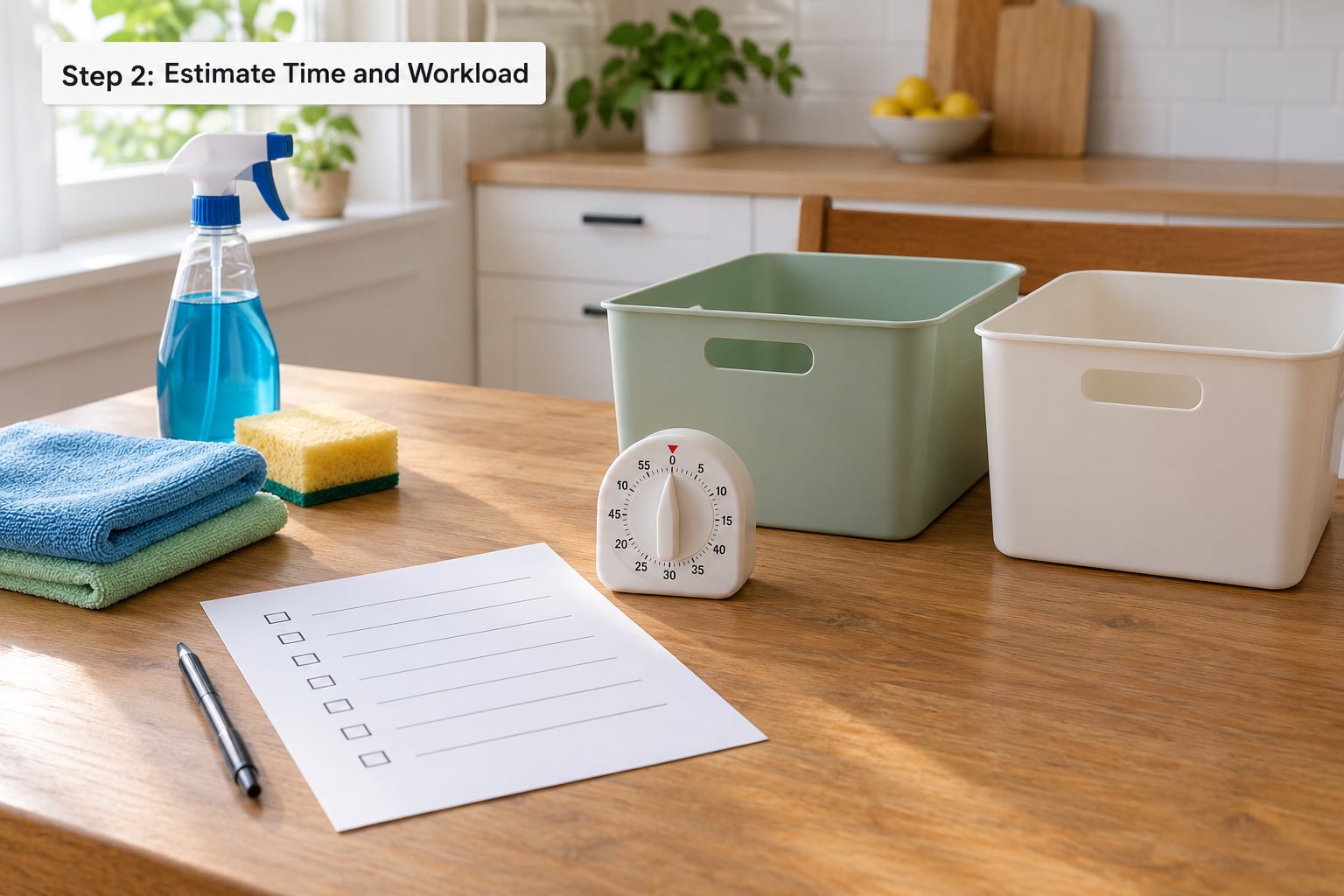
Now put a number on each line. Multiply how often the task happens by how long it takes. A task done daily for 15 minutes costs about 8 hours a month, while one done monthly for 3 hours costs 3 hours. Same household, very different weight.
Then add a difficulty and planning mark. Washing dishes after a family dinner is 25 minutes of standing up and putting things away, and somebody decided what to cook, bought the ingredients, and will clear the leftovers. Marking those tasks as two or three points instead of one keeps the split honest.
Add it all up and divide by two. If the totals are close, you have a workable baseline. If one side is running 60/40, you know exactly where the conversation needs to go.
Step 3: Match Tasks to Time, Skills, and Preferences
Now you are deciding who does what, and this is where a fair workload becomes possible. Three things should drive the assignment: when people are actually available, what they can comfortably do, and what they would rather do.
People tend to divide chores badly by assigning by default rather than by fit. A person who works from home and assumes their weekday tidying counts as their share has missed every task that happens at 6pm on a Saturday.
Match the schedule first. Anything tied to a specific day or time belongs to whoever is reliably awake for it. Then match skill: whoever cooks better, or fixes things without a second attempt, takes those tasks, not out of charity but because it saves everyone time.
Give each person whole ownership of at least a few tasks rather than swapping single jobs weekly. Someone who owns the kitchen, the shopping, and the bins will notice and handle them; someone who washes two dishes four times a week will not. Eve Rodsky’s Fair Play framework leans on this idea of full ownership and is worth reading if your household is stuck in a cycle of half-effort and rework.
Finally, be honest about the tasks people dislike. Rotation helps here. Trade the worst jobs between the two of you on a set cycle, and nobody is stuck with the fridge or the litter box forever.
Step 4: Agree on Ownership and Standards
Turn vague expectations into agreements. For every task, write down four things.
- Frequency. Daily, twice a week, weekly, monthly, or seasonal.
- Standard of done. Not clean. Specific: dishes put away and the counter wiped, not dishes sitting in the sink overnight.
- When it happens. Before work, after dinner, Sunday morning.
- What happens when someone cannot do it. They say so before the day, they own the catch-up, and the other person is not left to guess.
This is the step most households skip, and skipping it is why the same argument returns every month. A task without a standard will be redone by the other person, and the person who redid it will reasonably feel the split is unfair.
Step 5: Build a Weekly Routine and Review It

Put the agreed tasks on a weekly schedule. Give each person a named slot rather than a general expectation, and keep the plan visible: a chart on the fridge, a shared note, or a chore app both of you actually open. Visible lists work because nobody has to remember or track anything in their head.
Set a short weekly reset meeting, 10 minutes on a fixed day. Ask two questions: what slipped, and what needs to change next week. That single habit is what keeps a split from drifting back to one person doing everything within a month.
Review the whole plan whenever a schedule changes. A new job, a new baby, a student season, or a bad week at work all change the math, and a plan built for a different month is not a fair plan.
Common Mistakes and How to Fix Them
Counting tasks instead of weight. Ten light tasks do not equal two hours of cooking and washing up. Fix: score every task by time and difficulty first, then compare totals.
Assigning by gender or by default. Whoever did a task as a teenager still does it, and nobody reassigned the lawnmower. Fix: redo the assignment from the current list every few months, with no memory of who used to do what.
Leaving standards unstated. One person calls a sink clean; the other calls it an event waiting to happen. Fix: write a one-sentence standard for the ten tasks that cause the most friction.
Treating occasional help as a permanent arrangement. Doing the bins twice a month feels generous and changes nothing structurally. Fix: put it on the schedule at the agreed frequency, or take it off the list entirely.
Avoiding the conversation. The longer the imbalance runs, the more it is about the relationship than the dishes. Fix: use the list, not your memory, and open with something neutral like I looked at how the week actually ran and the totals are not close.
Using the chart as evidence. A shared list is a planning tool, not a weapon to win an argument three weeks later. Fix: bring it up in the weekly meeting, not during the fight.
Ignoring energy and executive function. Just make a chart advice fails when someone has ADHD, a chronic illness, or a job that leaves no attention left at the end of the day. Fix: shrink the task, attach it to an existing habit like after the morning coffee, use a visual timer, and lower the frequency before you lower the person.
Frequently Asked Questions
How do we split chores when one person earns more?
Earnings do not set the household workload, but they are worth naming. Paid hours, commuting, and care of dependents all reduce available time, so start by comparing total hours rather than income alone. If the higher earner works far more hours, a closer-to-equal split of chores is usually fairer. Where the gap is small, an even split with full ownership of whole tasks works well.
What if we have different standards of clean?
Write down a shared standard for the tasks you argue about most, using specifics rather than words like tidy. Example: dishes in the cupboard and the counter wiped, no dishes left overnight. If one person needs noticeably more than that, decide whether it is worth the cost, in time and money, and either agree to it or hire help for it. Fighting over taste rarely resolves itself.
Should chores be split equally or equitably?
Equitably is the better goal in most households. Equality means the same number of tasks; equity means a comparable share of time, effort, and planning. One person cooking dinner for six while the other does the laundry has produced an equal count and a very unequal workload. Score your tasks by time and difficulty and aim for equal totals instead.
How do we divide chores with very different schedules?
Assign tasks to the times when a person is reliably available instead of dividing by category. Night shifts and shift workers take the daytime block, early risers take the evening block, and weekend-only availability means weekend-only ownership of anything time-sensitive. Review the split whenever a shift pattern changes, because a schedule change quietly unbalances an old plan.
How do we share childcare and housework fairly with a baby?
Give one parent full ownership of the planning side of childcare while on leave: appointments, supplies, feeding schedule, and laundry, and give the working parent specific evenings and mornings with named duties. Be specific about tasks such as the bath and the bedtime routine rather than the vague offer of help. Re-split every few weeks; the balance in the first month rarely holds in the third.
Start this week with the list, not the argument. Write down every recurring task including the planning work, score the time on each one, and see where the totals actually land before deciding who owns what. Once the plan is written down and reviewed every Sunday, the conversation gets much easier.