
Knowing how to prepare your taxes as a freelancer comes down to one habit nobody does for you: keeping clean records all year and paying tax on your profit as you earn it. You file your own return, subtract business costs, calculate self-employment tax, and settle up with the IRS each quarter.
That is the whole job. No employer withholds anything from a 1099 invoice, so the bill arrives in full. A freelance business-of-one filing usually means Form 1040 with a Schedule C for income and expenses and a Schedule SE for self-employment tax, plus a state return if your state taxes freelance income.
Most freelancers can handle this themselves in an evening or two with a good bookkeeping habit and tax software. Pay a preparer instead when your situation has layers — a spouse, several states, an S corporation election, real rental income, or a first year that went sideways. Budget three to eight hours of work for a straightforward year.
This guide is educational, not tax advice. Rules and rates change and differ by state, so confirm current figures on IRS.gov and check with a qualified tax professional for anything unusual in your situation.
Table of Contents
- What You Need
- How to Prepare Your Taxes as a Freelancer Step by Step
- 1. How to Prepare Your Taxes as a Freelancer: Set Up a Record System
- 2. Confirm Your Income and Filing Status
- 3. Separate Personal and Business Costs
- 4. Review Deductions and Tax Credits
- 5. Estimate Your Quarterly Tax Payments
- 6. Complete and Review the Correct Return
- 7. File, Pay, and Keep Your Records
- Common Mistakes
- Frequently Asked Questions
- Do I have to file taxes if I am a freelancer?
- What can I deduct as a freelancer?
- How much should I set aside for freelance taxes?
- What if I did not receive a 1099?
- Do I need to make quarterly tax payments as a freelancer?
- Should a sole proprietor use an LLC or S corporation?
- Conclusion
What You Need
Preparation is mostly an assembly job. Every number you report on the return has to be traceable to a document you kept, so the list below is the whole raw material set.
- 1099 forms. Form 1099-NEC from each client, Form 1099-K from any payment platform that processed the work, and Schedule K-1s if you hold an interest in an S corporation or partnership.
- Invoices and payment records. Every invoice you sent, plus bank or payment-platform statements that show the money actually landed.
- Business expense receipts. Software subscriptions, equipment, insurance, professional education, office supplies, and travel.
- A mileage log. Date, destination, purpose, and miles for every business drive, recorded as you go.
- Retirement contribution records. Solo 401(k) and SEP-IRA contribution confirmations, and the plan documents behind them.
- Estimated payment confirmations. Proof of what you sent the IRS each quarter, so you can claim the credit on Form 1040.
- Your prior-year return. Needed for the standard deduction, prior-year figures, and any carryforwards.
- A separate business bank account and card. Not required, but it is the single change that removes most of the guesswork later.
One clarification that catches a lot of first-year freelancers: a 1099 is not a bill, and it is not the trigger for filing. It is just a report from one payer. You report all of it whether or not a form arrived, and receiving nothing changes nothing.
How to Prepare Your Taxes as a Freelancer Step by Step
1. How to Prepare Your Taxes as a Freelancer: Set Up a Record System
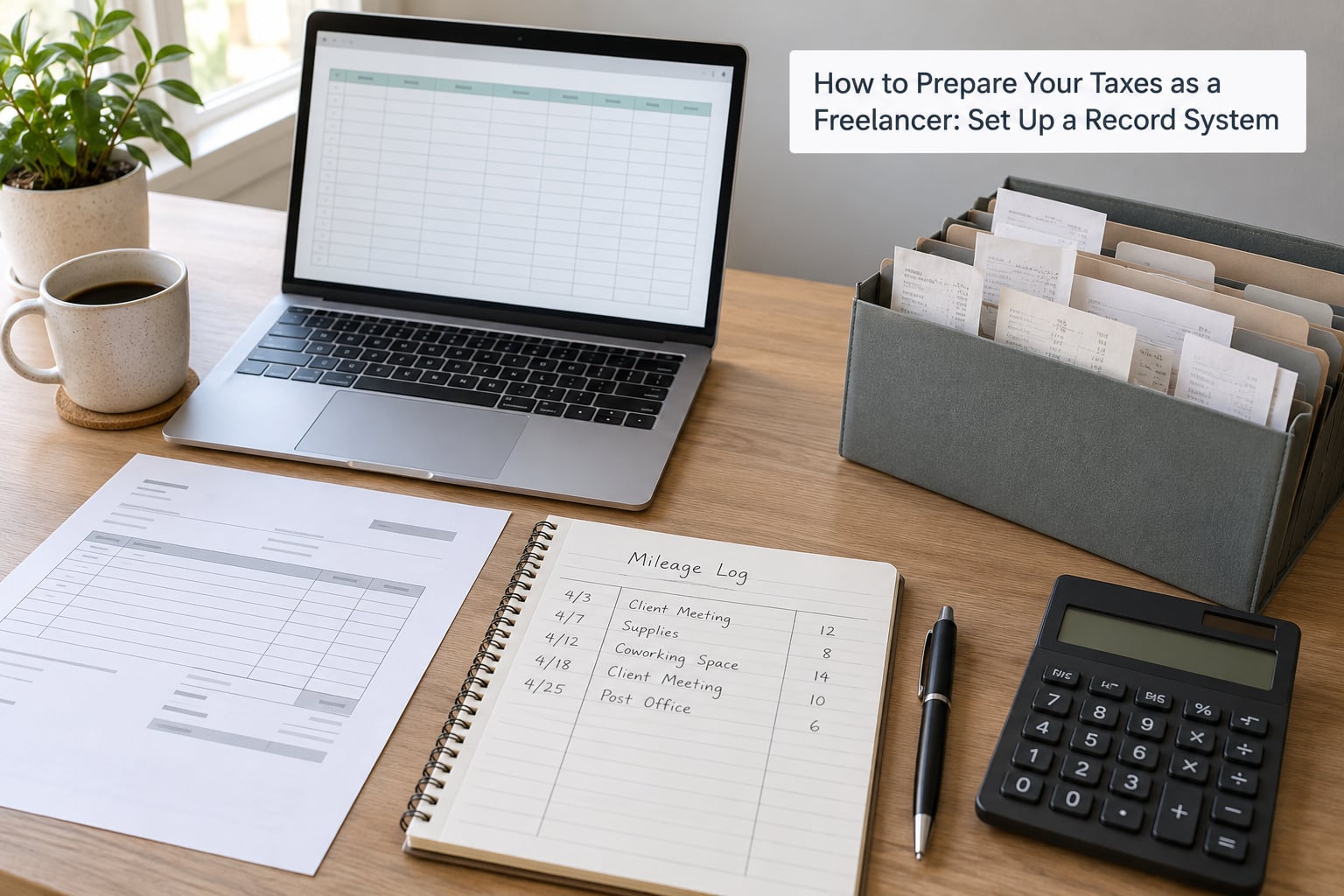
Start the record system before you need it. Open two running totals — one for money invoiced and received, one for money spent on the business — and update them the week the money moves.
Bank feeds and accounting software make this close to automatic, but the discipline that matters is categorization. Every transaction gets a business label or a personal label, and nothing sits in an “unsure” pile past the end of the month.
Keep the paper behind the numbers: receipts photographed with a date, invoices stored by client, contracts in one folder. When you can pull the source document behind any figure in seconds, you have finished the hardest part of preparation.
Check it worked like this: your income total, your expense total, and your net profit are all reproducible from records alone, with no memory involved. If that is true, move on.
2. Confirm Your Income and Filing Status
Reconcile three independent sources: your own invoices, your bank deposits, and the 1099s and platform reports clients sent. They rarely match perfectly. Late fees, refunds, and payments that cleared in the next month explain most of the gap.
Report gross receipts, meaning what clients paid you, not what cleared your account after processing fees. Those fees are a separate deduction.
Entity type follows from what you actually formed. A sole proprietor and a single-member LLC are the same for federal tax purposes — both use Schedule C. Forming an LLC gives you liability separation in many states, but it does not create a different federal return.
An S corporation election changes everything: profits pass through to a Schedule K-1, payroll becomes a real obligation, and reasonable compensation becomes required. That is a decision to make deliberately with a professional, not a default.
If you also hold a W-2 job, both incomes land on one return. Your employer’s withholding is claimed on Form 1040, and the W-2 job becomes the easiest place to raise the amount withheld, which often shrinks the quarterly freelance payment. Transition years are the most common source of confusion for people moving from payroll to contracting, so plan those payments deliberately.
You have confirmed income when your Schedule C gross receipts number equals your reconciled invoice total, and every 1099 you received is already reflected in it.
3. Separate Personal and Business Costs
The expenses most freelancers claim are ordinary and necessary: equipment, software, insurance, professional education and licensing, office supplies, and business travel. The rules about mixed-purpose items are where deduction claims get rejected.
Paying for something from a business account does not make it deductible. The test is whether the expense is ordinary and necessary for the business, and the burden of proof sits with you. A laptop you use for personal streaming on a Sunday is partly personal, and the business percentage has to be defensible.
Two rules worth knowing by name. The de minimis safe harbor lets you treat certain incidental items paid in cash as deductible without an accounting system; the 2,500-dollar equipment threshold, on the other hand, is a capitalization rule — equipment at or above it is generally depreciated or expensed rather than deducted outright, and Section 179 expensing is one route for smaller amounts. Get advice before you put a large purchase on the wrong line.
When a category feels uncertain, park it in a separate list and ask a preparer rather than guessing. One wrong classification carried across three years is more expensive than a short consultation.
4. Review Deductions and Tax Credits
Group deductions by category so the return is easy to check against your records: vehicle and mileage, home office, software and equipment, insurance, professional development, retirement contributions, and business insurance. Categories beat a long flat list.
Two mechanics trip people up. A deduction lowers taxable income; a credit reduces tax owed directly. And the deduction for self-employment tax — half of the amount calculated on Schedule SE, claimed on Schedule 1 — cuts income tax, not the self-employment tax itself, which is why the final bill rarely drops by the full amount you expect.
Credits and above-the-line items worth checking include the self-employed health insurance deduction, retirement contributions to a Solo 401(k) or SEP-IRA, and the qualified business income deduction. Eligibility depends on income level, business type, and how the business is structured.
Federal rules are not state rules. Some states allow a home office deduction that the federal return does not, some start taxing freelance income at far lower thresholds, and a few have no income tax at all. Check your state’s revenue department separately.
Your deduction review is complete when every claimed line has a supporting document and every uncertain line has either been confirmed by a professional or moved off the return.
5. Estimate Your Quarterly Tax Payments

You estimate on net profit, not on revenue. Take year-to-date gross receipts, subtract deductible business expenses, apply your standard or itemized deduction and any other adjustments, and estimate the income tax on what remains. Separately, self-employment tax applies at 15.3 percent to 92.35 percent of net self-employment earnings.
A worked example makes it concrete. Take 80,000 dollars of net profit for the year. Self-employment earnings are 80,000 multiplied by 92.35 percent, or 73,880. The 15.3 percent self-employment tax on that is about 11,304. Half of it, roughly 5,652, comes off your income tax. The total federal burden is income tax on the remaining base plus that 11,304 — and your state adds its own layer on top.
Use the IRS Withholding Estimator or the worksheet in Form 1040-ES, then check your answer against the IRS’s annualized income tax method instructions when income is uneven. Most months are not alike in freelancing, so annualizing avoids a lumpy bill in a good month.
Federal estimated payments for the prior tax year are due in April, June, September, and January. State deadlines differ and sometimes land earlier.
Safe harbors exist for the underpayment penalty. Paying 100 percent of last year’s total tax generally shields you, or 110 percent if your prior-year adjusted gross income was high enough. You are still expected to pay what you owe for the current year, but the penalty usually disappears.
Many freelancers move 25 to 30 percent of every payment received into a separate tax account the day it lands. It is the difference between paying a tax bill and paying a tax bill plus an avoidable penalty and interest.
6. Complete and Review the Correct Return
For most sole proprietors the path is Form 1040, Schedule C for income and expenses, Schedule 2 and Schedule SE for self-employment tax, and Schedule 1 for the half-of-SE-tax deduction. Supplemental forms appear when the situation calls for them — Form 8829 for a home office, Form 7206 for self-employed health insurance, Schedule K-1s from an entity, Schedule D for investment sales, Schedule E for rental income.
Work through the review checklist before you file: legal names and taxpayer identification numbers match the Social Security records, gross receipts tie to your reconciled total, every deduction has documentation behind it, estimated payments match the confirmations you saved, credits are supported, and the final number is a refund or a balance due that you can explain out loud.
If the software produces a self-employment tax figure that looks wrong, check whether Schedule C expenses landed where you expected. A miscategorized payment fee or a retirement contribution in the wrong box cascades through everything below it, and a single line in the wrong box has been enough to swing a return figure by thousands of dollars.
7. File, Pay, and Keep Your Records
Electronic filing is faster, cheaper, and gives you error checking before submission. Choose a payment method that matches your balance — direct debit, a card with its fee, or an IRS Direct Pay account — and save the confirmation number immediately.
Individual returns are generally due in mid-April, and businesses and certain other filers have different due dates. If you cannot finish, Form 4868 extends the filing deadline for individuals, and Form 7004 covers business returns. The extension buys time to file, not time to pay, and the failure-to-pay penalty still runs on the original due date. Estimated payments usually cannot be extended at all.
Keep records for at least three years from the filing date, one year from the payment date, six years if you understated income, and indefinitely for anything involving property. The IRS asks for substantiation, not memories, and mileage logs are the records freelancers most often wish they had kept.
If you find an error after filing, correct it with an amended return on Form 1040-X rather than ignoring it, and respond to any IRS notice through official channels.
Common Mistakes
- Ignoring income with no 1099. Cash clients, off-platform work, and small payments all count. Fix: reconcile bank deposits against invoices every month so unreported income never accumulates.
- Mixed personal and business spending. One card for everything makes the business percentage a guess. Fix: separate accounts now and untangle older months with documented percentages.
- Waiting until January. Year-end cleanup is what turns a two-hour job into a two-week one. Fix: close the books monthly and do a short review in December.
- Underestimating quarterly payments. Underpayment penalties are calculated on Form 2210. Fix: pay on schedule, or meet a safe harbor based on the prior year.
- Assuming an extension defers payment. It does not. Fix: estimate and pay by the original deadline, then file the extension if you need more time to assemble records.
- Forgetting state obligations. Fix: check your state’s filing threshold and deadlines separately from federal ones.
One more preparation tip that quietly pays off: read the return line by line before you submit it, not after. Most amended returns trace back to a single unreviewed figure, and ten minutes of checking catches nearly all of them.
Frequently Asked Questions
Do I have to file taxes if I am a freelancer?
Yes, in most cases. If you earned money as an independent contractor, you report it whether or not a client sent a 1099. Even a small amount of side income generally creates a filing obligation once it reaches the reporting threshold used for your tax year, and you may owe self-employment tax on top of income tax. If you are unsure whether your amount counts, check the current IRS thresholds and confirm with a preparer.
What can I deduct as a freelancer?
Common deductions include equipment, software and subscriptions, business insurance, professional education and licensing, office supplies, mileage driven for business, a qualifying home office, retirement contributions to a Solo 401(k) or SEP-IRA, and self-employed health insurance. The test is whether the cost is ordinary and necessary for the business. Mixed personal and business items need a defensible business-use percentage.
How much should I set aside for freelance taxes?
Most freelancers move 25 to 30 percent of every payment into a separate account the day it arrives, then pay the IRS quarterly. The exact amount depends on your income tax bracket, state of residence, deductions, and credits. If you fall into a higher bracket, add to the set-aside rate. Under-estimating is the single most common cause of an unpleasant spring surprise.
What if I did not receive a 1099?
You still report the income. A 1099 is a report from a single payer, not a permission slip, and paying clients without sending a form is their mistake rather than yours. Reconcile your invoices against bank deposits to find the missing income, then report it yourself. If a client sent a 1099 that never arrived, request a corrected copy directly from them.
Do I need to make quarterly tax payments as a freelancer?
Usually yes. Because nobody withholds from a 1099, the IRS expects estimated payments in April, June, September, and January for the prior tax year. Payments are made, not filed, and they cover net profit after business expenses. If the amounts were genuinely too small, the IRS safe-harbor rules based on the prior year’s tax can reduce underpayment penalties, but a late filing still needs paying.
Should a sole proprietor use an LLC or S corporation?
For federal tax purposes a single-member LLC is taxed like a sole proprietor, so forming one mainly buys liability separation in states that offer it. An S corporation changes the tax picture substantially: profits pass through on a Schedule K-1, payroll taxes apply, and reasonable compensation becomes required. It makes sense once profits are consistently substantial and stable. Decide with a tax professional, not from a blog post.
Conclusion
Freelance tax preparation is bookkeeping with a deadline attached, and the work happens during the year rather than in April. Gather your 1099s, reconcile income against your records, separate business costs from personal ones, calculate self-employment tax on net profit, and pay estimates on schedule.
If you do one thing after reading this, open a separate account and move a quarter of every payment into it today. That single habit prevents the most expensive and most common mistake in freelancing.