To build a hobby back into your life, pick the one you actually miss, shrink it until a session is almost too easy, put it in the calendar at a fixed time, and tell one other person your plan. A weekend is enough to start; the whole rebuild usually takes a month of showing up rather than one big burst of motivation.
The reason hobbies fall away is rarely dislike. Work expands, kids arrive, the couch gets easier, and a few months turn into a few years. Then picking the hobby back up feels intimidating, so you do not start, which confirms the idea that you have outgrown it.
This guide is for adults restarting something they put down in their twenties or thirties. It works whether you are coming back from burnout, a career change, a move, an empty nest, or just a decade of evenings that went to work and screens.
Table of Contents
- What You Need
- Step-by-Step
- 1. Remember why the hobby mattered
- 2. Choose one hobby instead of rebuilding your whole identity
- 3. Set a minimum version you can keep
- 4. Put the hobby on the calendar
- 5. Remove the friction that stopped you
- 6. Start small and let progress build naturally
- 7. Protect the hobby when life changes again
- Common Mistakes
- Frequently Asked Questions
- How do I restart a hobby after stopping for years?
- What if I only have 10 or 15 minutes for a hobby each week?
- How do I know which hobby to choose if I have several interests?
- How can I keep a hobby habit when my schedule keeps changing?
- Should I feel guilty about missing several hobby sessions?
- How do I return to a hobby that now feels too difficult?
- Conclusion: Start With One Small Block
What You Need
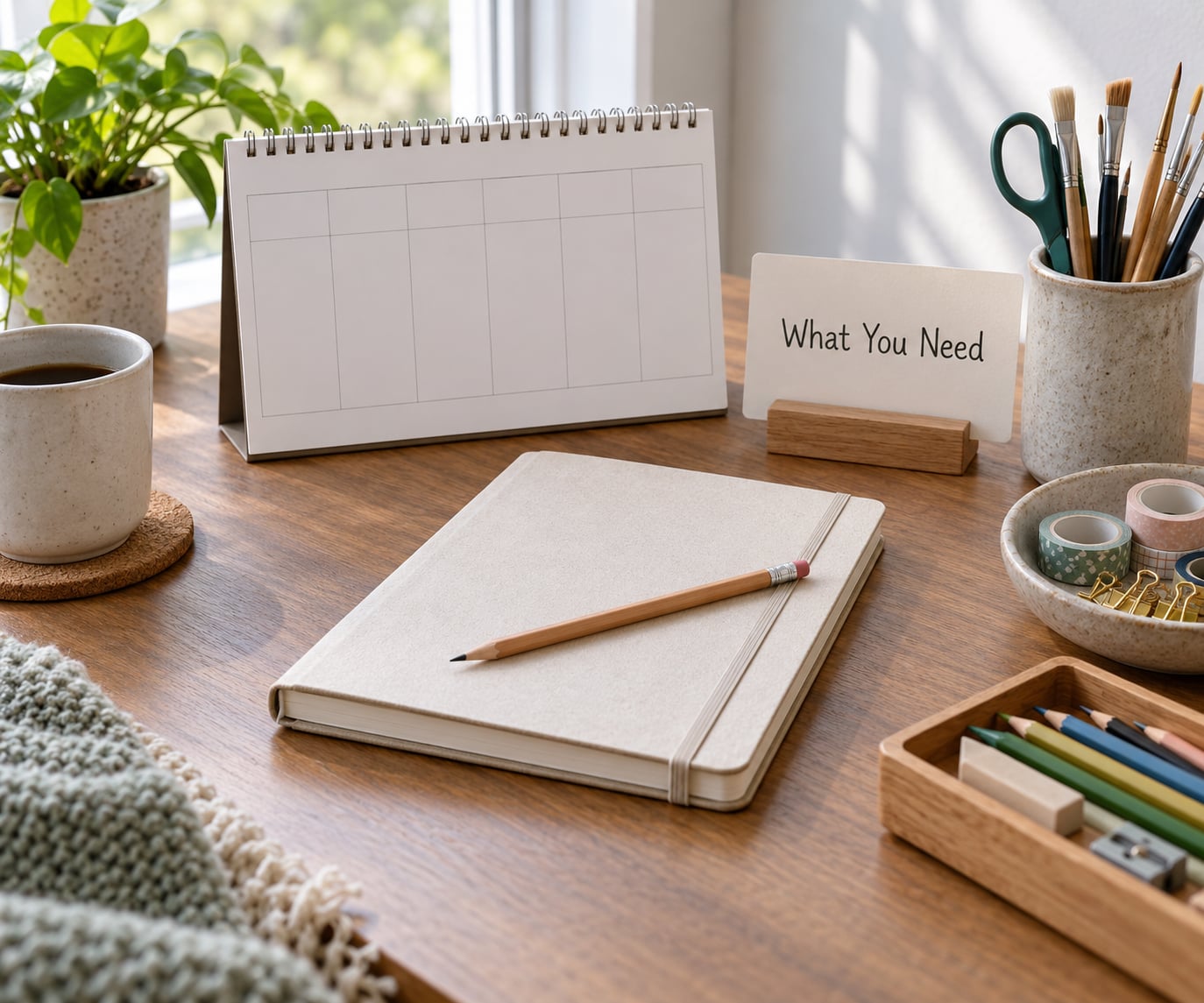
Five things, and none of them cost much. If you skip ahead to the steps, come back to this list first.
- One hobby. A single one. The version you want back, not an ambitious reinvention of it.
- A realistic minimum. The smallest session you would keep doing on a bad week. Ten minutes of reading, one walk around the block, one recorded practice.
- A fixed slot. A specific time and day, chosen around your actual obligations rather than an ideal week that does not exist.
- A tracking method. A paper calendar, a note on your phone, or a small journal. Anything that shows you a row of kept appointments.
- A low-pressure restart. A way back in that does not require buying supplies, joining a class, or committing to a season.
Notice what is missing. No gear list, no budget, no twelve-week plan. Those come later, if at all, and only once the habit is standing on its own.
Step-by-Step
1. Remember why the hobby mattered
Start by writing down what you got from it, not what you accomplished with it. Two or three sentences is plenty.
Be specific. “I liked painting” tells you nothing. “Painting was the one hour a week where nobody needed a decision from me and the result never got judged” tells you exactly what you are trying to build back into your life now.
Compare that reason to your current situation. If you are exhausted, you probably want something restorative. If you feel scattered, you may want a structure with visible steps. If you feel isolated, you may want something built around other people. People who return to a childhood activity often report that nostalgia works better than picking something new, because the memory already carries a pull.
You will know this step worked when your list of reasons feels specific enough to argue with. If it reads like a greeting card, keep digging.
2. Choose one hobby instead of rebuilding your whole identity
Choosing one is the hardest part, because the alternative is appealing. Restarting four things at once sounds like getting your life back.
It almost never works. Four half-started hobbies produce four guilt piles, and none of them build a record of kept appointments. Forum regulars who have tried this generally land on the same conclusion: pick one and do very little of it.
Reduce the scope instead of the number. A full-size pottery wheel can become a hand-building kit at the kitchen table. A marathon plan can become a 20-minute run. A guitar can become fifteen minutes of scales or one song played badly on purpose.
Guard against turning it into a second job. The moment the hobby exists to produce something impressive, it starts generating the same performance pressure you were trying to escape, and you will abandon it for the same reason you abandoned the last one.
3. Set a minimum version you can keep
Write down the smallest version of the hobby you would still do on a day when you have nothing left. Ten minutes. One page. One mile of walking. One recorded take you do not post.
At the start, consistency beats duration, and it is not close. A minimum you keep six days out of seven builds a habit faster than a long session you manage twice a month, because what you are training is the act of starting, not the skill itself.
A useful test: would you do this version if someone guaranteed you would never improve and nobody would ever see it? If the answer is no, your minimum is still too high. Keep cutting until the answer is yes, because early progress comes from small kept promises, not from sessions that impress.
4. Put the hobby on the calendar
Motivation runs out by about the third week. A recurring appointment does not, which is why this is the step that decides whether the hobby survives.
Pick a time that competes with nothing important. Parents often find that hobby time works better scheduled during nap time or done together with kids than squeezed into whatever remains at the end of a long day. People with demanding jobs do better with a fixed early slot than with an open invitation to practice whenever there is time, because there is never time.
Book it as an appointment with yourself, with a start and an end. Two 30-minute blocks beat one hopeful free afternoon, and a repeating reminder helps because it removes the daily decision. Treat the appointment the way you would treat a dentist visit: it does not move because the week got busy.
If you want to learn how to build a hobby back into your life in a way that survives a chaotic week, this is the step that does the most work. Everything else is decoration on top of a slot that holds.
5. Remove the friction that stopped you
Every abandoned hobby has a physical or mental obstacle attached to it. Find yours and fix just that one thing.
- Equipment in the way. If the gear lives in a garage under a tarp, bring one item into the room you actually use. Setup should take under two minutes.
- No clear next step. Sit down for five minutes before the first session and write the literal next action. “Open the box, find the pattern, cut three pieces.”
- Interruption built in. Choose something that survives a bad start. Ten minutes of reading can be interrupted and resumed. A half-finished canvas cannot.
- Cost anxiety. Restart with what you already own and what you can borrow or make. Buy the real upgrade only after the habit has survived a month.
- It feels too difficult. This is the most common one. Adopt the beginner version on purpose for the first month, and treat it as training rather than a downgrade.
The objective is to make starting automatic. Time the setup once. If it takes more than a few minutes, cut the setup.
6. Start small and let progress build naturally
Run one short first session, write down what happened in a sentence, and stop there. That is a successful week.
Then choose one manageable next step for the following week. Slightly harder, still doable. Write it down the same way. This kind of progress tracking works better than a streak count, because a missed session simply means the next step is due, not that you have failed.
Before-and-after photos are worth more than most people expect for tactile hobbies. For anything creative, keep the first attempt. The gap between the two is your own evidence that you are getting better, which is what keeps a slow hobby from feeling pointless.
Increase time or difficulty only when the routine feels stable. If you are reliably keeping the minimum, add ten minutes or one level. If you are not, do not add anything, just repeat.
Adding one other person is the strongest single accelerant. A class, a club, a scheduled group session, a weekly message to a friend, or an online community with a date on it all convert a one-off return into something you are unlikely to drop. People who come back to an old hobby with other people expecting them tend to stick, and the ones doing it alone tend not to.
7. Protect the hobby when life changes again
Life will change again, so plan for that now rather than treating the next disruption as a failure.
Define a five-minute fallback version for bad weeks. Five minutes counts. Most people skip because a skipped session feels like breaking a chain, so the rule is: a fallback session resets the chain instead of breaking it.
Give yourself permission to change the format. Doing the hobby badly, doing a cheaper version, or doing it alone instead of with the group still counts as doing it. The activity matters more than the conditions.
Run a short monthly reset. Look at what happened, cut what got in the way, and set the next block on the calendar before the month starts.
Finally, allow the hobby to end. Some hobbies are finished, and noticing that is information rather than failure. A hobby that no longer does anything for you can be retired without a ceremony, freeing room for whatever comes next. If you do want to keep it around, put it on a seasonal rotation with one other interest so a bad season for one does not leave you with nothing.
Common Mistakes
These are the reasons restarted hobbies usually disappear within a month or two. Each one has a straightforward fix.
- Scheduling too much time. Booking a three-hour weekend session guarantees a long gap before the next one. Fix: set the minimum from step 3 as your real appointment and treat extra time as a bonus.
- Waiting to feel motivated. Motivation is a result of starting, not a precondition for it. Fix: use the scheduled time regardless of how you feel, and stop early if you must.
- Chasing mastery too fast. Comparing beginner work to years of practice is the fastest way to quit. Fix: keep your first attempt, photograph progress monthly, and judge yourself against your own earlier work only.
- Starting several at once. Four hobbies means four chances to feel behind. Fix: commit to one for a full season before you add anything.
- Treating a missed session as failure. A missed Tuesday convinces most people to stop entirely. Fix: use the five-minute fallback the same evening, and never let a gap run past a week.
- Buying gear first. New equipment feels like commitment but does not create the habit, and it creates expense you can resent. Fix: restart with what you own, then reinvest once the habit is real.
A few motivation tips that hold up better than the rest. Schedule the session before you feel like doing it, and pair it with something you already do daily so it rides an existing routine rather than needing its own willpower. Tell someone your plan. Track the kept appointments rather than the quality of the output. And remember that the fun usually arrives after skill, not before, so the flat early weeks are the normal part, not a sign you chose wrong.
If losing interest has spread well past hobbies, that deserves a separate conversation. Exhaustion tied to work that lifts with rest is burnout. A broad, persistent loss of pleasure across most activities is a different thing, and worth raising with a doctor or therapist, particularly if it comes with sleep or appetite changes. A hobby can support recovery, but it is not a treatment for either.
Frequently Asked Questions
How do I restart a hobby after stopping for years?
Start with a version so small it feels silly, then put it on the calendar. Many people write down what they miss about the hobby, pick one thing to restart, choose a ten-minute minimum, and schedule it like an appointment. Gear comes later. After a few weeks of kept sessions, the muscle memory of starting returns, and so does some of the enjoyment.
What if I only have 10 or 15 minutes for a hobby each week?
Ten minutes is enough for many hobbies if you pick the right container. Reading a few pages, a short walk, hand exercises, one recorded rehearsal, or a single recipe all fit that window. What matters more than length is that the time is scheduled and repeated, because short sessions kept regularly build the habit faster than rare long ones.
How do I know which hobby to choose if I have several interests?
Rank them by how much you miss each one, not by how good you are at it. Nostalgia is a reliable signal, so a childhood activity usually beats a new idea right now. Pick the top choice, give it one full season, and keep the others on a list for later instead of running them in parallel.
How can I keep a hobby habit when my schedule keeps changing?
Use a fallback session you can complete in five minutes on the worst possible day, and treat it as a kept session rather than a broken streak. Run a short monthly reset to set the next block on the calendar. Shifting the exact time is fine; dropping the slot for a month is what ends habits.
Should I feel guilty about missing several hobby sessions?
No. A gap is a scheduling event, not a character flaw, and guilt is the reason most people never return at all. The only thing worth tracking is how long the gap runs. Come back with the five-minute version the same week, adjust the slot to your real week, and keep going without an audit.
How do I return to a hobby that now feels too difficult?
Adopt a beginner version on purpose for the first month and treat it as training. Start with the easiest possible entry, like scales, one short walk, or the first row of a pattern, and expect awkward output. Skill returns faster than people expect once the sessions are regular, and the early discomfort is mostly unfamiliarity rather than evidence you no longer belong there.
Conclusion: Start With One Small Block
To build a hobby back into your life, the sequence matters: name what you miss, choose one hobby, shrink it to a minimum you can keep, book a recurring slot, remove one obstacle, and start small enough that you cannot fail. Progress follows, then motivation does, which is the reverse of how most people expect it to work.
Do one thing today. Pick the hobby, write down a ten-minute minimum, and put it in a specific slot this week. Write down afterward what made it easier to start, because that note is what you will use next time life gets busy again.