To read more books with a busy schedule, stop counting hours and start counting windows: pick one book, attach it to one reliable moment in your day, and set a floor of ten minutes or five pages that you clear even in a bad week. That is the whole system. Everything below just makes it easier to keep.
I finished 31 books in the last twelve months, and most of them happened in slots I would be embarrassed to call a reading session: the last ten minutes before sleep, a phone screen at the dentist, the first sip of coffee while the kettle settles. What changed was not my schedule. It was the size of the promise I made to myself.
There is a version of this advice that says “just make time,” and readers rightly roll their eyes at it. Time is already made — in the gaps between a job, a commute, kids, chores and the slow collapse at 10pm. The real barriers are duller than that. Reading competes with a phone that requires no effort, a missed day gets framed as a broken streak, and the only time available is often the time you are too tired to concentrate. Fix those three and the books pile up on their own.
Updated for 2026.
Table of Contents
- What You Need
- Step-by-Step: How to Read More Books With a Busy Schedule
- 1. Choose Books That Fit a Busy Schedule
- 2. Set a Minimum Reading Target
- 3. Schedule Specific Reading Windows
- 4. Use a Simple Note-and-Tracking System
- 5. Keep Momentum With Flexible Reading Options
- 6. Review and Adjust Every Week
- Common Mistakes
- Frequently Asked Questions
- What is the 50 page rule?
- Is it better to read a little every day or in longer sessions?
- Are audiobooks as valuable as reading books?
- How do you read multiple books at a time?
- Do people with ADHD have to reread pages?
- What if I keep abandoning books partway through?
What You Need
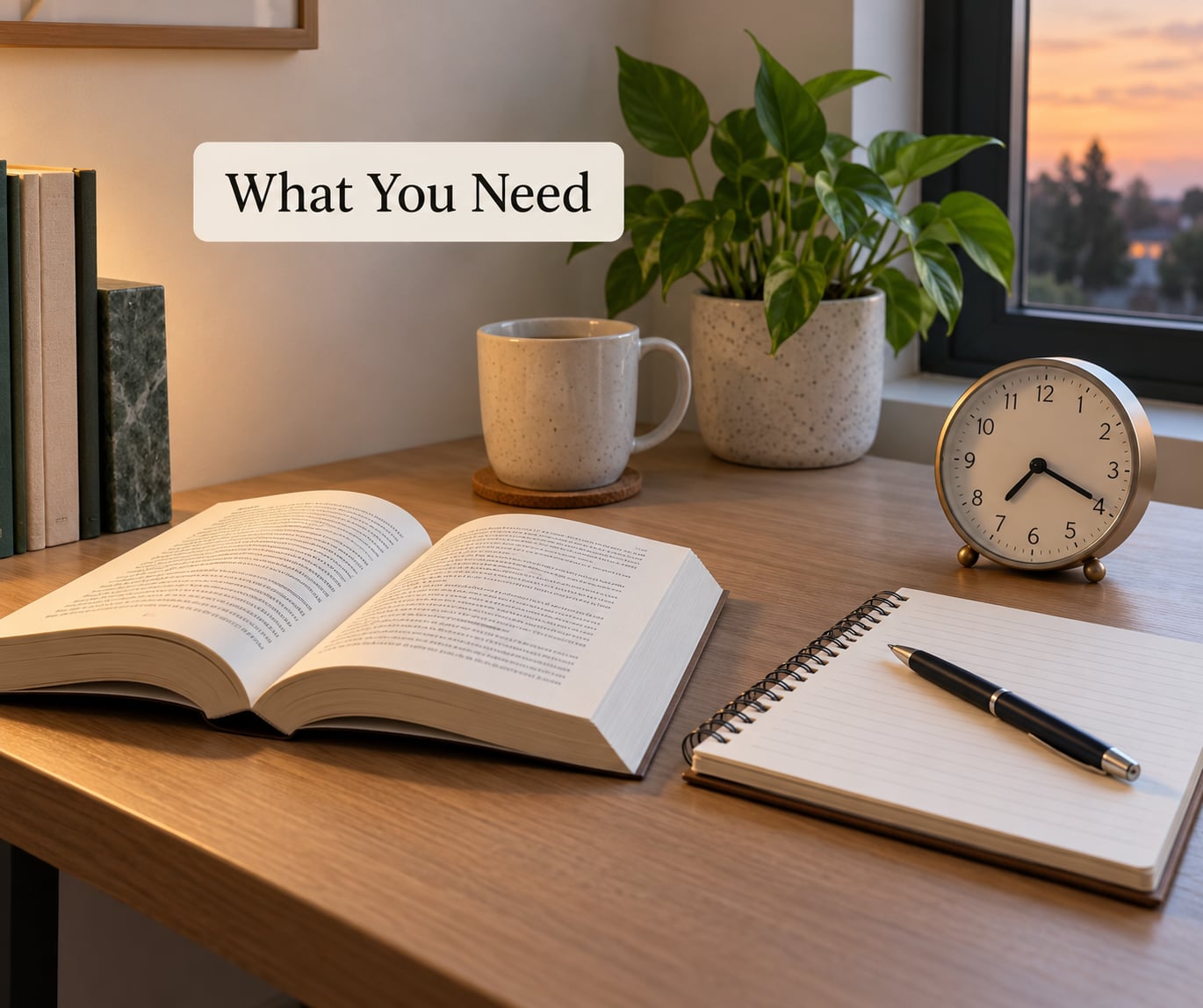
Four things, and none of them expensive. The honest list is short because everything else people buy for reading habits is optional.
- One chosen book. Not a list of twelve. A single title sitting where your hand can find it.
- One fixed reading window. A recurring moment you already defend, such as breakfast, your lunch break, the ride home, or bedtime.
- One tracking method. A cheap notebook, the notes app on your phone, or a reading tracker app. Pick one and stop evaluating options.
- Optional format access. An ebook app on your phone and an audiobook library card. Both recover time you would otherwise spend staring at a wall in a queue.
That is the setup. If you want the format comparison before you start, it is a few sections down.
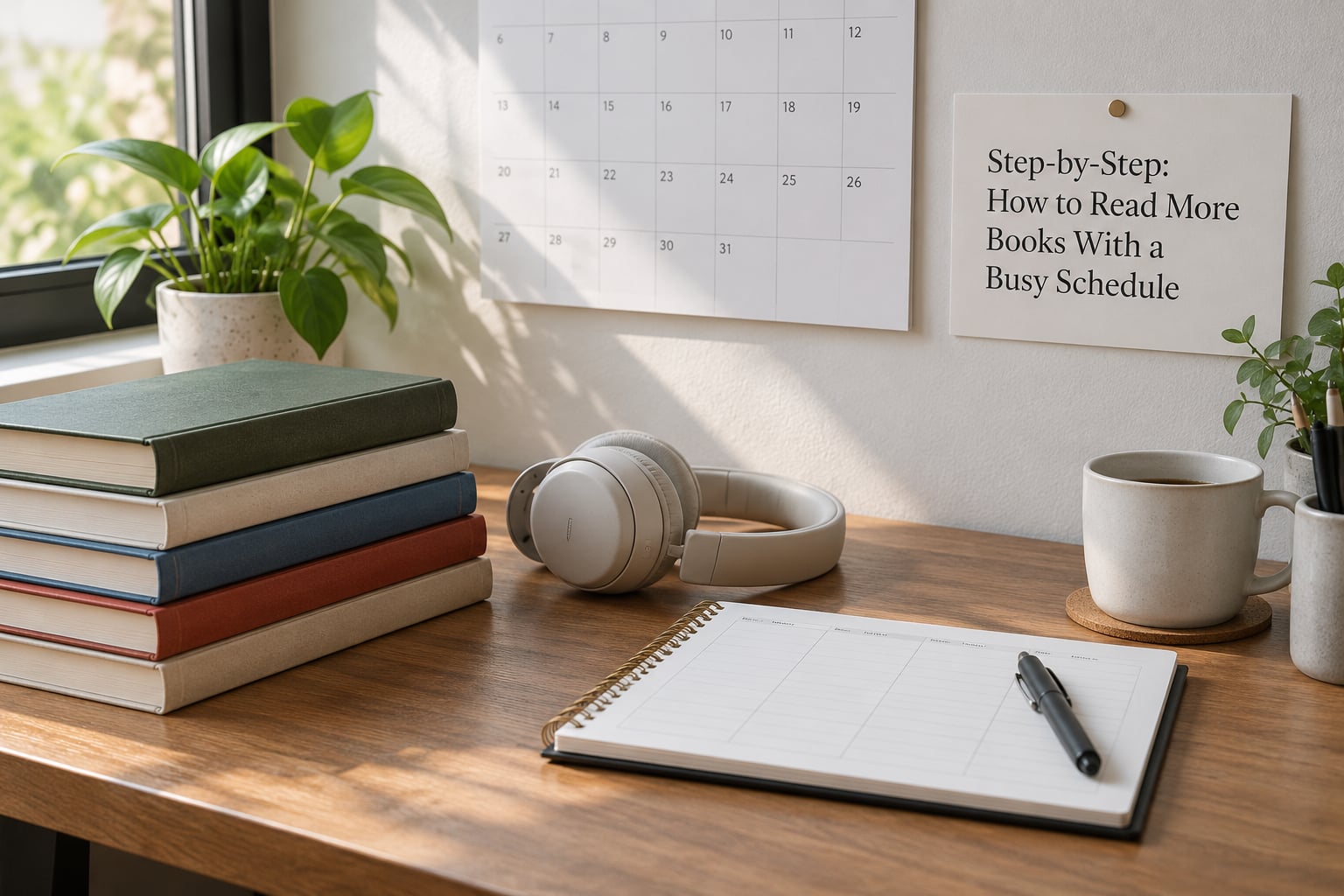
Step-by-Step: How to Read More Books With a Busy Schedule
1. Choose Books That Fit a Busy Schedule
Match the book to the time you actually have, not the time you wish you had. A 700-page history will lose to a 240-page book on a week when your only free window is fifteen minutes and you are already tired.
Keep three kinds of books in rotation so you always have something that fits. A short practical book that moves fast and gives you a win. A long audiobook, which costs you nothing in attention because it plays while you drive, cook or walk. And one reference book — a cookbook, a manual, a dictionary of arguments — that is built to be opened at random for five minutes.
Aim to start one book every time you finish one. Readers on productivity and book forums describe the same pattern: one always-on book for tired evenings, one demanding book for a weekend morning, and one audiobook for the commute.
2. Set a Minimum Reading Target
Five pages. Ten minutes. One chapter. Pick the smallest number that still feels slightly too easy, because the point of a minimum is that it survives your worst day.
Page targets work, but time targets work better for busy readers, because a chapter runs at different speeds in different books. BJ Fogg’s behavior model, the basis of Tiny Habits, makes the point that a habit needs a small enough starting action that it survives a bad day, and a reader who misses once treats that miss as proof the habit failed. Momentum beats intensity, and the arithmetic rewards it: ten pages a day is roughly 3,650 pages a year, which at 250 to 300 pages a book is somewhere between twelve and eighteen finished books.
Read that number again, because it is the whole argument. You do not need a free evening. You need ten pages.
3. Schedule Specific Reading Windows
Attach reading to something that already happens. This is habit stacking, and it is the most reliable tactic in this article, because you are not creating a new routine — you are hitching a ride on one you already keep.
The windows that work most often are small and unglamorous. The first ten minutes after waking, before the phone tells you what is wrong. The commute, whether you drive or ride. A lunch break, even twenty minutes of it. The queue at the pharmacy. Fifteen minutes in bed with the lights off, which also handles the tiredness problem better than most people expect. Some readers keep a book in the car, one beside the sofa, one in the bathroom, specifically to catch a window when it opens.
Write the window down with a time attached. “Read more” is a wish. “Six fifteen to six thirty, kitchen, before I check messages” is a plan. BJ Fogg calls this an implementation intention, and the specificity is what does the work.
4. Use a Simple Note-and-Tracking System
Capture one idea after each session. That is the whole system: the page you reached, one sentence you want to keep, one question the book raised.
This does two useful things. It makes recall easier later, when you want to reference the idea without rereading 300 pages. And it turns reading into something that produces a visible artifact, which is what keeps people coming back when the motivation is thin.
Keep it low effort. A notes app with one note per book is fine. A paper notebook with three lines a session is fine too. A tracker app is fine if you enjoy the numbers, and plenty of readers do — public challenges and yearly goals work as motivation for some people and as a source of shame for others. If you fall behind on a challenge, ignore it. The readers who describe lasting habits are the ones measuring their own progress privately.
5. Keep Momentum With Flexible Reading Options
Formats are not ideology. Audiobooks, ebooks and print each fail and succeed at different things, and the useful move is to use the one that fits the moment you are in.
| Format | Best for | Time it recovers | Watch out for |
|---|---|---|---|
| Long weekend sessions and deep nonfiction | None, it needs quiet | Easy to lose, easy to skip | |
| E-reader and ebook app | Short gaps, waiting rooms, bedtime | Micro-windows all day | Screen fatigue before bed, note export is clunky |
| Audiobook | Commutes, chores, walks, cooking | Up to an hour a day on a normal drive | Fewer details land, easy to drift |
Audiobooks are where the biggest time gain sits, because they run inside dead time instead of beside it. One reader on a book forum put her annual count at roughly double after she started listening on the drive. If you try it, look for a free trial credit from a subscription service or borrow through your public library’s app, and set playback speed a little above normal to shorten dense nonfiction.
Where formats go wrong is switching constantly. If you jump between four books in four formats in one evening, you spend more energy orienting yourself than reading. Keep one book per format and let them sit.
6. Review and Adjust Every Week
Spend fifteen minutes on Sunday with three questions: which sessions actually happened, what did your schedule look like, and what target would have been realistic?
If you cleared your minimum most days, raise it slightly — five pages becomes eight, ten minutes becomes fifteen. If you cleared it half the time, the target is wrong, not you. Drop it a notch. If a week was genuinely brutal — exam season, a launch, a sick kid, a night shift rotation — scale down to one page and keep the streak alive rather than restarting from zero.
The review matters because schedules change weekly and reading plans usually do not. A plan written in a calm week is a fiction by Thursday.
Common Mistakes
Setting a target you can only hit in a perfect week. Fifty pages a day sounds admirable and fails by day four. Set the floor at a level that survives a hospital visit, then let the real weeks be better than the floor.
Treating one missed day as failure. A missed session is a missed session, not a broken habit. The people who quit reading are usually the ones who decided the streak was already gone. Read the page you were on. That is it.
Reading only at your lowest-energy hour. If your only window is 11pm after a full day, you are asking willpower to do the work of scheduling. Move some reading to a sharper hour, even if it is shorter.
Choosing books that do not match your available time. A demanding 800-page book in a week of twelve-minute gaps will die on page 40. Save it for a weekend morning, and keep a lighter book in the gap.
Starting a new book before finishing the current one. Starting more books than you finish feels productive in week one and turns into a pile of half-read spines by month three. Use the 50-page rule instead: if a book has not earned its place by page 50, quit it without guilt and pick something else.
Counting books as the goal. Book counts make reading feel like a competition, and a year of forty books reads as failure next to someone else’s list. Count sessions. A book finished is a bonus, not a verdict.
None of these mistakes mean you lack discipline. They mean the system was set up for a life you do not have. Adjust the system.
Frequently Asked Questions
What is the 50 page rule?
The 50 page rule is a simple test for quitting a book early. If you are still bored, confused or unmoved on page 50, the book is not for you, and you stop without finishing it. The idea is that reading time is limited, so a book that has not engaged you by page 50 will rarely start now. Readers who use it finish more books, not fewer, because they stop spending weeks on books they quietly resent.
Is it better to read a little every day or in longer sessions?
For a busy schedule, a little every day wins. Short daily sessions keep the habit alive, and the habit is what compounds: ten pages a day works out to roughly 3,650 pages a year, or about twelve to eighteen books. Longer weekend sessions still have a place, especially for demanding nonfiction, but use them to go deeper rather than to carry the habit.
Are audiobooks as valuable as reading books?
For time, audiobooks are hard to beat, since they turn a commute or a set of chores into reading time you were not using. Research on comprehension is mixed, and many readers retain more detail from print when a book involves argument or numbers. A practical compromise is to listen for fiction and straightforward narrative, and read the dense chapters.
How do you read multiple books at a time?
Keep two or three books going, each matched to a different energy level. One fiction book for tired evenings, one audiobook for the commute, one practical book you can open at random for five minutes. Switching a lot within one session wastes energy, but having options means a bad night does not become a night with no reading at all.
Do people with ADHD have to reread pages?
Rereading is common, and it is not a personal failing. Attention shifts, notifications pull focus, and losing your place in a dense chapter sends you back a few paragraphs, which is normal for many readers and especially for ADHD readers. Practical helps include putting the phone in another room during a session, using the bookmark or highlight feature as a physical place marker, and reading shorter chapters in a louder setting.
What if I keep abandoning books partway through?
Most unfinished books are a scheduling mismatch, not a failure of commitment. Match the book to the time you actually have, apply the 50 page rule so bad books end early on purpose, and start a replacement book the same week. Readers who quit deliberately and start freely report finishing more books than readers who push through every slow one.
Do one thing tonight. Pick the book, decide which window tomorrow it belongs to, and put it where you will see it. Everything else in this guide is a way to keep that promise small enough to keep.