To track spending without feeling deprived, set aside a named guilt-free spending amount first, then track everything else against flexible category ceilings and review the totals once a week for about five minutes. The restraint has to be small, named, and protected up front, otherwise the tracking turns into a monthly guilt cycle you abandon by the third week.
Most people who quit budgeting did not quit because they are bad with numbers. They quit because they were tracking everything to try to cut everything, and both halves of that plan fail. Logging a 4 dollar coffee takes eleven seconds you do not have, and treating that coffee as a failure removes the one small pleasure that was holding the rest of the plan together.
What actually works is narrower. You pick a handful of categories instead of all of them, you give the discretionary one a number you can spend without asking permission, and you check in weekly instead of staring at a live balance every evening. A weekly five-minute review with a total per category beats daily monitoring every time, because daily monitoring is where the shame shows up.
Table of Contents
- What You Need
- A recent statement
- An honest take-home number
- A split between fixed and flexible costs
- A tool you will not resent
- A named guilt-free line
- Step-by-Step: How to Track Spending Without Feeling Deprived
- Step 1: Set a baseline from real transactions, not a guess
- Step 2: Review recent transactions line by line
- Step 3: Categorize expenses into four groups
- Step 4: Separate necessary spending from guilt-free spending
- Step 5: Set flexible limits with a buffer
- Step 6: Capture cash, cards, and online purchases
- Step 7: Review weekly, adjust, and repeat
- How to Separate Necessary Spending From Guilt-Free Spending
- How to Set Spending Limits You Can Actually Keep
- How to Track Cash, Cards, and Online Purchases
- How to Review Your Spending Without Judging Yourself
- A Worked 30-Day Example
- Common Mistakes and the Fix for Each One
- Frequently Asked Questions
- How can I track my spending without feeling deprived?
- What is the easiest way to track spending every month?
- Should I track cash spending as well as card purchases?
- How do I set a budget for flexible expenses like eating out?
- What should I do if I overspend after tracking my expenses?
- How often should I review my spending tracker?
- What to Do First
What You Need
You need five things, and none of them require a finance degree or a strict deprivation-based budget. If you have these, you can start this week.
A recent statement
The last 30 to 60 days of bank or credit card statements, however incomplete. Paper statements, downloaded PDFs, or screenshots of your account history all work. Sixty days is better because it catches a monthly cycle that a single month might hide, like a subscription that only bills twice a year.
An honest take-home number
Your income after tax, after deductions, after anything that leaves your account before you get to spend it. Take-home is the number that matters, not your gross paycheck. Round down slightly. People who plan against gross spend the first two weeks of the month confused about why the plan breaks.
A split between fixed and flexible costs
Rent, utilities, insurance, minimum debt payments, and childcare tend to stay the same month to month, so those are fixed. Groceries, dining out, rideshare, personal care, and subscriptions move around, so those are flexible. Fixed costs get covered first and quietly. Flexible costs are where the tracking actually earns its keep.
A tool you will not resent
That could be a spreadsheet you build once, a notes app with a running monthly list, or a spending tracker app that imports your transactions through bank sync. Pick based on how much friction you can tolerate, not on which one looks the most impressive. I have kept up with a plain spreadsheet longer than any app I have tried, because nothing in a spreadsheet asks me to confirm a login.
A named guilt-free line
This is the part most guides bury. Before you track anything, decide how much discretionary spending you get this month and give it a label tied to something real, like 120 dollars for concerts, weekend food, and the coffee you actually enjoy. A named line is easier to defend against a surprise expense than a vague promise to be careful.
You do not need perfect records, deep financial knowledge, or a budget built around deprivation. You need those five things, roughly 30 minutes of setup, and the willingness to look at the numbers once a week.
Step-by-Step: How to Track Spending Without Feeling Deprived
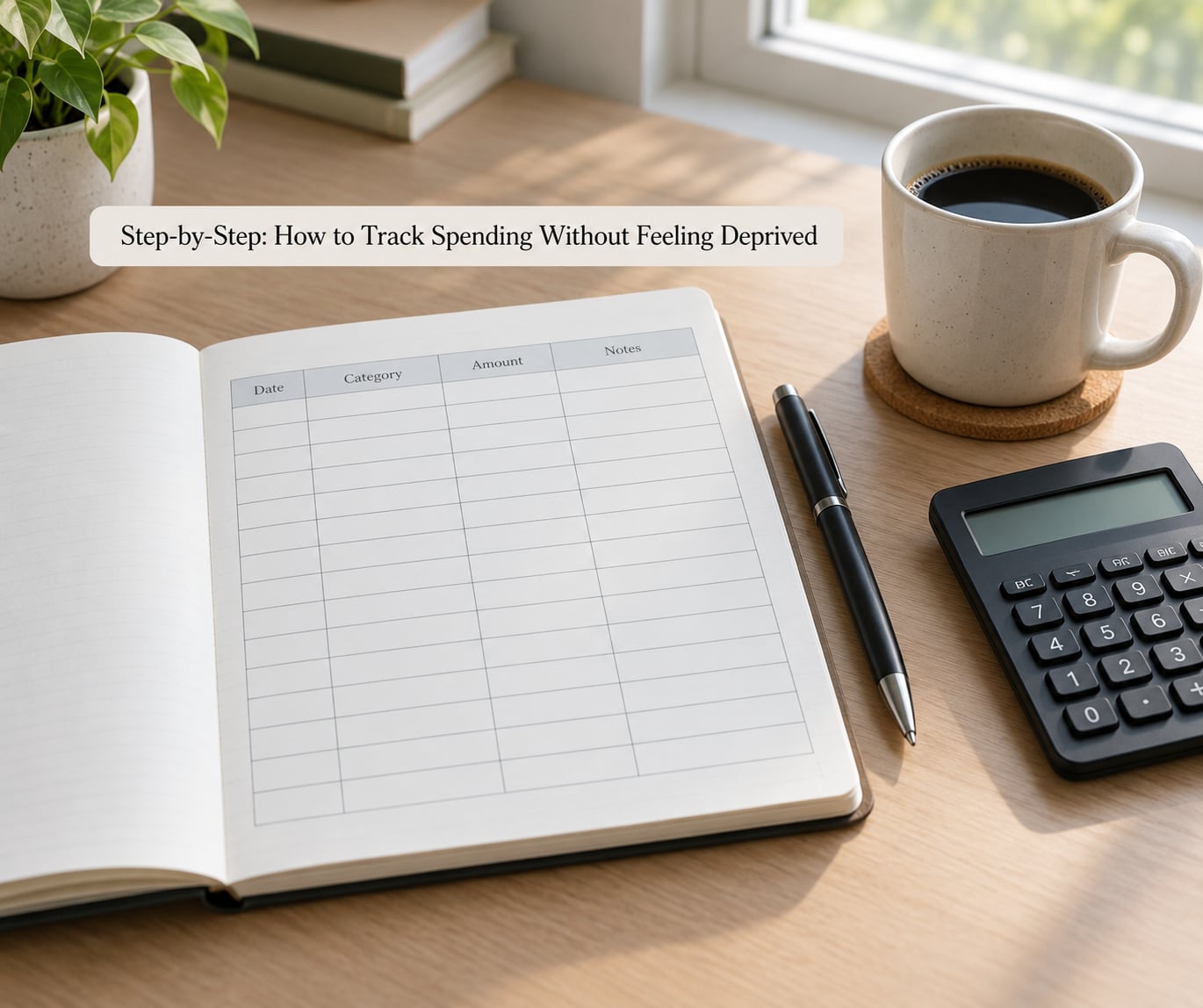
Here is the whole method in seven steps. Set a baseline, sort your transactions into a small number of categories, separate the necessary from the guilt-free, give each flexible category a ceiling, decide how you will capture cash and card spending, and then review weekly without turning it into a self-proceeding.
Step 1: Set a baseline from real transactions, not a guess
Go back through your last 30 to 60 days and total what you actually spent. Do not start from an ideal budget you wrote from memory. Memory is where the shame lives, and an ideal budget you fail to hit in week one is the fastest way to quit.
Write down the total, then write down the three categories that took the most. Most people are surprised by at least one of them, and that surprise is useful. If delivery shows up 14 times in a month, that is a habit with a price tag, not a series of unrelated decisions.
Step 2: Review recent transactions line by line
Go through the most recent statement and mark each charge with a one-word category. Use the smallest number of categories that still tells you something, usually six to eight. A category you never look at is not a category, it is clutter.
Mark the recurring ones as you go: rent, phone, streaming, gym, car insurance. Recurring charges are the easiest thing to miss and the most expensive to miss, because they repeat silently for years. Several budget apps also mis-sort recurring transactions, so assume nothing and check them yourself the first month.
Step 3: Categorize expenses into four groups
Sort your categories into four groups: fixed and necessary, variable and necessary, planned guilt-free spending, and untracked. The untracked group is not a failure, it is the design choice that makes this method survivable. Anything under roughly 10 dollars that happens casually goes there.
Step 4: Separate necessary spending from guilt-free spending
This step decides whether the whole system feels like punishment or like a plan, so it deserves its own explanation. A line item only becomes deprivation when it has no ceiling you agreed to and no permission attached to it.
Step 5: Set flexible limits with a buffer
Give each flexible category a range, not a single hard number, and keep a small buffer so one surprise does not cascade. Ranges survive contact with real life in a way that exact targets do not.
Step 6: Capture cash, cards, and online purchases
Decide once how every payment method gets recorded so nothing slips through the cracks. This is the step most people skip, and skipped steps are where the numbers stop adding up at the end of the month.
Step 7: Review weekly, adjust, and repeat
Spend five minutes once a week adding up your categories and comparing them to the ceilings. Adjust the plan where it was unrealistic. Never adjust the plan because one purchase disappointed you.
How to Separate Necessary Spending From Guilt-Free Spending
Classify by whether the expense keeps your life running, not by how guilty you feel after buying it. Housing, groceries, transportation, utilities, insurance, minimum debt payments, and health basics are necessary. Subscriptions, personal care beyond the basics, entertainment, dining out, travel, and gifts are guilt-free.
The mistake is letting the feeling set the category. If you dread your phone bill every month but it is genuinely necessary, it stays in necessary and you look for ways to reduce it. If you genuinely enjoy a monthly movie pass, it stays in guilt-free and gets protected, because cutting it would remove a pleasure for a saving you did not want badly enough to give it up.
Needs and wants also shift with the season and your priorities. Travel is a want in February and a need when you have a funeral to attend or a graduation to cover. Moving a category back and forth is normal and not a failure of discipline. What matters is that you move it consciously rather than letting the same charge sit in the wrong bucket all year.
Several people in budgeting communities say the smallest named treat line is the thing that keeps the rest of the plan from collapsing. That matches what I have seen: a plan with a protected line survives contact with a bad week, and a plan without one does not.
How to Set Spending Limits You Can Actually Keep
Use percentages or ranges based on your baseline, then add a buffer. A workable starting point for many households is a flexible discretionary ceiling near 10 to 15 percent of take-home pay, but if your baseline says 8 percent, start at 8 percent. The number that comes from your own transactions will hold longer than one borrowed from a framework.
Build the limit in three parts. A daily number for the small stuff you buy without thinking, a monthly number for the categories that spike, and a separate buffer of roughly 10 percent of the flexible budget for the car repair, the birthday gift, the flight change fee. The buffer is what stops one bad week from becoming a broken month.
Set an unexpected expense category too, and fund it as a sinking fund rather than treating it as an emergency. Sinking fund is just a small pot you build ahead of time for a known future cost, like new tires or a laptop replacement. Building it slowly is not exciting, but it removes the moment where a necessary expense eats all your discretionary spending at once.
When a category keeps getting exceeded, adjust the ceiling instead of yourself. A ceiling you have quietly moved up is not defeat, it is the plan telling you something true about your life. What does not work is the overly restrictive reset, the kind where you cancel everything fun on the fourth and end up quitting by the eighth.
How to Track Cash, Cards, and Online Purchases
Every payment method needs one capture rule so your monthly total is complete. Cards and digital wallets with bank sync handle themselves, which is why most people track those accurately and still end up short on cash.
For cash, pick one of three systems and stick with it: a daily note with the amount withdrawn and the reason, a small envelope for a set weekly amount, or a running tally you update every time you use it. The reason field matters more than it sounds. Two months of writing down what you withdrew cash for tells you which errands were actually convenience spending dressed up as necessities.
Recurring charges deserve a separate check even with bank sync. Open your subscriptions list once a month, cancel anything unused, and compare the total against what you are actually paying for. Subscription creep is slow, quiet, and usually several hundred dollars a year across a household.
At the end of the month, reconcile. Add up every capture method and compare to your bank and card statements. If the two numbers disagree by more than a small amount, the gap is almost always cash or a transfer counted twice. Fix the rule, not the month.
How to Review Your Spending Without Judging Yourself
The weekly review is the habit that decides everything else, and it takes about five minutes. Add up your categories, compare each to its ceiling, and then answer four questions in plain language: what was worth it, what felt automatic, what needs a boundary, and which expenses stay guilt-free no matter what.
Write the answers in a sentence or two. Noticing that every single purchase that felt automatic was a delivery order at 8 pm is the kind of thing a spreadsheet total will not tell you on its own. Naming it turns a vague feeling into a specific decision.
Split the review into a weekly five-minute pass and a monthly thirty-minute pass. The weekly pass is current-state awareness and adjustment. The monthly pass looks at patterns across four weeks, which is where you catch lifestyle creep, the slow rise in spending that happens because your income rose or your circle changed, not because you made a single bad decision.
Judge the plan, not the person. The question is whether the ceilings still match your life, not whether you were disciplined enough. Budget apps that scold you get closed and never reopened, and that is a design failure rather than a character flaw. Turn off the notifications you find shaming, keep the ones that are neutral, and choose tools that describe rather than accuse.
A Worked 30-Day Example
Here is what a first month actually looks like, using round numbers for a household with 3,800 dollars of take-home pay.
- Housing and utilities: 1,650. Fixed, covered on payday, never reviewed daily.
- Groceries: 480 over four shops. Tracked, with a weekly range of 100 to 140.
- Transport: 260, mostly fuel and two rideshare rides that replaced a parking problem.
- Subscriptions: 71 after an audit cut a streaming plan nobody watched. Now a fixed line.
- Dining out and coffee: 165. Guilt-free line, no ceiling discussion required.
- Fun money: 120 for a concert and a weekend trip, decided before the month started.
- Buffer: 90, untouched because the car behaved.
Two things are worth noticing. The dining out line was never revisited, because it had an agreed number and it stayed inside it. The subscription line dropped by about 30 dollars a month without any fun being removed, which is what most easy savings actually look like.
The next month, the same person raised the fun line slightly and moved nothing else. That is the adjustment step working as intended: the plan bent toward what they valued instead of the person bending toward the plan.
Common Mistakes and the Fix for Each One
Starting with an unrealistic budget. The fix: build your first month entirely out of transactions you already made. Accuracy first, ambition later.
Forgetting recurring charges. Subscriptions, annual fees, and quarterly insurance premiums are the usual culprits. The fix: mark every recurring charge during your first review and give it a name in your tracker.
Tracking only cards. Cash and split payments quietly disappear, and then your total is wrong and you assume the tracker is broken. The fix: one capture rule per payment method, chosen before you start.
Changing everything after one overspend. This is the what the hell effect: overspend early, decide the month is ruined, spend freely, and abandon the system. The fix: only adjust the category you actually exceeded, and adjust the ceiling rather than your whole lifestyle.
Confusing wants with needs on the fly. If every purchase feels like a failure, there is no relief valve and the system collapses. The fix: pre-decide which categories are guilt-free and leave them alone during the month.
Abandoning everything after a busy week. A missed week is not a failed system. The fix: if you skip, skip a week only, then do a ten-minute catch-up review the next Sunday and keep the same cadence. A partial log beats a perfect system you abandoned in month two.
Tracking everything down to the dollar. The volume alone is why people quit. The fix: keep a minimum viable tracking method, where you log daily totals and named categories and ignore incidental purchases. One person in a budgeting forum described tracking a single daily total rather than category detail because that is the only level of granularity they sustain, and that is a perfectly good system.
A related one worth naming: leftover room early in the month leads to bigger spending later, which is why a monthly ceiling matters more than a daily one. You decide the month, not the day, so a slow Tuesday does not feel like permission to spend.
If tracking feels like a punishment, the honest test is whether your tool is doing the punishing. Turn off shame-based alerts, keep the data, and replace the app if its tone makes you avoid opening it. People in personal finance forums say the tone of the tool matters more than the feature list, and that is true of spreadsheets too.
Not every category belongs in your tracker. Anything tiny, frequent, and unremarkable does not need a line. Keeping that list short is the difference between a habit you keep for a year and one you delete in a week.
Frequently Asked Questions
How can I track my spending without feeling deprived?
Give yourself a named guilt-free amount before you track anything else, keep flexible category ceilings with a small buffer, and check your totals once a week for about five minutes instead of every day. The restraint has to be small and agreed in advance, otherwise every purchase reads as a failure and the plan collapses by week three.
What is the easiest way to track spending every month?
The easiest method is the one you will still do in month three. For most people that means a bank-synced app that imports card and digital wallet transactions automatically, plus a short manual note for cash. Set it up once, name six to eight categories, and review the weekly totals on a fixed day like Sunday evening.
Should I track cash spending as well as card purchases?
Yes, at least roughly. Cash is where most trackers lose accuracy, and an incomplete total makes a correct plan look broken. Keep a simple rule: log the amount and reason each time you withdraw, or set a weekly cash amount and track against that. Two months of reasons usually reveals which cash spending was actually convenience spending.
How do I set a budget for flexible expenses like eating out?
Use a range instead of a single number, based on your own last two months rather than an ideal. A range near 10 to 15 percent of take-home pay is a workable starting point for many households, and a buffer of roughly 10 percent on top absorbs birthdays and car repairs. Raise the range when it keeps getting exceeded rather than cutting all enjoyment.
What should I do if I overspend after tracking my expenses?
Adjust only the category you actually exceeded, then move on. Do not rebuild the whole budget or cancel every planned pleasure, because that is the reset that leads to quitting. Note what happened, change the ceiling or the rule for that one category, and run the rest of the month as planned. A broken category is a data point, not a verdict.
How often should I review my spending tracker?
Once a week for about five minutes, plus a longer monthly pass of around thirty minutes. The weekly review keeps you aware without making you monitor a live balance daily, which is where guilt tends to show up. The monthly review is where you spot patterns like subscription creep or lifestyle creep that a single week never reveals.
What to Do First
Open this month’s statements tonight and add up your spending across six to eight categories, then write one number at the top as your guilt-free allowance. That is the whole first step, and everything after it is just five minutes a week.