A meeting that earns its time does one thing: it produces a decision or a next action before the last person leaves the room. To run a meeting that does not waste time, write one objective, keep the guest list short enough to hold in your head, give every agenda item a clock, make the call in the session instead of parking it, and send the actions out the same day. Prep takes about an hour. The meeting takes as long as the agenda says it will.
Most time disappears before anyone speaks, in the calendar invite that says only “sync.” This guide covers the preparation, the facilitation, and the two habits that make the difference later: a pre-read that arrives a day ahead and action items with a person’s name attached.
Table of Contents
- What You Need
- Step-by-Step
- How to run a meeting that does not waste time: nine moves
- 1. Test the objective before you write the agenda
- 2. Invite only people who speak to the objective
- 3. Write the agenda as a narrative, not a list of topics
- 4. Named rules that make the timings stick
- 5. Send the pre-read the day before
- 6. Start on time and set ground rules in sixty seconds
- 7. Timebox each item and protect the clock
- 8. Make the decision before you leave the item
- 9. Close with a read-back, then write it up the same day
- Common Mistakes That Waste Meeting Time
- No objective, just a title
- Reading the pre-read out loud
- Everyone is invited because someone might need to know
- Starting late and ending late
- One voice filling the room
- Ending with “let’s circle back”
- Two habits that shrink the whole calendar
- Frequently Asked Questions
- How long should a productive meeting last?
- How do I write an agenda that prevents wasted time?
- What if a meeting needs more than 60 minutes?
- How do I keep people from dominating a hybrid meeting?
- Should status updates be discussed in every meeting?
- How can I tell whether a meeting was worth the time?
What You Need
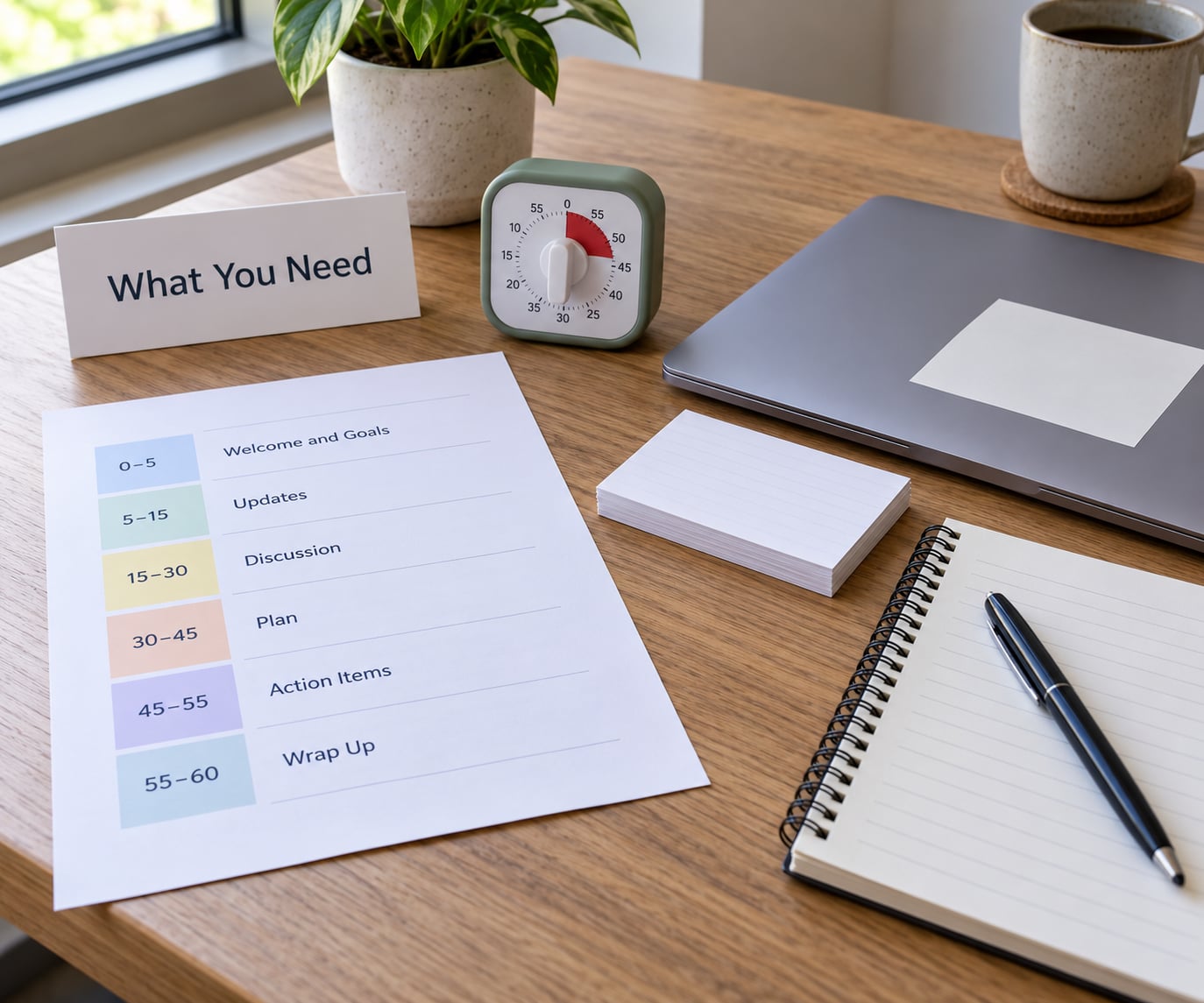
The list is short, and every item has a job. If you cannot get one of them, the meeting will quietly absorb its absence.
- One written objective. A single sentence starting with “By the end of this meeting we will…” If you cannot finish it, the meeting is a conversation, and a conversation does not need a calendar slot.
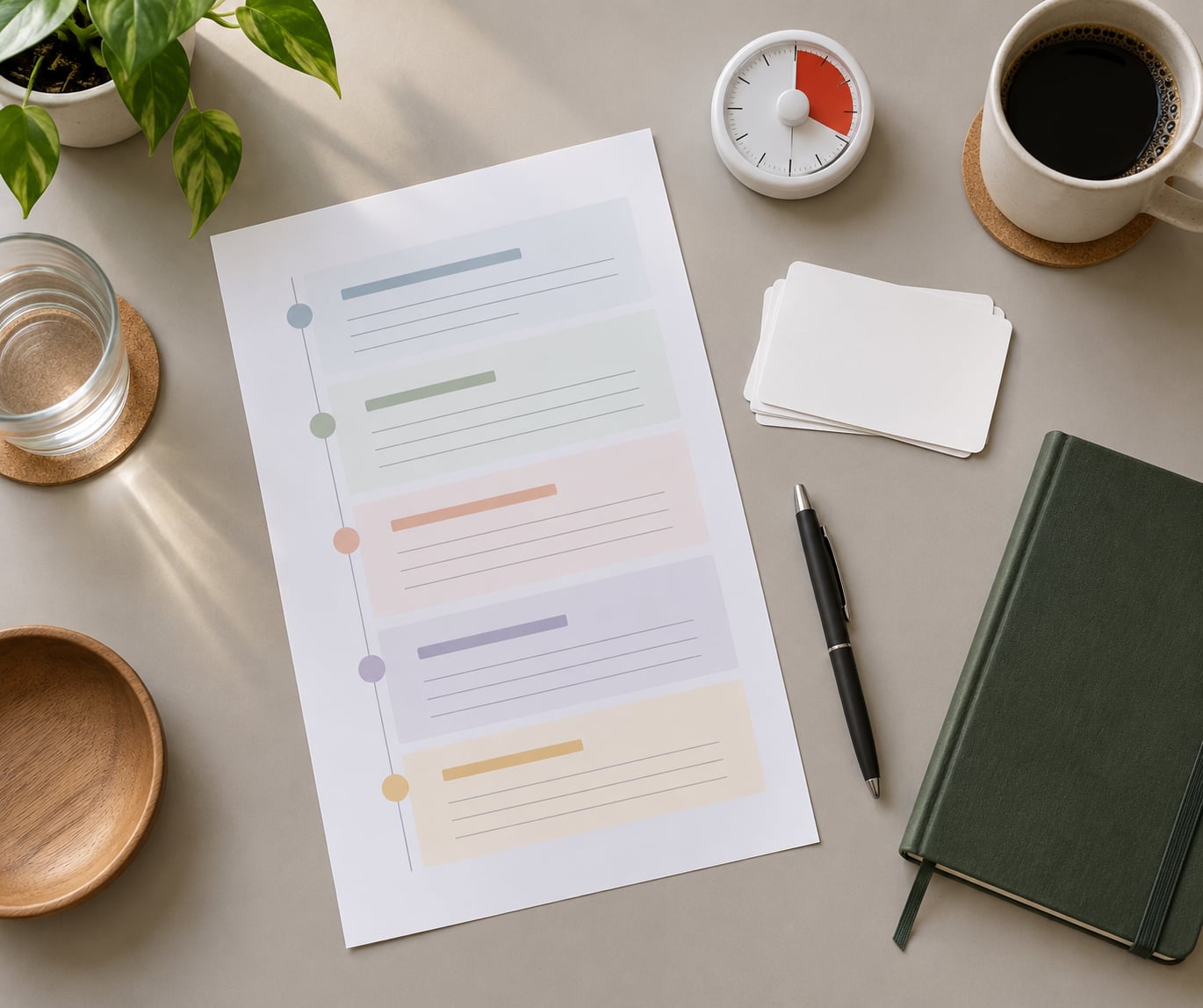
- An agenda with time boxes. Three to five items, minutes beside each, plus a two-minute slot at the end for reading back actions.
- An invite list with roles. Decide each person’s role before you send it: decider, contributor, or informed. Informed people get the notes, not the hour.
- A pre-read, one page. Sent at least 24 hours ahead, with the background, the options and the recommendation on it.
- A facilitator who is not the loudest voice. Usually the most senior person is a poor choice, because the room stops being honest the moment they open their mouth.
- A named decision owner. One person who makes the call when the discussion stalls, and who says the sentence out loud when it is made.
- A note taker. Someone whose only job is capturing decisions, owners and dates in a shared document everyone can see.
- A parking lot. A visible list of everything good that is off the agenda today. Without it, good points become reasons the clock runs out.
- A timer. A phone face-up on the table works fine. This is the cheapest item on the list and the most effective.
If the objective, the agenda and the pre-read are missing, you are asking nine people to donate an hour to a guess.
Step-by-Step
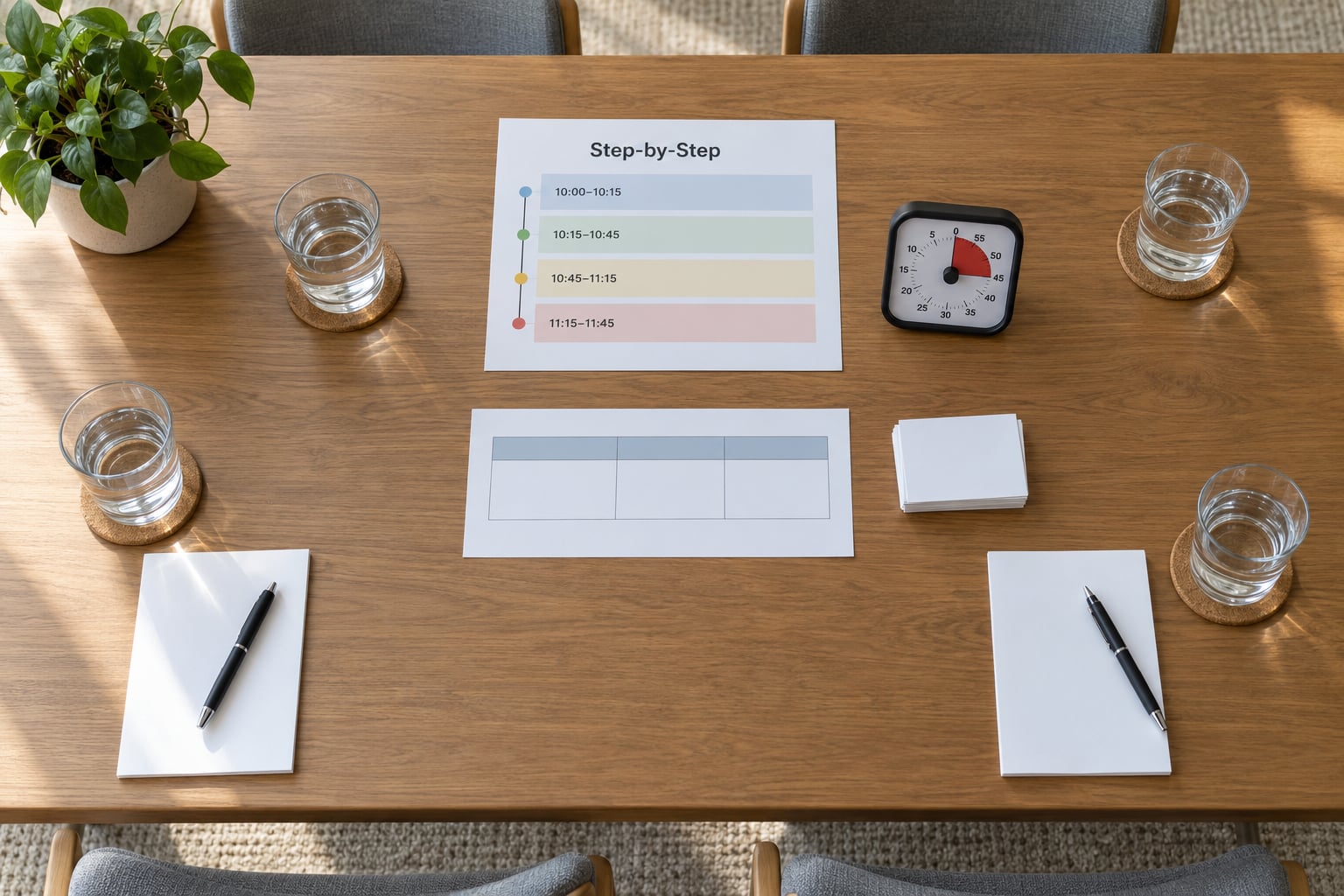
How to run a meeting that does not waste time: nine moves
Each move below has a check you can apply within seconds. If the check fails, you have your fix before the next invite goes out.
1. Test the objective before you write the agenda
Run the sentence through a filter: does this meeting produce a decision, a plan or a piece of shared understanding? “We need to discuss the launch” fails all three. “We need to pick one launch date out of three” passes, because at the end of it something is true that was not true before.
When nothing needs a live room, choose the async route instead: a written proposal with a comment deadline, then a short call only if the comments conflict. Most status meetings are a document pretending to be a conversation.
2. Invite only people who speak to the objective
The two-pizza rule is a fast sanity check: if the group could not be fed with two pizzas, the guest list is too long. It is a rough guide rather than a science, but it catches the common case where a meeting has fourteen attendees and four speakers.
Send the invite to deciders and contributors, then send the notes to the rest. It is faster for you than inviting everyone and faster for them than sitting through a meeting where they contribute nothing.
3. Write the agenda as a narrative, not a list of topics
A topic list tells people what you will cover. A narrative agenda tells them what you will do. Write it as sentences: “We spend twenty minutes comparing the two supplier options, pick one, and assign the contract check to Priya.”
Attach minutes to every line. If an item has no time, cut it or move it to the parking lot, because an untimed item is the one that eats the last ten minutes.
4. Named rules that make the timings stick
The 5 Ps of preparation are the working checklist I use before any invite leaves: Purpose, People, Process, Pace, Paper. Purpose is the one-sentence outcome, People is the role-assigned list, Process is the format you will follow, Pace is the minute count, Paper is the pre-read going out 24 hours early.
The 40/20/40 rule is a budgeting heuristic: roughly 40 percent of the session for context and discussion, 20 percent for the actual decision, and the remaining 40 percent for confirming, recording and writing it up. It sounds lopsided until you notice that most wasted hours come from skipping the last 40 percent.
The 10-10-10 rule fits a half hour: about ten minutes to orient, ten to decide, ten to capture and confirm. The 25/50 rule caps drift inside a longer meeting: in a fifty-minute slot, no single item runs past twenty-five minutes without either a decision or a move to the parking lot.
5. Send the pre-read the day before
Twenty-four hours is the minimum gap that works, because it is long enough for someone to read while commuting and short enough that the content is still live. Put a line at the top asking people to mark disagreements in the document, not to save them for the room.
Teams that moved to pre-reads report that decisions happen in the meeting instead of the week after, because the reading happens before the room rather than inside it.
6. Start on time and set ground rules in sixty seconds
Even with eight people, one minute of context is worth it. A simple opener covers the objective, the times, the parking lot, and how decisions get made: raised hands for input, and a named owner for the call.
Then open in a way that involves people rather than reporting at them. The IEEI start does this in four beats: Inform the room what the decision is, Explain why it is needed now, Explore the options, and Invite contributions before you take a position. Leaders who speak last get more usable information out of the room, not less.
7. Timebox each item and protect the clock
At the start of each item, state the minutes out loud. At the halfway point, give a thirty-second warning. When time is up, stop the item even mid-sentence and move the remainder to the parking lot.
This is the move people resist most, and it is the one that decides whether a 50-minute meeting ends at 50 minutes. Set the end time in the invite, keep to it, and people start saying yes to invitations they would have declined.
8. Make the decision before you leave the item
The most common waste is deferral: the group agrees it is a hard call, explores it for forty minutes and exits with “we will circulate something and meet again next week.”
Name the decider at the start. When the discussion stalls, they choose, and the facilitator asks them to say it as a plain sentence: “We are going with the March date.” Write that sentence into the notes while the room is still in it.
9. Close with a read-back, then write it up the same day
Spend the last two minutes reading each action back: the task, the owner, the date. Owners who hear their own name commit to it more reliably than owners who find out later in a document.
Send the notes within 24 hours while you still remember what was decided. Decisions, owners and dates go at the top, the discussion goes underneath. The result should be readable in under a minute by someone who was not in the room.
Common Mistakes That Waste Meeting Time
No objective, just a title
“Weekly sync” tells the room nothing about what success looks like. Fix: put the one-sentence outcome in the invite subject line, and cancel the meeting if that sentence cannot be written. A meeting nobody can evaluate is a meeting nobody can improve.
Reading the pre-read out loud
Ten minutes of reading a document that was sent the day before is the most common avoidable loss in a business meeting. Fix: start with questions and disagreements. Anyone who read it already knows the content.
Everyone is invited because someone might need to know
An audience turns into an audience the moment a senior leader joins, and quieter people stop contributing. Fix: assign roles before you send the invite, keep informed people on the notes list, and give the two-pizza rule a try for a month.
Starting late and ending late
A meeting that begins five minutes late usually ends five minutes late, and the last item is the one that carries the decision. Fix: start without the person who is not there, keep the end time on the invite, and make the last two minutes the read-back.
One voice filling the room
Fix: before moving on, ask by name the two people who have not spoken, and wait the full five seconds after the question. In a hybrid room, the person at the table always finishes first unless you deliberately leave the silence.
Ending with “let’s circle back”
Any action without a name attached is a wish. Fix: if you cannot say the owner and the date out loud, the item did not get decided. Either decide it, park it, or move it to a named person with a date.
Two habits that shrink the whole calendar
Run a calendar audit for the last quarter of 2026: count meetings by type, total the hours per person and mark anything that repeats. Teams doing this usually find a large share of recurring meetings could be a written update plus an optional call. Recurring status meetings convert first because nothing is decided in them.
Then protect one half-day a week. A no-meeting block only works if the whole team honours it, and it is the clearest signal an organisation can send that focus matters more than availability. Pair it with a simple rule: anyone may decline a meeting without giving a reason, and the organiser has to find the missing people a different way.
Frequently Asked Questions
How long should a productive meeting last?
Most working meetings should be 25 or 50 minutes, because those lengths leave a buffer before the next one. Set the end time in the invite, name what will be decided, and stop when the clock runs out even when the discussion is still interesting. Stand-ups fit in 10 to 15 minutes, decision meetings in 45 to 60, and anything past 90 minutes needs a pre-read.
How do I write an agenda that prevents wasted time?
Write one sentence describing the outcome, then list three to five items with a minute count beside each. Send it at least 24 hours ahead and keep the background in a separate pre-read rather than in the agenda. If an item has no time attached, cut it or move it to the parking lot. An agenda nobody read is just a list of things you intend to talk about.
What if a meeting needs more than 60 minutes?
Treat the length as evidence that the meeting is doing more than one job. Split it into a working session for the options and a shorter decision session for the choice, or give each topic its own pre-read. If you keep the long slot anyway, build a break into the middle and publish the agenda a day ahead so people arrive having already thought about it.
How do I keep people from dominating a hybrid meeting?
Naming it out loud usually fixes it: say you want to hear from the two people who have not spoken yet before the discussion moves on. In a hybrid room, ask a question by name and wait the full five seconds, because whoever is at the table finishes first every time. Put the chat on the shared screen and read questions aloud so remote voices enter the same conversation.
Should status updates be discussed in every meeting?
No. Status that has not changed since last week belongs in a written update people read on their own time, and a calendar audit usually shows that a recurring status block is the easiest meeting to convert. Keep live time for exceptions, blockers and anything needing a decision in the room. If a status meeting survives, have each person post a number before it starts.
How can I tell whether a meeting was worth the time?
Ask two questions as you close: did we decide the thing we said we would decide, and did every action leave with a named owner and a date? Those checks take thirty seconds and tell you more than a satisfaction survey. Track them across a few meetings and the pattern shows up fast. That is the practical test for how to run a meeting that does not waste time.
Start with the next meeting on your calendar. Write its one-sentence objective, cut the guest list to the people who will speak, and give every item a number of minutes. Send it a day ahead and finish with two minutes of read-back.
Do that for four meetings without changing anything else, then check two things each time: did we decide what we came to decide, and does every action have a name and a date on it. Those two checks will tell you which meetings to keep and which ones to cancel, and cancelling is the fastest way to protect the hours you just freed up.