Cooking for one without wasting food comes down to three habits: buy only what one person can actually finish, cook components instead of one finished meal, and freeze the extras in single portions the day you cook them. A small kitchen setup and a short weekly routine do most of the work, and together they take about fifteen minutes a week.
The waste usually starts before the stove comes on. Onions arrive in three-pound sacks, salad greens come in bags sized for two, and recipes are written for four to six servings. A person eating alone spends their week swimming against that packaging, which is why cooking for one can feel wasteful even when the plan was careful.
Then there is boredom. Cooks posting on r/LivingAlone and r/CookingForOne describe throwing away food that was still perfectly good, simply because facing the same dinner for a fourth night in a row felt worse than binning it. Spoilage is real, but monotony empties the fridge faster for most single households than spoilage does.
What follows is a system rather than a set of rules: check what you already have, shop to the amount one person eats, cook components, freeze extras in singles, and eat the oldest container first. Adjust it each week until it fits how you actually eat.
Table of Contents
- What You Need
- Step-by-Step: A Low-Waste Cooking Routine
- Step 1: Check What You Already Have
- Step 2: Plan Flexible Meals
- Step 3: Shop With Amounts for One
- Step 4: Prep and Cook Only What You Need
- Step 5: Store Food Safely
- Step 6: Turn Extras Into Planned Leftovers
- Step 7: Use the Emergency Fridge-Cleaning Meal
- Common Mistakes
- Frequently Asked Questions
- How do I stop wasting food when cooking for one?
- What can I cook for just one person?
- How do I cook for one without eating the same thing all week?
- Can you freeze leftovers in single portions?
- How long do cooked leftovers last in the refrigerator?
- What is the 5 4 3 2 1 rule for groceries?
- Conclusion
What You Need
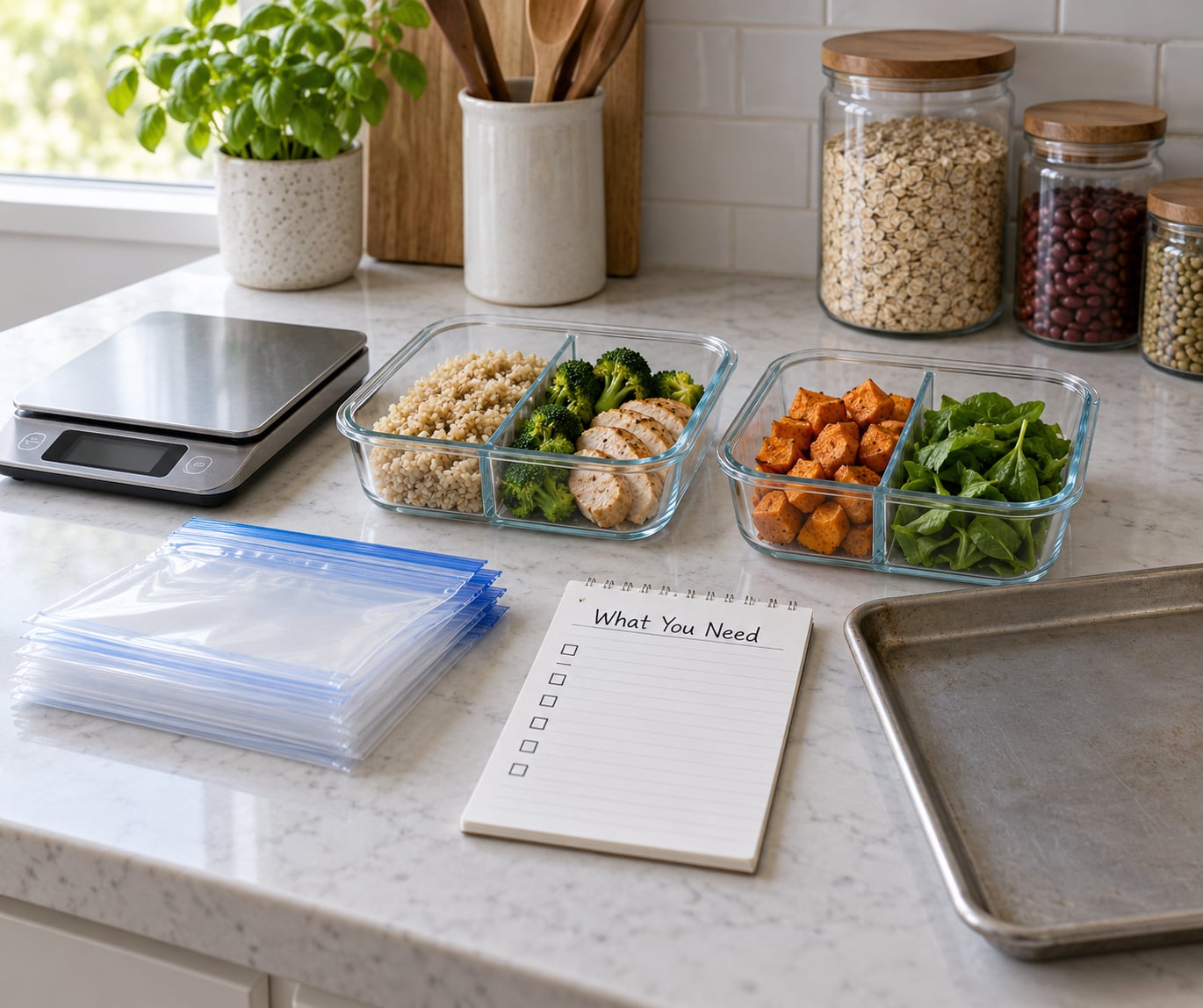
You need less than most people expect, and none of it is specialized equipment.
- A digital food scale. Portions are guesswork until you weigh them. One plate is roughly three ounces of protein, half a cup of grain and half a plate of vegetables, and a scale makes that repeatable.
- Shallow single-cup containers. Wide and short beats tall and deep, because food cools faster, stacks in the freezer and reheats evenly.
- A permanent marker. Date and contents go on the lid every time. Old marks come off with rubbing alcohol.
- A sheet pan and a small skillet. An eight-inch skillet and one sheet pan handle a whole evening of cooking with a single pan to wash.
- Freezer bags and ice cube trays. Bags flatten for grains and cut produce, trays portion sauces, stock and herbs in oil.
- A list you actually keep. A running use-up list on the fridge door, for cooked leftovers and half-used ingredients, is the single cheapest waste tool in the kitchen.
A food dehydrator and a vacuum sealer get recommended constantly online. They help, but they are not where a single household should start. Containers, a marker and a working freezer do the same job.
Step-by-Step: A Low-Waste Cooking Routine
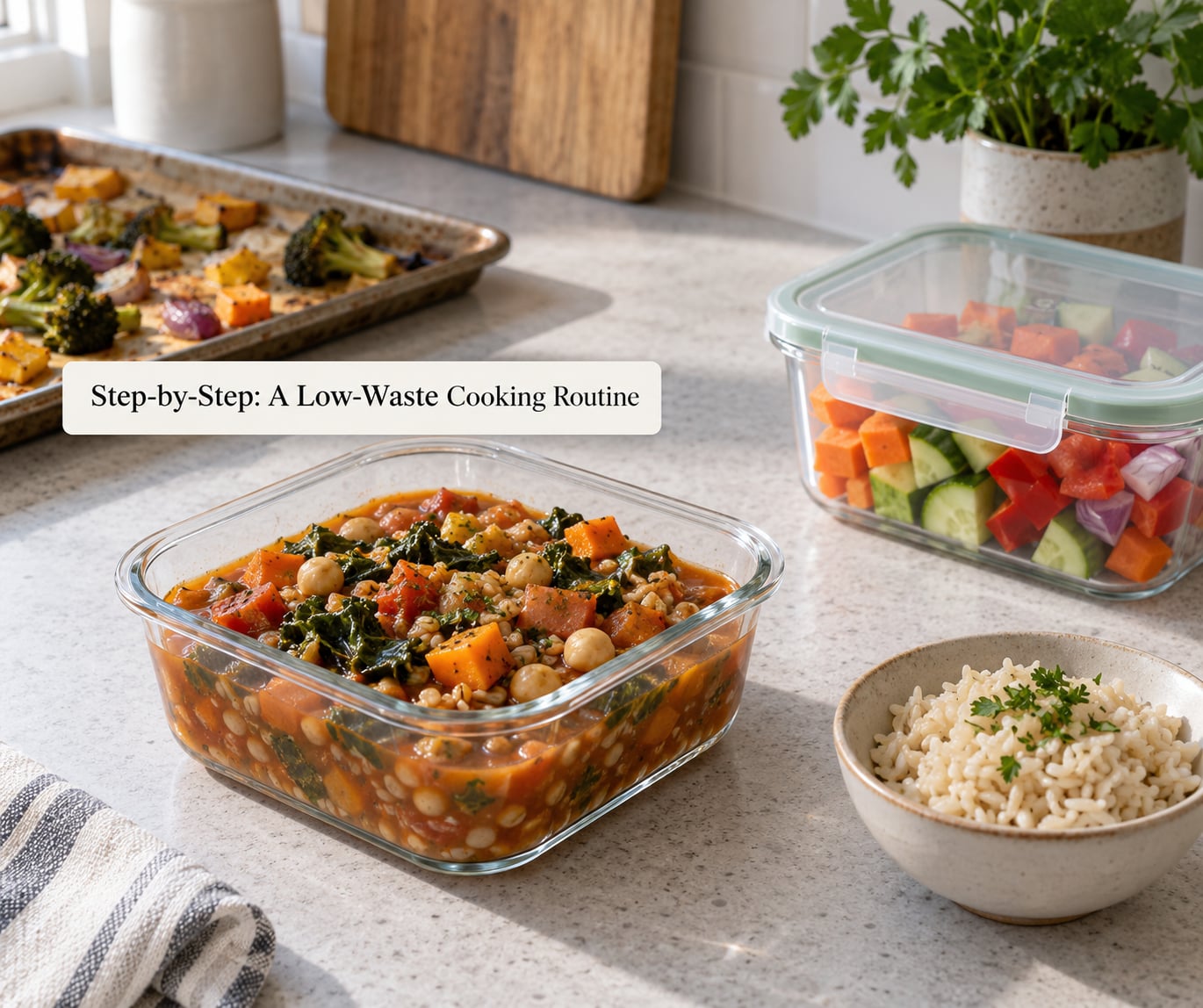
Seven steps, run in order. Most weeks take fifteen minutes for steps one through three and about forty minutes of actual cooking on two evenings.
Step 1: Check What You Already Have
Open the fridge, the freezer and the pantry before you write a shopping list. Every wasted grocery begins as something bought while older food sat in the back of a shelf, often behind the condiments where nobody looks.
Do a three-door sweep and write down only what genuinely needs replacing. Anything that has to be eaten within two days goes at the top of the list, because that is the item most likely to be wasted.
Set up two freezer bags while you are in there: one for vegetable peelings, ends and stems, the other for bones, chicken carcasses and meat trimmings. Both become stock, and cooks describe running both bags as the habit that stopped their scraps going out. Add water, simmer for a few hours and freeze the result in ice cube trays.
Step 2: Plan Flexible Meals
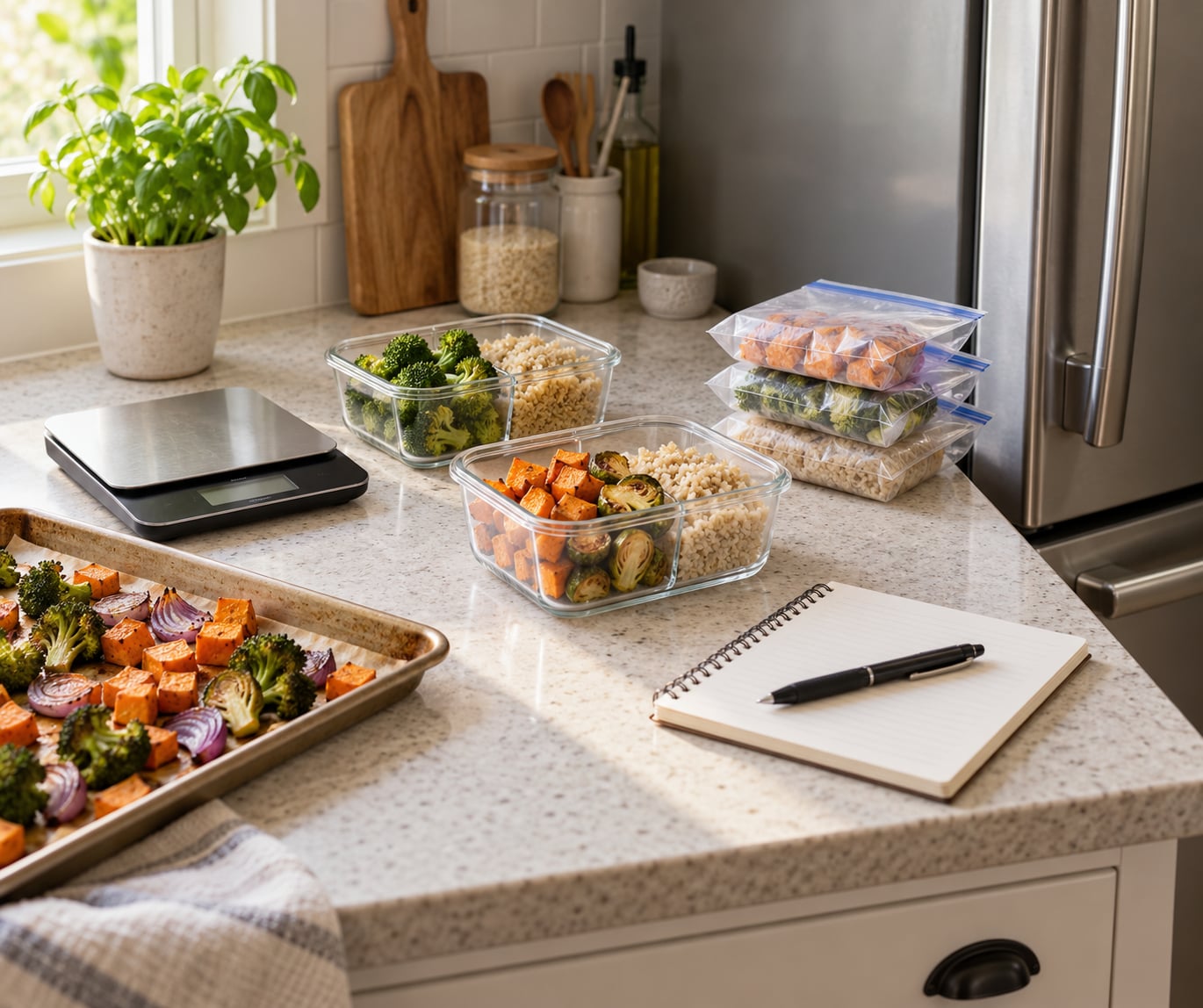
Choose one base, one vegetable, one protein and one sauce, and you have four or five meals instead of one. A pot of rice, a tray of roasted vegetables and a batch of chicken thighs turn into bowls, wraps, fried rice, soup and a sheet-pan stir-fry over the next three days.
Component cooking solves two problems at once. It stops you cooking a finished dish you will be sick of by day three, and it stops you buying three separate ingredient lists for three unrelated meals that each leave a half-used jar behind.
Formats built from components are the easiest ones-person meals there are: sheet pans, stir-fries, grain bowls, stuffed vegetables and single-protein bakes. If a dish cannot be assembled out of parts, it becomes a bigger commitment than a single person usually wants.
Step 3: Shop With Amounts for One
Buy the quantity you can eat or freeze, not the quantity that looks like a deal. That single change does more for a one-person food waste rate than anything that happens in the kitchen.
- Buy loose produce. Ask for two onions instead of a three-pound sack, and skip the clamshell that assumes two people or a long lunch.
- Use bulk bins for exact amounts. A quarter pound of cheese or a scoop of oats costs what you use and nothing more.
- Use the butcher and deli counters. A single portion of roast chicken or a few slices of sandwich meat solves the family-pack problem without a freezer.
- Choose frozen for perishables you cannot finish. Frozen peas, berries and vegetables waste nothing and cook faster than thawing is slow.
- Split proteins the day you buy them. Ground meat into sandwich-sized baggies, chicken breasts flattened in a freezer bag, sausage portioned by the link.
The USDA estimates Americans throw away roughly a fifth of the food they buy. Spread across a household of four, that is an annoying number. Spread across a single weekly grocery run, the share that spoils before it gets used is regularly larger, and it comes out of the smallest budget in the house.
One popular framework for this is the 5-4-3-2-1 grocery rule: five vegetables, four fruits, three proteins, two dairy or pantry extras, and one grain or starch for the week. For one person, treat those numbers as a ceiling rather than a target, and shop smaller trips for anything that spoils quickly.
Step 4: Prep and Cook Only What You Need
Cook one plate’s worth at a time unless the recipe specifically rewards doubling. A useful standard: three ounces of protein, half a cup of grain, half a plate of vegetables. Weigh the protein once and you will not have to think about it again.
Cutting and washing go further than a single meal too, but only up to a point. Chop a whole head of onion if you will use two cups this week and freeze the rest in a bag, which cooks on r/Cooking call a fair trade for the chopping. Do not prep produce you have no plan for; it moves from sealed to spoiled faster than anything else in the fridge.
One-pan methods reduce both prep and washing-up. A sheet pan of protein and vegetables goes in the oven, one pot of rice goes on the stove, and dinner is two pans instead of five.
Scaling a four-serving recipe down to one needs a little arithmetic. Half the cups to tablespoons, since one cup is sixteen tablespoons. For eggs, beat one egg and use half of it, or use a tablespoon less than half if the batter is delicate. Baking is the exception that punishes you: cakes and breads depend on leavening ratios and pan size, so halving them often means using the smallest pan you own and accepting a shorter bake.
Step 5: Store Food Safely
Cool cooked food fast, portion it shallow, date it and freeze anything you will not eat inside the window. The USDA Food Safety and Inspection Service puts leftovers at three to four days in a refrigerator at or below 40°F, and cooked food keeps roughly three to four months in the freezer.
Follow the safe minimum internal temperatures for anything you cook from raw: 165°F for poultry, 160°F for ground meat, and 145°F for whole cuts of meat and fish. Reheat leftovers to 165°F, and cool leftovers in shallow containers rather than one deep bowl.
Where food sits changes how long it lasts, and most people put things in the wrong drawer.
| Food | Where it goes | How long it holds |
|---|---|---|
| Leafy greens and herbs | Crisper, wrapped in a dry kitchen towel | About 5 to 7 days |
| Berries | Crisper, lined with a paper towel | 3 to 5 days |
| Mushrooms | Counter in a folded paper bag, not the fridge | About a week |
| Cooked leftovers | Shallow airtight container, back of the top shelf | 3 to 4 days |
| Raw poultry and ground meat | Sealed tray on the bottom shelf | 1 to 2 days |
| Rice, soups and sauces | Freezer, flat bag or single container | 3 to 4 months |
The paper towel in the berry container and the brown bag around mushrooms are folk methods that hold up. Both pull moisture out, which is what shortens shelf life.
Step 6: Turn Extras Into Planned Leftovers
Leftovers get thrown out when they have no job. Give each extra a destination the moment it is cooked.
- Cooked rice becomes fried rice, a soup starter or a grain bowl base within a day.
- Roasted vegetables become a sheet-pan frittata, a soup, a flatbread topping or a pasta sauce.
- Half a can of beans becomes a soup, a wrap filling, a salad topper or a quick side.
- Cooked grains become bowls with whatever protein and sauce is in the fridge.
- Roast meat or baked salmon becomes sandwiches, wraps and grain bowls for the next two lunches.
- A soft or overripe vegetable becomes soup, roasted at high heat until it caramelizes, or blended into a sauce.
Cooked components also reheat better than a finished casserole, and freezing single portions in bags pressed flat means one meal can come out without thawing the rest.
Here is what one week looks like when a single set of components carries most of the meals.
| Day | Meal | Built from |
|---|---|---|
| Day 1 | Roasted chicken and vegetables over rice | Cooked Sunday, three portions |
| Day 2 | Chicken wrap with yogurt sauce | Same chicken, same sauce |
| Day 3 | Fried rice with frozen peas | Day one rice plus an egg |
| Day 4 | Roasted vegetable and bean soup | Day one vegetables plus pantry stock |
| Day 5 | Sheet-pan vegetable frittata | Day one vegetables, two eggs, hard cheese |
Step 7: Use the Emergency Fridge-Cleaning Meal
Keep one formula in your head for the night when the kitchen is a mess and something is about to spoil: a protein, a grain, a vegetable and a sauce, combined hot or cold.
A can of tuna over last night’s rice with whatever green thing is softening in the crisper is a legitimate dinner. Half a bag of frozen vegetables, two eggs and a spoonful of soy sauce makes a fast stir-fry. Soup from the freezer bags, a handful of noodles and yesterday’s roasted vegetables is a fifteen-minute meal that clears the freezer.
Cooking this way means food gets used when it is still worth eating, instead of being evaluated at its worst on day six.
Common Mistakes
Most food waste for one person comes from a short list of repeatable habits. Each has a simple correction.
Cooking bulk portions by default. A recipe written for four is not a plan for one. Fix: cook one serving, and only double when the second serving has a named destination, such as a packed lunch tomorrow or a container in the freezer.
Storing food in oversized containers. Deep containers trap heat, cool slowly and freeze into one large block you cannot break apart. Fix: one-cup containers, pressed flat, or bags for grains.
Not dating leftovers. Guessing is how good food ends up in the bin out of guilt. Fix: marker on the lid, date and contents, every single time.
Treating every leftover as a separate meal. This is the mistake that wastes the most food, and it is not about spoilage. Fix: change the format, not the ingredients. Rice becomes fried rice, roast vegetables become soup or a frittata, meat becomes a wrap.
Shopping before checking the kitchen. Fix: do the three-door sweep first and write the list from what is missing, not from what sounds good.
Buying fresh for things you cannot finish. Fix: frozen for perishables, fresh for things you will eat within two days.
One more habit worth adding: for a month, write down everything you throw away. Most solo cooks find the same three or four items every week, and buying less of those fixes most of the problem.
Frequently Asked Questions
How do I stop wasting food when cooking for one?
Stop buying at household scale, which mostly means fighting the packaging. Shop smaller and more often, cook components rather than finished meals, freeze every extra in a single portion with the date on the lid, and eat the oldest container in the fridge first. The freezer is what makes it safe to buy a family-size pack of chicken for one person, and the use-up list is what stops it being forgotten.
What can I cook for just one person?
Sheet-pan chicken and vegetables, a stir-fry over rice, a grain bowl topped with a fried egg, one baked salmon fillet with roasted broccoli, overnight oats with fruit, a one-pot soup built from freezer stock, black bean quesadillas and stuffed peppers all work at a single serving. Each uses one protein, one grain and one vegetable, so a second and third meal can be built from the same components without repeating dinner.
How do I cook for one without eating the same thing all week?
Cook components instead of complete meals. One tray of protein and vegetables plus a pot of grain becomes bowls, wraps, fried rice and soup over three days, so no single dish has to carry you through a week. Keep two or three sauces on hand and change the format each night rather than the ingredients. Boredom, not spoilage, is what usually empties the fridge.
Can you freeze leftovers in single portions?
Yes, and it is the most useful habit in this whole routine. Portion warm cooked food into shallow one-cup containers or freezer bags, press out the air, lay bags flat in the freezer, and write the contents and date on the lid with a permanent marker. Frozen cooked food keeps around three to four months. Ice cube trays handle small amounts of stock, sauce, grated cheese and herbs in oil.
How long do cooked leftovers last in the refrigerator?
The USDA Food Safety and Inspection Service says three to four days, counted from the day the food was cooked rather than the day you got around to eating it, at or below 40°F. Reheat leftovers to 165°F. If you cannot eat something inside that window, freeze it the same day rather than leaving it in the fridge to be judged on day five.
What is the 5 4 3 2 1 rule for groceries?
It is a weekly shopping framework: five vegetables, four fruits, three proteins, two dairy or pantry extras, and one grain or starch. For a single person, treat the numbers as a ceiling for the week rather than a target for every trip. Shop twice a week rather than once, and keep the fast-spoiling items for the first trip.
Conclusion
Start with three actions this week. Open the fridge, freezer and pantry and list what needs eating first, then throw out anything past its date.
Pick one flexible base meal you can build three dinners from, and cook one serving of it. Portion the extras into single containers, freeze what you will not eat within four days, and write the date on the lid. From there, keep the use-up list going and shop for the amount one person actually eats. That is how to cook for one without wasting food, and it works as a habit rather than a rule.