
Late-night eating that has nothing to do with hunger is emotional eating, and it can be managed. The answer is a sequence you can run in about 20 minutes, not a personality transplant. How to manage emotional eating at night comes down to three things: notice the urge before you act on it, check whether you are actually hungry, and hand the feeling something other than food to do. You do not need a perfect plan. You need a pause, a glass of water, and a snack you picked earlier in the day.
I coach adults who come to me with this exact pattern, and the most common story is the same one. Nothing catastrophic happened. A hard day, an empty evening, a screen in the dark kitchen, and suddenly it is 10:40 pm and the cookies are gone. That is a coping mechanism doing its job badly, not a character flaw.
Last updated: October 2026
Table of Contents
- What You Need
- Step-by-Step: How to Manage Emotional Eating at Night
- 1. Pause Before You Eat
- 2. Check Whether You Are Physically Hungry
- 3. Identify the Emotional Trigger
- 4. Choose a Planned, Satisfying Snack
- 5. Delay and Redirect the Urge to Eat at Night
- 6. Review the Pattern Without Shame
- Common Mistakes
- Banning food after a cutoff time
- Shrinking meals during the day
- Eating straight from the bag in front of a screen
- Judging yourself for what you ate
- Distracting without naming the feeling
- Expecting a fast fix, or trying supplements alone
- Frequently Asked Questions
- What can I do when I feel emotional eating coming on at night?
- Is it bad to eat a snack before bed if I am hungry?
- Why do I feel most hungry or tempted to eat after an emotionally difficult day?
- Can relaxing or distracting myself stop emotional eating?
- When should I talk with a doctor or registered dietitian about nighttime eating?
- Start With One Night This Week
What You Need
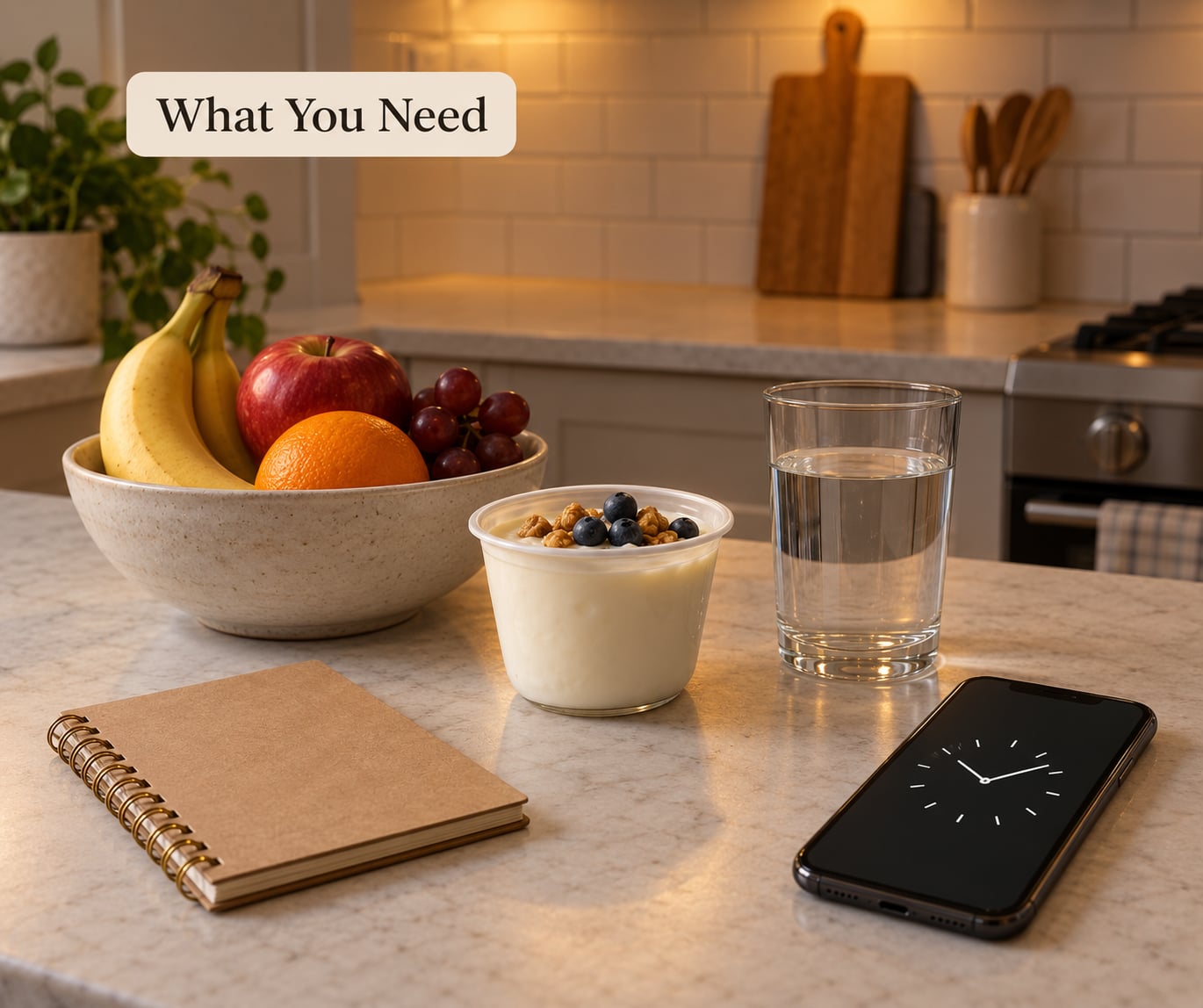
None of this needs a membership, an app, or a delivery order. You need five things within arm’s reach, and most of them cost nothing.
A meal and snack plan that is loose enough to keep. The point is not to hit numbers. The point is that going into the evening already fed means the 10 pm craving is a craving, not an emergency.
One balanced evening snack you like. Fruit with yogurt. Whole-grain toast with peanut butter. Oatmeal with a banana. Decide it in the afternoon while you are thinking clearly, so you are not negotiating with yourself at midnight.
Water within reach. Thirst at night gets misread as hunger more often than people expect. A full glass takes two minutes.
A notebook or your phone notes. Four lines is enough: time, feeling, hunger level, what you did. You are building a record, not a journal entry.
One calming activity that is already in your evening. Stretching on the living room floor, a shower, a specific playlist, a phone call to someone who picks up, four slow breaths with the exhale held longer. If it takes more than a minute to start, it will not happen at 10 pm.
Step-by-Step: How to Manage Emotional Eating at Night
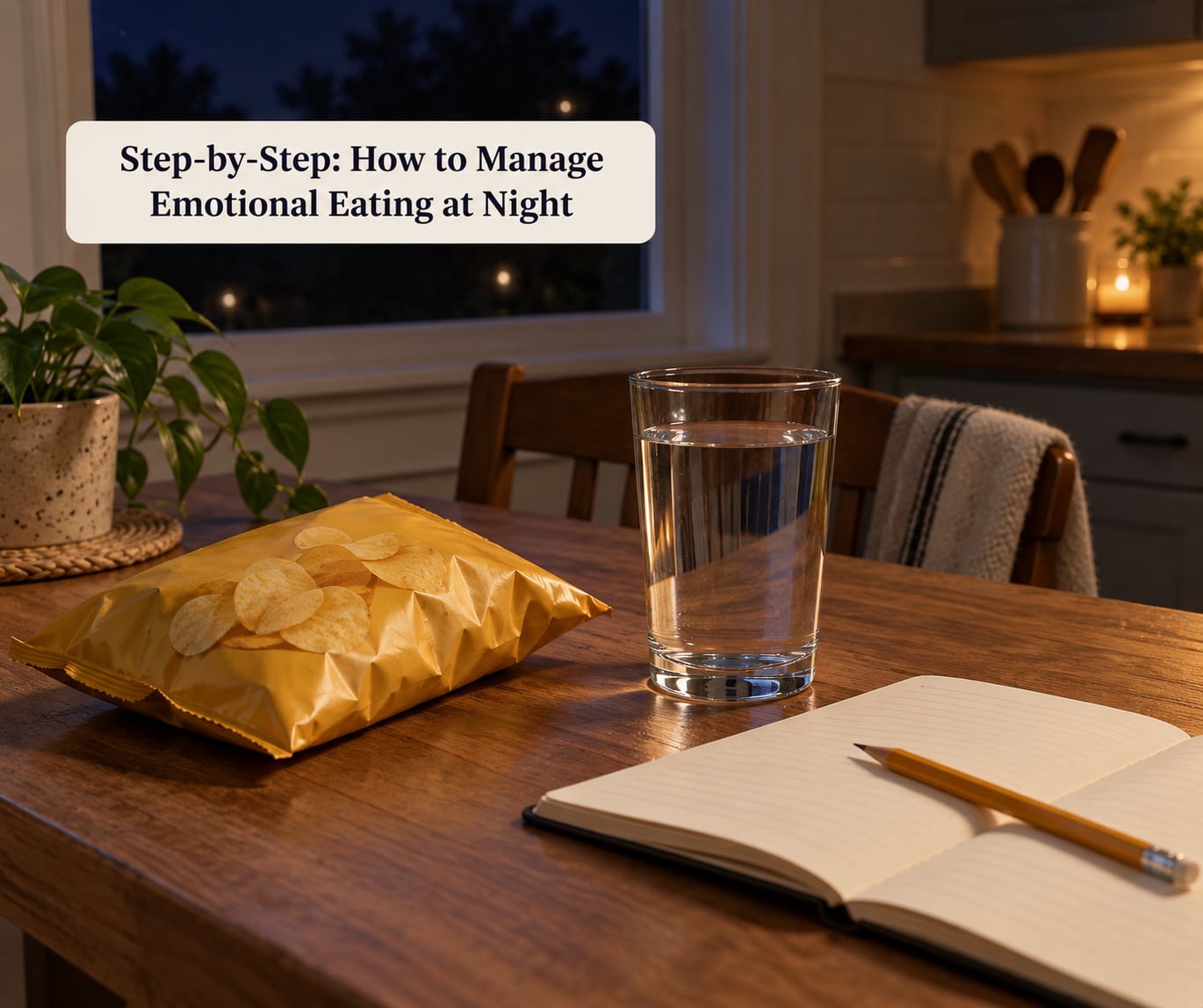
Run these in order, starting tonight. The order matters more than the effort, because each step makes the next one easier.
1. Pause Before You Eat
The urge is not an emergency, even when it talks like one. It typically peaks and eases inside about fifteen minutes if you let it, which means ten minutes of not deciding buys you most of the distance.
Ask three things. What happened in the last hour? What feeling is sitting in your chest right now, in one or two words? And would eating actually solve that feeling, or just cover it up for a while?
Naming the feeling matters more than resisting the food. “Anxious” is workable. “I am failing at my whole life” is not, because that is a story, and stories need a different response.
2. Check Whether You Are Physically Hungry
Sometimes the urge is real hunger wearing an emotional disguise. Run this check before you assume it is emotional.
| Signal | Physical hunger | Emotional craving |
|---|---|---|
| Where you feel it | Anywhere in the body, stomach or low back | Tied to a feeling or a thought |
| How it shows up | Builds gradually over hours | Arrives fast, often tied to a thought or scene |
| Speed it fades | Eases within 20 minutes of eating | Often returns quickly, even after eating |
| What it asks for | Anything satisfying, portion not fixed | A specific food, often a comfort one |
| What it sounds like | “I could eat” | “I need this” |
Also rule out thirst, tiredness, and a long gap since your last meal. If dinner was six hours ago and it was small, the answer is a snack, not a confrontation.
3. Identify the Emotional Trigger
Run a quick trigger check: stress, loneliness, boredom, frustration, conflict, overwhelm, or plain tiredness. In my experience the most common one is the quiet kind. It is the hour after the last task is done and the house goes still.
Write the feeling down in one or two words. Then write what actually happened today that produced it. That single line is usually more informative than any app.
On eating disorder support forums, the phrase people keep coming back to is riding the wave instead of fighting it. The urge loses most of its force when you stop arguing with it and just let it be there.
4. Choose a Planned, Satisfying Snack
If hunger is real, eat. Build the snack around three parts: a carbohydrate for quick energy, protein to stay full, and fiber for volume. Fruit with yogurt. Whole-grain toast with peanut butter. Oatmeal with a banana. A handful of nuts with a piece of fruit.
Skip the good and bad labels. There is no such thing as a ruined evening meal, and a snack you feel fine about is far easier to stop than one you resent. Portions that feel reasonable to you are the right portion.
Sit down for it, off the couch if you can. Eating standing at an open fridge, out of the bag, in front of a screen is the format that turns a snack into an episode.
5. Delay and Redirect the Urge to Eat at Night
This is the step people skip, and it is the one that changes the pattern. Ten minutes, then something else.
Stretching on the floor, a shower, music, writing two lines in your notebook, a call to someone who answers, or four slow breaths with a longer exhale. Urge surfing means watching the feeling like weather rather than obeying it, and most people find the wave loses height somewhere in minute six.
If the urge is still strong after the delay, eat the snack you planned. That is not failure, it is the plan working. What matters is that you do not compensate for it the next morning by skipping meals or moving on to fasting.
6. Review the Pattern Without Shame
Each time you go through the sequence, log four things: the trigger, your hunger level, what you chose, and how it turned out. After seven nights, read it back like a stranger wrote it.
Patterns show up fast this way. Most people find one specific trigger doing most of the damage, often an empty evening or an under-eaten afternoon, and that is where the real work goes.
Keep the log blameless. Guilt is itself a trigger for the next episode, and the shame spiral is how one night becomes a month.
Common Mistakes
Almost every approach I see fail at night shares one feature: it makes food the enemy. Here are the six that come up most, and the fix for each.
Banning food after a cutoff time
A hard 7 pm rule turns dinner into a finish line you sprint past. The result is usually a bigger, later meal. Remove the cutoff, keep a planned evening snack, and let the decision be about hunger rather than the clock.
Shrinking meals during the day
Skipping breakfast, eating a salad for lunch, then grazing at midnight is the most common pattern in the people I work with. One person on r/loseit described ending years of post-work binging simply by putting more in their lunch. Add food earlier rather than removing it later.
Eating straight from the bag in front of a screen
The container and the screen remove the count and the awareness at the same time. Portion your snack into a bowl and sit somewhere that is not the couch. That one change breaks the autopilot.
Judging yourself for what you ate
Criticism feels productive and lands like another trigger. Note what happened in neutral language, the way you would describe it to a friend, then move to the next step. Self-compassion is not softness here, it is the thing that interrupts the cycle.
Distracting without naming the feeling
Watching four episodes to get past a hard evening works until you are six episodes in. Distraction buys time, but naming the feeling is what actually discharges it. Do both: name it, then distract yourself on purpose.
Expecting a fast fix, or trying supplements alone
There is no supplement that reliably stops night eating, and the ones marketed for it are not evaluated for this use. Melatonin for a genuinely shifted sleep schedule is a different conversation, and that one belongs with your doctor or pharmacist.
Frequently Asked Questions
What can I do when I feel emotional eating coming on at night?
Run the sequence in order: pause and name the feeling, check whether you are physically hungry or just thirsty, have a glass of water, then give yourself ten minutes before deciding. If you are genuinely hungry, eat a planned snack sitting down. If you are not, name the feeling, write down what caused it, and do one calming thing. The urge usually eases within about fifteen minutes if you stop arguing with it.
Is it bad to eat a snack before bed if I am hungry?
No. Eating when you are physically hungry at night is a reasonable thing to do, especially if you under-ate during the day. Choose a snack with a carbohydrate, some protein, and fiber, such as fruit with yogurt or oatmeal with a banana, and sit down to eat it. The problem is not the timing of an honest snack. The problem is eating past fullness, out of a feeling, or on autopilot from the container.
Why do I feel most hungry or tempted to eat after an emotionally difficult day?
Stress hormones and a natural evening energy dip both raise hunger, and a demanding day usually means you ate less without noticing. Add screen-lit evenings and a mind that has nowhere to put the feeling, and the urge for comfort food starts to look physical. Evening and night is also simply when most tasks are finished, so boredom and loneliness fill the gap. That is why the trigger check works better at night than willpower does.
Can relaxing or distracting myself stop emotional eating?
It helps, but on its own it rarely holds. Relaxation lowers the intensity of the feeling, and distraction keeps you from acting while it does. The stronger version combines them: name the feeling first, then do a calming activity for ten minutes, then decide. Without the naming step, most people find themselves still hungry and more tired an hour later.
When should I talk with a doctor or registered dietitian about nighttime eating?
Talk with a professional if nighttime eating happens most days, if you eat to the point of feeling uncomfortably full, if you hide it, or if it is paired with marked distress about food or weight. Night eating syndrome and binge-eating disorder are real, treatable conditions, and neither improves through stricter rules on your own. A registered dietitian or a therapist trained in eating behaviour can help. In the United States you can also call or text 988, or the National Eating Disorders Association helpline on 1-800-931-2237.
Start With One Night This Week
Pick one night. Eat a real dinner, choose your evening snack in advance, and put a notebook by the water. When the urge shows up, run the six steps and write down what you found. That is the whole starting point for managing emotional eating at night. If the pattern keeps repeating or it is costing you sleep and peace, that is the signal to bring a registered dietitian or therapist into it.
This article is general information, not medical advice. Individual situations vary, so anything personal belongs with a doctor, a pharmacist, or a registered dietitian.