
The honest answer is that finding community when you feel isolated is mostly a matter of repeating low-pressure contact with the same people until familiarity turns into trust. You do not need to be outgoing, popular, or ready. You need one group that meets on a schedule, one small way to contribute each time, and enough weeks in a row to let it compound.
That is the part almost every guide skips. People tell you to put yourself out there, which is advice with no instructions in it. Below is a slower method: six steps you can work through over about three months, built around recurring activities instead of one big brave night out.
It also helps to name what you are actually short of. Loneliness comes in more than one flavor, and the wrong kind of community will not fix it.
Table of Contents
- What You Need Before You Start Looking
- A clear picture of the kind of community you want
- Two or three things you would do anyway
- A time slot you can protect
- Basic conversational skill, which is smaller than you fear
- Realistic expectations about trust
- Step-by-Step: Six Steps to Find Community When You Feel Isolated
- Step 1: Start with one low-pressure community
- Step 2: Look for people with shared experience, not just shared interests
- Step 3: Turn attendance into a repeatable routine
- Step 4: Build one safe connection outside the group
- Step 5: Bring value, not pressure
- Step 6: Create community beyond one circle
- Common Mistakes That Keep People Stuck
- Frequently Asked Questions
- Do I have to be an extrovert to find community?
- How long does it take to make friends as an adult?
- What do I do if someone does not respond to my invitation?
- How do I know if a group is safe before I commit to it?
- What is the 11-3-6 or 5-3-1 rule of friendship?
- When does loneliness mean I should talk to a professional?
- Conclusion
What You Need Before You Start Looking
You need far less than you think, but you do need to be specific. Vague searching is the reason most people give up after a month.
A clear picture of the kind of community you want
Decide whether you want emotional loneliness solved, social loneliness solved, or both. Emotional loneliness is the absence of someone who knows you well, and it usually needs one or two deep ties. Social loneliness is the absence of a wider network, the sense that nobody would notice if you disappeared, and it responds well to groups.
Most people who feel isolated have both, and the honest sequence is group first, close friend second. Groups are lower stakes and give you a reason to talk to the same people again next week.
Two or three things you would do anyway
Pick interests that survive a bad week: cooking, running, chess, photography, fixing things, singing, volunteering, gaming. The list matters less than the fact that you would still show up on a week when nobody invited you. That is the test for whether a group will last.
A time slot you can protect
One recurring hour beats three flexible options. Isolation is usually a scheduling failure as much as a social one, because the first thing to get cut when work, bills and family pile up is the optional appointment nobody else is counting on.
Basic conversational skill, which is smaller than you fear
You need to ask a question, make one observation, and answer when someone asks you something. Most conversation is that simple in a room where the same topic comes up every week.
Realistic expectations about trust
Roughly six weeks is a fair window to decide whether a new group is worth staying in. Deep adult friendships typically take one to three years to form, and anything faster is usually surface-level connection that feels good but does not hold weight. Expecting a best friend in a month is how people quit groups that were working.
Step-by-Step: Six Steps to Find Community When You Feel Isolated
Work in order. Each step assumes the previous one is holding steady, and skipping ahead is how people end up with a dozen group memberships and nobody they can call.
Step 1: Start with one low-pressure community

Pick one group built around an activity, a cause, a faith community, a hobby or a life stage, and choose one where participation does not demand advanced social skill. Recurring beginners classes, volunteer teams, church small groups, neighborhood associations, hobby clubs and support groups all fit. Skip the ones built on big open-mixing networking for now.
The rule: commit to attending twice before you judge it. The first visit is observation, and almost nobody remembers what you did in it. The second visit is where faces become familiar and someone usually greets you by name, and that small recognition is what keeps most people from walking out.
You will know the room is safe if people talk to each other when you are not in the conversation, if nobody is performing status, and if the same few people show up each time. That last one is the strongest signal. A group that rotates entirely through new faces will never become yours.
Sign it worked: one person knows your name and greeted you without being asked.
Step 2: Look for people with shared experience, not just shared interests
Shared interests get you in the room. Shared experience is what builds loyalty. Search outward from the activity toward the reason people are there: cultural identity, faith, a transition you have been through, a support need, a neighborhood, a profession, a season of life such as new parenthood, recovery, grief, divorce or a career change.
Places worth checking: local organizations that serve specific communities, libraries that run free discussion groups, faith congregations with small groups rather than only large services, professional and trade associations, recreation leagues, community centers, parent groups, mutual aid networks, and hobby-specific forums. Remote workers should look at coworking spaces and local associations, since home is the one place where community cannot grow.
Screen as you go. Belonging in a group is not automatic, and a group that makes you argue for basic respect is not a slow-burn friendship, it is a slow drain.
Sign it worked: someone mentions a part of your life that you did not have to volunteer, which means they have been paying attention.
Step 3: Turn attendance into a repeatable routine
This is where belonging actually gets built. Arrive ten minutes early. Sit near the same people. Do one small thing every session, whether that is asking one question, bringing one item, or staying fifteen minutes after to help stack chairs. Repetition is doing the emotional labor here, not charisma.
Consistency inside the group matters more than a grand gesture outside it. Before you try to organize anything, become someone whose presence is expected. People protect the people they already have a slot for.
Online groups can work at this stage as a bridge, as long as you judge them by one question: after an hour in the space, do you feel more connected or less? Some do a great deal of good. Some turn connection into a competition. Drop the ones that leave you measuring yourself.
Sign it worked: you start a session by looking for specific faces instead of scanning the room for an exit.
Step 4: Build one safe connection outside the group
Keep invitations small and specific. The vague version, we should hang out sometime, converts into nothing because it asks the other person to do the planning. The specific version, I am going to the market Saturday, want to come, converts often because it only needs a yes or no.
Coffee after the meeting, a walk before work, a shared link about something you discussed, a lift to an event that starts early. Respect the pace they set. If they are busy, keep showing up at the group and try again later without any pointed commentary.
Do not open your deepest material early. People rarely know what to do with intensity from a near-stranger, and undirected disclosure often ends a promising connection instead of deepening it. Match the other person’s disclosure, roughly, and go one level further at most.
Sign it worked: the conversation continues where you left off, which means something carried between weeks.
Step 5: Bring value, not pressure
Arriving with a contribution is easier than arriving with an apology for being there. Reliable information about the process. A skill you can teach. Steady help with setup and cleanup. Listening that makes someone feel understood. Asking the question nobody asked. These turn a social situation into a useful one, which is how reciprocity starts without anyone negotiating it.
The point is not to be the most valuable person in the room. It is to be useful in small, repeatable ways so the group associates you with being dependable rather than needing something.
One caution for men, especially Black men who were raised to be the one who holds things together: competence is how you enter the room, but it is not the same as being known. Saying that you are tired, grieving, lost or struggling is what turns an acquaintance into a friend. You do not have to tell everyone. You have to tell one person.
Sign it worked: people start asking you for things, which is the polite version of trust.
Step 6: Create community beyond one circle
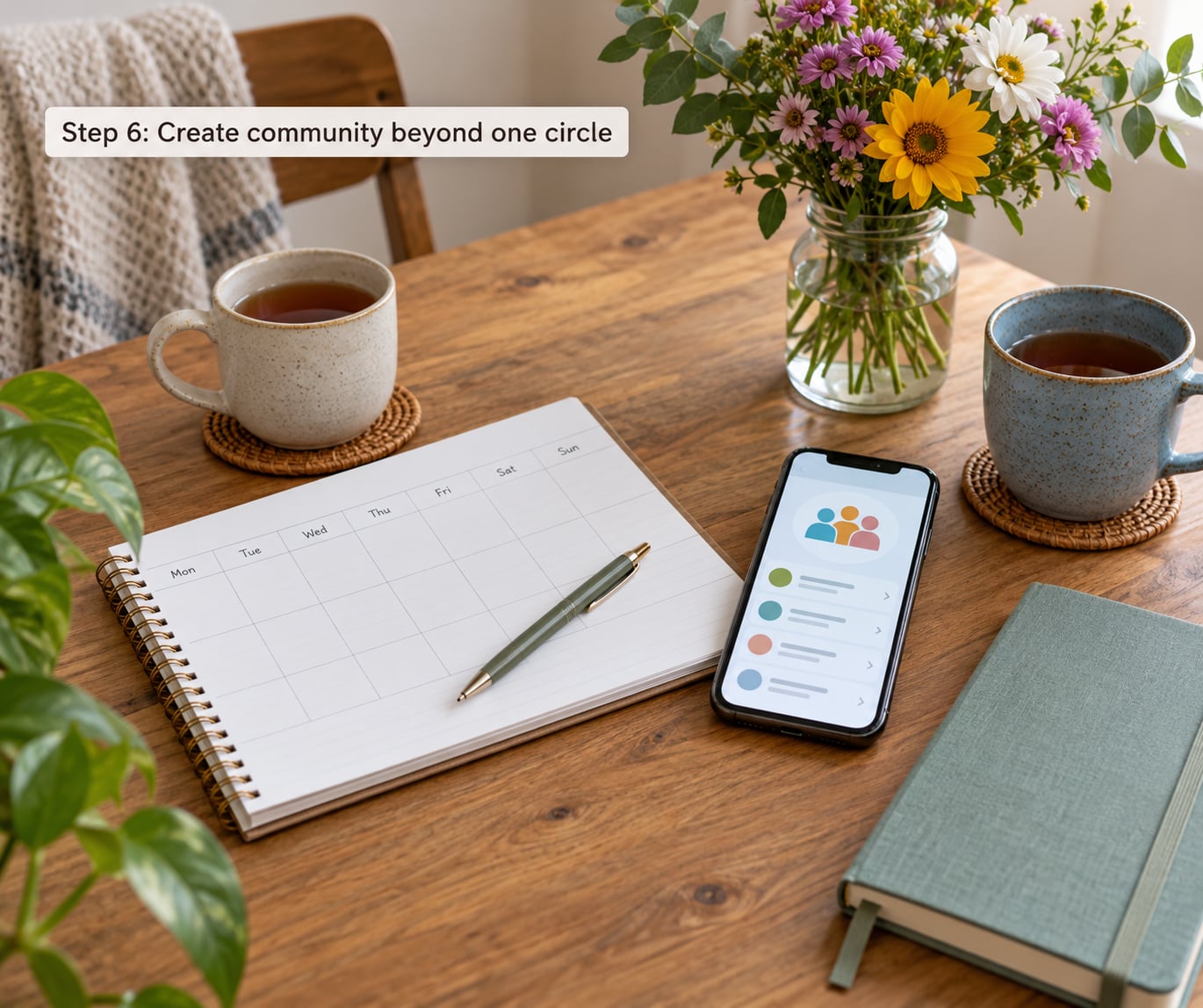
One group cannot carry your whole emotional life, and leaning on a single circle makes every bad week feel like losing everything. Layer your connection instead: one recurring group for shared purpose, one or two one-on-one friendships, an online community that shares your actual interests, and occasional community events you look forward to.
Keep a light touch on all of it. A weekly calendar with three social entries beats a single packed weekend of socializing followed by silence for three weeks. Distributed connection is what keeps a quiet month from becoming a lonely one.
Do not forget the connections you already have. Old friends drift because calendars never overlap, and the drift is rarely a rupture. One message a month, a yearly tradition, a specific invitation. Low maintenance is not the same as gone.
And let go of what is not nourishing you. Belonging is not a moral obligation. Leaving a group that consistently drains you is part of finding community, not a failure at it.
Sign it worked: no single person is responsible for your whole week, and a week with nobody in it is survivable.
Common Mistakes That Keep People Stuck
Waiting until you feel ready. Readiness does not arrive before belonging. You will feel underdressed, under-informed and mildly embarrassed for the first several weeks no matter what, and that feeling is a symptom of doing something unfamiliar, not evidence that you do not belong.
Quitting after one awkward interaction. Silence is common in new groups. People are checking you as carefully as you are checking them. Give any group six weeks and roughly four sessions before you decide, and judge it by the trend, not by one evening.
Trying to meet everyone at once. A new group of thirty people every month produces a lot of names and no shared history. One group for three months produces the opposite. Depth comes from repetition, not variety.
Confusing activity with belonging. Filling every weekend keeps you busy and just as alone. Activity is the vehicle; repeated contact with the same humans is the fuel. If you cannot name three people in that space who would notice your absence, you have a calendar, not a community.
Overexplaining yourself. A long story about why you left, why you moved, why your last group went wrong lands differently in week one than in month three. Give people a name and a couple of interests first. The rest unfolds when they ask.
Ignoring red flags to avoid another fresh start. Dismissive jokes about your race, your faith, your family or your weight are data. So are group rules that punish people who raise concerns. Leaving is not losing. It is the fastest way to find the group you actually want.
None of this means the fix is instant. Most people who do this work describe the same arc: awkward and quiet for about a month, comfortable with a few faces by month two, and genuinely surprised at having people to call somewhere between year one and year three. That is the honest timeline.
Frequently Asked Questions
Do I have to be an extrovert to find community?
No. Most adult friendship happens in small recurring rooms with side conversations, shared tasks and predictable seating, not at big loud events. Pick activities where you interact with a handful of people rather than a crowd, arrive early, stay for the whole session, and let repeated contact do the work. Introverts often build fewer, deeper friendships than extroverts because they are not spreading attention across fifty acquaintances.
How long does it take to make friends as an adult?
Give a new group roughly six weeks before you judge it, and expect deep adult friendships to take one to three years to form. Most people feel comfortable with a few faces in the first six to eight weeks, become a regular by month three, and only then start disclosing real things. Anyone promising closeness faster is usually offering intensity rather than durability.
What do I do if someone does not respond to my invitation?
Assume they are busy, not rejecting you. Do not send a follow-up that asks whether they received it or implies they hurt your feelings. Keep attending the group, greet them normally next time, and try once more in two or three weeks with a different, equally low-pressure plan. One non-response is noise. A pattern of silence after several genuine attempts is information, and you are allowed to let it be information.
How do I know if a group is safe before I commit to it?
Look for a few things: people talk to each other when you are not performing, the same faces return, newcomers get introduced rather than ignored, and nobody treats one member as the punchline. Ask the organizer directly what the group does about harassment. A group that shrugs at the question has already answered it. Trust takes weeks to build, but warning signs show up in the first two sessions.
What is the 11-3-6 or 5-3-1 rule of friendship?
The 11-3-6 idea is that healthy adult contact means roughly 11 meaningful one-on-one conversations a month, three group activities, and six meaningful hours spent with friends. The 5-3-1 idea works in the other direction: five people you can count on in a crisis, three you would invite to your birthday, and one you would call at 2 a.m. Neither is a real clinical measure, but both are useful for noticing when your life has quietly emptied out.
When does loneliness mean I should talk to a professional?
Reach out to a doctor, therapist or counselor when isolation comes with persistent low mood, loss of interest in things you used to enjoy, sleep or appetite changes, hopelessness, or trouble functioning at work or home for more than two weeks. Those are signs of depression rather than of a bad social season. A therapist can also help if you are stuck in a cycle where isolation lowers your energy, which lowers your ability to socialize, which deepens the isolation.
If loneliness has come with low mood, loss of interest, sleep or appetite changes, or any thoughts of harming yourself, contact a doctor, a counselor, or a local crisis line in 2026 rather than waiting for a community to fix it. Community helps. It is not a substitute for care.
Conclusion
Finding community when you feel isolated comes down to one mechanism: repeated, low-pressure contact with the same people until it turns into trust. Choose one group that meets on a schedule, attend it twice before you judge it, contribute something small each time, and give it about six weeks before you decide.
Then add one layer at a time. One recurring group, one specific invitation, one person you eventually tell the truth to. Start 2026‘s version of this tonight by picking one recurring group and looking up when it meets next.