If your mind will not stop thinking, meditation still works. You are not supposed to empty your head, sit in perfect silence, or clear every thought before the timer goes off. You are supposed to notice that a thought appeared, then gently bring your attention back to one thing you chose, like the breath, your feet on the floor, or a sound in the room. That return is the whole practice.
The reason most people quit is that they measure a meditation session by how quiet they were. The honest measure is how many times you came back. Sit for five minutes, pick one anchor, and start.
Table of Contents
- What You Need
- Step-by-Step: How to Meditate When Your Mind Will Not Stop
- Set a Short, Manageable Timer
- Use a Physical Anchor: How to Meditate When Your Mind Will Not Stop
- Label Distracting Thoughts and Continue
- Try a Five-Sense Grounding Practice
- End With a Deliberate Reset
- Common Mistakes
- Trying to Force Thoughts Away
- Starting Too Long
- Judging the Session by Mental Silence
- Changing Techniques Every Few Days
- Expecting Calm in the First Few Sessions
- Quick Tips That Solve the Problems Nobody Warns You About
- Frequently Asked Questions
- Should I try to stop my thoughts while I meditate?
- How long should I meditate when my mind is restless?
- Is it possible to meditate while walking?
- When should I use a guided meditation instead of sitting in silence?
- Do people with ADHD struggle with meditation?
- Why do my thoughts get louder when I close my eyes?
- Conclusion
What You Need
You need nothing to buy. No cushion, no app, no special clothes, no incense, no particular belief system. Everything below is optional and most beginners do better with less equipment.
- A place that is only mostly quiet. A bedroom, a corner of the kitchen, a parked car. Traffic outside is not a disqualifier, it is practice material.
- A comfortable sitting position. A chair with both feet flat on the floor works better than a hard bench. If your legs or back start complaining within a minute, you will quit, so fix that first.
- Five minutes. Five to twenty minutes is realistic. Begin at the short end and earn longer sessions.
- One chosen anchor. Decide before you start what you will come back to, so the decision is not made in the moment by a restless mind.
- An open willingness to notice thoughts without judging them. Not an ability to stop thinking. Curiosity and mild friendliness toward yourself is enough.
If meditation reliably makes you more distressed rather than less, that is worth raising with a doctor or therapist. Panic disorder, trauma history and some physical conditions need professional guidance before you start sitting with closed eyes.
Step-by-Step: How to Meditate When Your Mind Will Not Stop
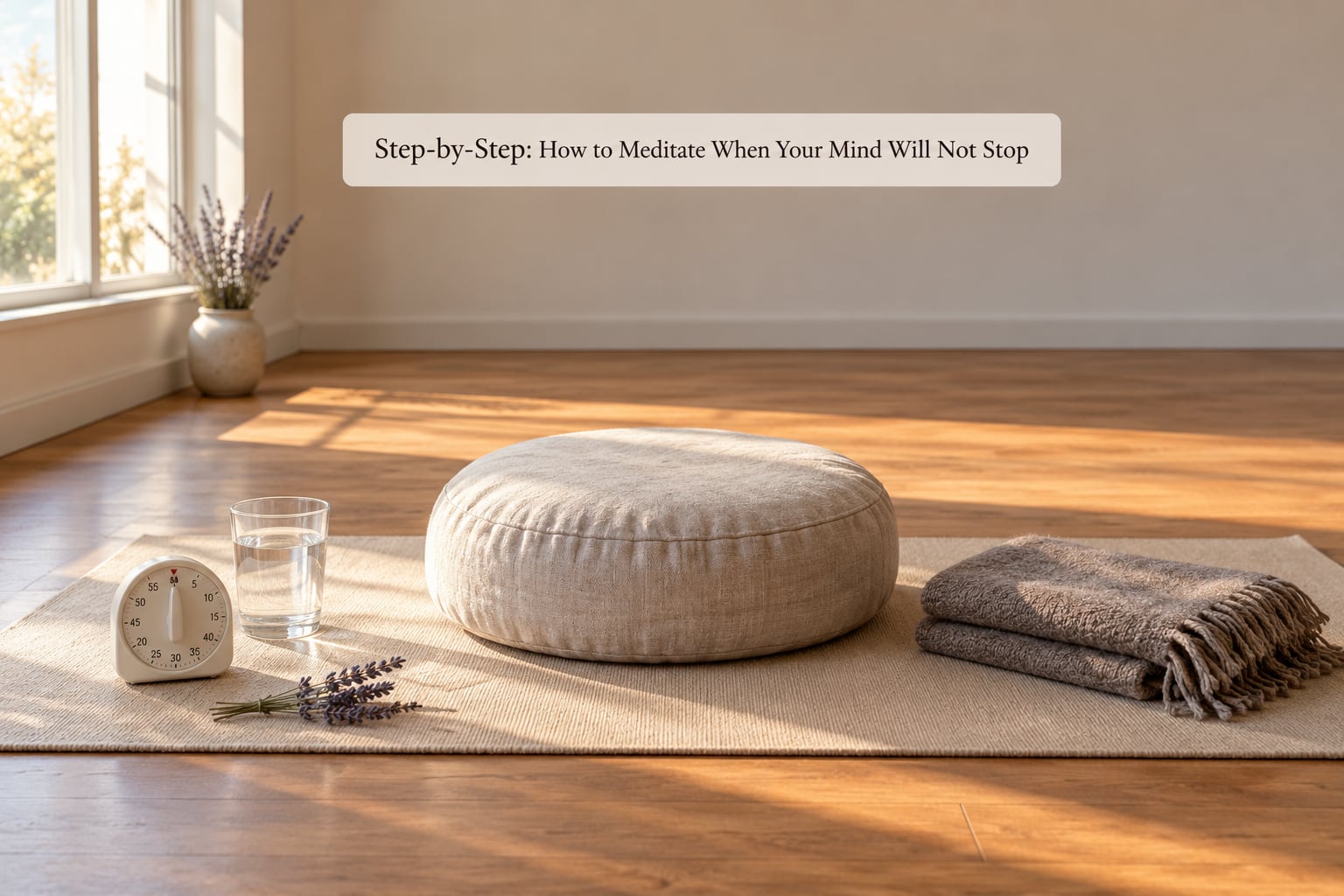
The full practice below takes five to ten minutes and works whether you are meditating at your kitchen table, in bed, or on a park bench. Read the five steps once, then follow them in order.
Set a Short, Manageable Timer
Start with five minutes, not thirty. Five minutes is long enough to genuinely practice and short enough that you will actually finish. A session you complete builds the habit, and a session you abandon teaches you that meditation is something you fail at.
Use a kitchen timer or a phone timer set face down, and keep it out of sight. A timer you can keep glancing at quietly turns into another thing to be anxious about.
Once you have finished five minutes on three separate days, move to ten. Longer sessions matter much less than repeated ones. The aim is building a reflex of returning, not accumulating minutes.
Use a Physical Anchor: How to Meditate When Your Mind Will Not Stop
You do not push thoughts away. You notice them, let them pass without grabbing, and return to a physical anchor. Over three or four minutes your attention will wander a dozen times, and that is normal.
Pick one anchor and stay with it:
- The breath at the nostrils. Feel air move in and out, or the chest and belly rise and fall. Do not control the breath or try to slow it.
- The floor under your feet. Weight, pressure, temperature. Good if the breath feels too subtle or too exciting.
- One hand resting on the other. Warmth, contact, the slight pulse under the fingertips.
- A sound. A fan, traffic, a neighbour’s footsteps, the hum of a fridge. Follow one sound, then let it widen to include the rest of the room.
When a thought arrives, silently say thinking or planning, or just note it, then go back to the anchor. No argument with yourself, no promise to do better next time.
If the breath keeps pulling you back into your own head, switch to sound or foot pressure. Anchors are interchangeable, and the one that works today is not necessarily the one that worked last week.
Label Distracting Thoughts and Continue
Naming what kind of thought showed up turns an overwhelming loop into one small item you noticed. Do it silently, in one word, and move on without a second look.
- Planning for something you did not do yet
- Worrying about a conversation or a result
- Remembering something from earlier in the day
- Imagining a scene, a conversation, a holiday
The label is not a judgement. Planning is not bad, worry is not a failure, and a memory is not a distraction to be scolded. You are naming traffic so you know which direction you are facing.
A useful line I use with beginners: thinking, coming back. Two words, and then the anchor. It sounds too simple to work, and it works because it removes the argument with yourself that usually takes five minutes on its own.
Try a Five-Sense Grounding Practice
When the racing thoughts feel too loud for a breath anchor, switch to the outside world. This five-sensory grounding practice works well during a moment of acute anxiety, in an unfamiliar room, or while your head is full.
Run through it slowly, naming each thing silently, one category at a time.
- Five things you can see. Actual objects, not screens. The edge of a door, dust on a windowsill, a cable under the desk.
- Four things you can feel. Feet on the floor, fabric on your skin, the chair back behind your shoulders, air on your face.
- Three things you can hear. Including the quiet ones. A low hum, a distant car, your own swallowing.
- Two things you can smell. Often this is where it gets thin. Paper, coffee, laundry detergent, damp outside air through a window.
- One thing you can taste. The water on your desk helps with this one.
Go slowly enough to actually look. The goal is to land your attention in the room, not to get through five categories fast.
Some people find sensory grounding makes them more agitated rather than less, especially if focusing inward has felt unsafe before. If that happens, drop the technique and try walking or a movement practice instead, or talk to a professional before trying more inward attention.
End With a Deliberate Reset
Do not just jolt back to your day. Close the practice with a short, deliberate sequence so it feels finished rather than interrupted.
Open your eyes. Take one natural breath, deeper than the small sips you have been making. Look around the room and name five things you see. Then choose one small intention, such as answer the next email after a drink of water, or go to bed at eleven.
That intention matters more than it sounds. A short meditation that ends with a defined next step is far more likely to become a habit than one that fades into whatever the minute after happened to be.
Common Mistakes
Most people who feel they cannot meditate are doing one of five things. Each has a straightforward fix.
Trying to Force Thoughts Away
Trying to suppress thoughts creates the exact tension you are trying to escape. Fighting a thought strengthens its grip, and the more effort you put in, the louder it gets.
The fix: replace the instruction with a simpler one. Notice, name, return. Nothing about the thought has to change for you to move past it.
Starting Too Long
Thirty minutes on day one, for someone with racing thoughts, is a guarantee of failure and a good way to conclude that meditation is not for you.
The fix: five minutes daily for two weeks before you change anything. Length follows consistency, never the other way around.
Judging the Session by Mental Silence
If you finish and your mind was noisy the whole time, that was not a wasted session. Count the returns instead of the silence, because the returns are the muscle you are building.
The fix: keep a pencil and write a single number for how many times you came back. Most beginners are pleasantly surprised, and it gives you something real to track.
Changing Techniques Every Few Days
Trying six methods in one week means you have done none of them long enough to notice whether they help. Progress in this practice is quiet and slow.
The fix: stick with one anchor for two weeks. If it genuinely is not working for you, switch, but switch once rather than constantly.
Expecting Calm in the First Few Sessions
Most people feel nothing much for the first week or two. That is normal and not a sign that your brain is broken or that you are bad at this.
The fix: lower the target. You are not trying to feel peaceful in five minutes, you are trying to notice a thought and come back. Do that reliably and the calm tends to follow over weeks, not sessions.
Quick Tips That Solve the Problems Nobody Warns You About
If you fall asleep during meditation. Sit upright rather than lying down, keep eyes soft and open, hold a cool object or run cool water over your wrists beforehand. Bedtime meditation works well for many people because the mind is already winding down, so it is a trade, not a defect.
If sitting still feels unbearable. Walk. A walking meditation with slow, deliberate steps, matching attention to each footfall and the contact of the air, works as well as sitting for many beginners. Swaying gently while standing is another version, and the moving option often opens the door to the still one.
If you have ADHD or a neurodivergent mind. Long silent sitting with a fixed anchor can be genuinely difficult, not a character flaw. Shorter sessions of two to three minutes, physical movement before you sit, external anchors such as sound or a visible object, and following a voice or a visual focus instead of your own breath all tend to work better. Working with hands, such as colouring or journaling, gives the attention something to do while the body settles.
If you feel worse after sitting. Change the input, not your effort. Eyes open instead of closed, movement instead of stillness, external sounds instead of inner sensation. And if distress keeps climbing, stop and speak to a doctor or a mental health professional about what kind of practice suits you.
Frequently Asked Questions
Should I try to stop my thoughts while I meditate?
No. Stopping thoughts is not the goal and trying to do it usually backfires, because suppression adds tension and the thought comes back louder. The practice is noticing that a thought appeared, then returning your attention to your anchor without arguing with it. Every return is a repetition of the skill you are training, whether the session felt peaceful or not.
How long should I meditate when my mind is restless?
Five minutes. For a restless or overactive mind, a session you finish beats a session you abandon. Do five minutes daily for about two weeks, then move to ten, then fifteen. Longer practices matter much less than repeated ones, and most of the benefit shows up across weeks of consistency rather than in a single long sitting.
Is it possible to meditate while walking?
Yes. Walking meditation is one of the easiest entry points for people who cannot sit still. Walk slowly and deliberately, and bring your attention to the sensation of each foot lifting, moving and touching down, or to the contact of air on your face. It also works as a commuter practice, since the rhythm of the steps holds your attention without demanding silence.
When should I use a guided meditation instead of sitting in silence?
Use a guided practice for the first few weeks, or whenever your mind refuses to settle on its own. A voice gives you something external to follow, which is easier than holding attention on an internal sensation alone. Once you can follow an anchor on your own for five minutes without constant guidance, switch to unguided practice and keep the guided version for travel or difficult days.
Do people with ADHD struggle with meditation?
Many people with ADHD find long silent sitting with a fixed anchor hard, because sustained attention and suppressing the urge to move both go against the wiring involved. That is not a failure of character. Shorter two to three minute sessions, movement before sitting, external anchors like sound or a visible object, and following a spoken guide tend to work much better than breath counting alone.
Why do my thoughts get louder when I close my eyes?
With your eyes closed and nothing else engaged, inner thought becomes the loudest input, so it feels more intense. It is a change of attention, not a sign something is wrong. Keeping your eyes soft and open with a fixed gaze on one spot, or using a sound anchor instead of the breath, usually takes the pressure off. Many long-term practitioners keep their eyes partially open for exactly this reason.
Conclusion
Sit down for five minutes, choose one anchor, and set a timer you cannot reach past. When a thought arrives, name it once and go back to the anchor, as many times as it takes. That return is meditation, not a failure of meditation, and it is enough for today.