The fastest way to calm down when you are angry is to create physical distance from the moment and slow your breathing, with a longer exhale than inhale. Ten uninterrupted minutes is usually enough to bring your voice and your judgement back. It takes practice, and it fails for some people more than others.
Here is the sequence I would use, in order, and why each part matters.
Table of Contents
- What You Need
- How to Calm Down When You Are Angry, Step by Step
- 1. Create distance from the moment
- 2. Notice what your body is doing
- 3. Slow your breathing to calm down when you are angry
- 4. Ground yourself in the present
- 5. Decide what you need to say later
- 6. Return and communicate clearly
- Common Mistakes
- Frequently Asked Questions
- How can I calm down quickly when I am angry?
- Why do I feel physical symptoms when I am angry?
- Is it healthy to suppress anger instead of expressing it?
- When should I seek help for anger or losing control?
- How do I apologize after I said something hurtful while angry?
- What to Do First
What You Need
Calming down does not need a special kit. You need somewhere you can be for a few minutes without being interrupted, one method that takes your attention off the argument, and enough time to come back to the conversation later.
- A safe place. Another room, the car, a stairwell, outside. Anywhere you can stop performing for a moment.
- A few uninterrupted minutes. Ten works better than two, and ten is easier to promise than an hour.
- One grounding method you already know. Counting, breath, cold water on your face, a walk. Familiarity matters when your brain is busy.
- Water. Dehydration makes everything feel louder.
- A plan for later. A rough idea of when and how you will raise it again. Without that, the pause just delays the same outburst.
None of this is a guaranteed fix. Some people calm down quickly, some take longer, and a few need a different approach entirely.
How to Calm Down When You Are Angry, Step by Step
1. Create distance from the moment
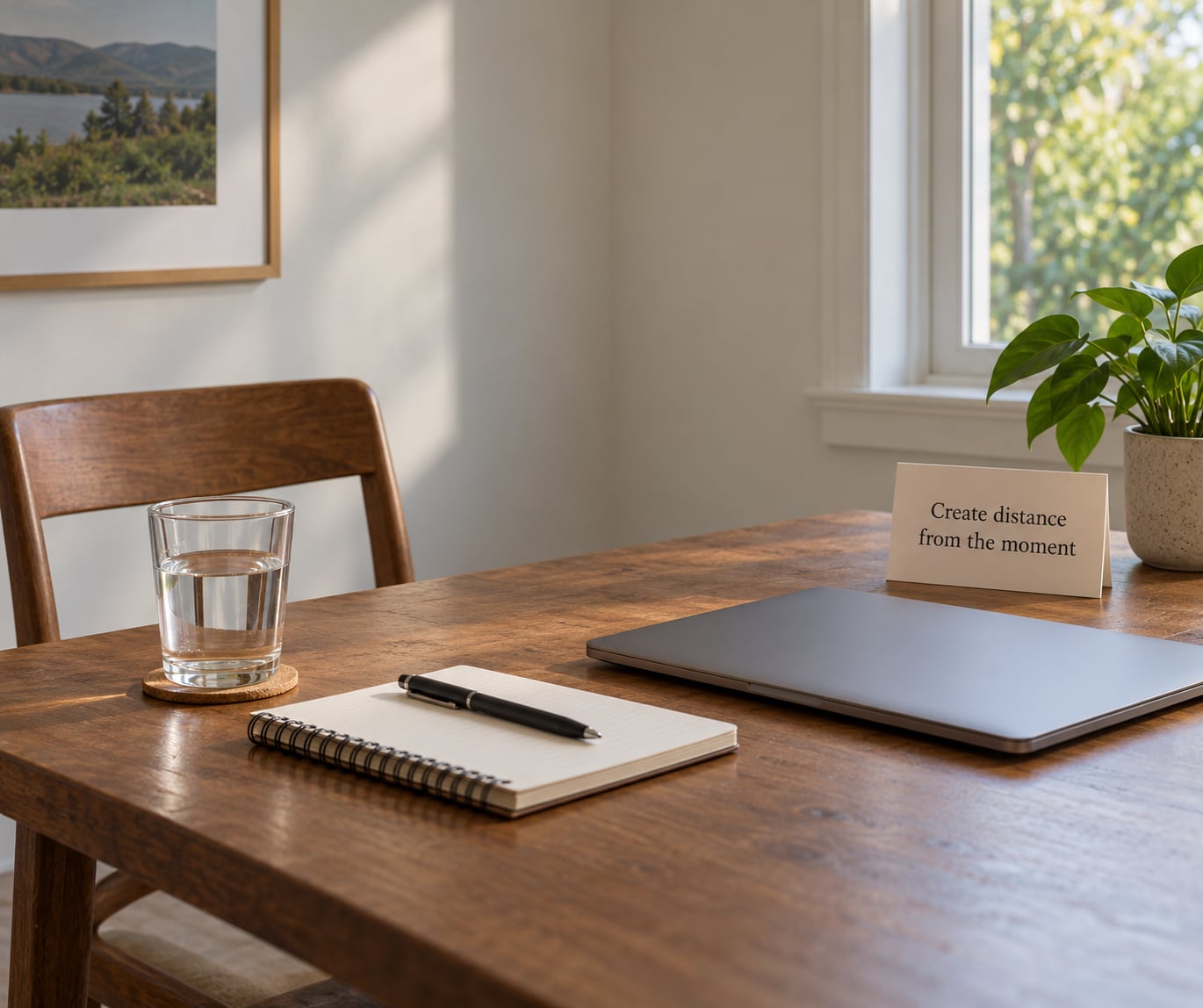
Leave, turn away, or stop talking. The physical separation is what does the work, because your body cannot fully settle while you are still standing in the middle of the thing that set it off.
Say one neutral sentence before you go: “I need a few minutes and I’ll come back to this.” Then actually come back, at a time you name out loud. Walking out without a return time reads as abandonment, and people rarely calm down while waiting for the other person to return.
You will know it is working when your voice drops back to its normal pitch, or when you realise you have been clenching something and can stop. If you are still rehearsing sentences to deliver, you have not left yet.
2. Notice what your body is doing
Anger announces itself in the body before you consciously decide to feel it. A tight jaw, fast shallow breaths, heat in your face or chest, a raised voice, a heavy feeling in your stomach, tension across the shoulders.
Say what you notice out loud or in your head, plainly: “My jaw is tight and my breathing is shallow.” Naming a sensation creates a little space between you and it. You are observing it rather than obeying it, and that gap is where the choice sits.
Do not add a story to the sensations. “Everything always goes wrong” is an interpretation, and it will keep the heat up. The tight jaw is a fact; the story is optional.
3. Slow your breathing to calm down when you are angry
The exhale is the lever. Longer out-breath than in-breath activates the calming side of your nervous system, so the pattern matters more than the volume of air.
Box breathing: in for 4, hold for 4, out for 4, hold for 4. That is one 16-second cycle. Do six cycles, about 100 seconds. If holding feels like too much, drop the holds and just make the out-breath longer than the in-breath.
Stop if you feel dizzy, faint, or more agitated. Focusing on the breath makes some people angrier, and that is common enough that it is worth naming rather than pushing through.
4. Ground yourself in the present
Grounding redirects attention without asking you to suppress anything. You are not pretending you are fine. You are giving your brain a less inflammatory thing to process.
Name five things you can see, four you can feel, three you can hear, two you can smell, one you can taste. Go slowly enough that you actually register each one. If the counting feels silly at first, that is normal; it is a technique, not a revelation.
Readers on anger forums describe this as one of the few things that works when they cannot leave the room, such as a meeting or a late-night parenting moment.
5. Decide what you need to say later
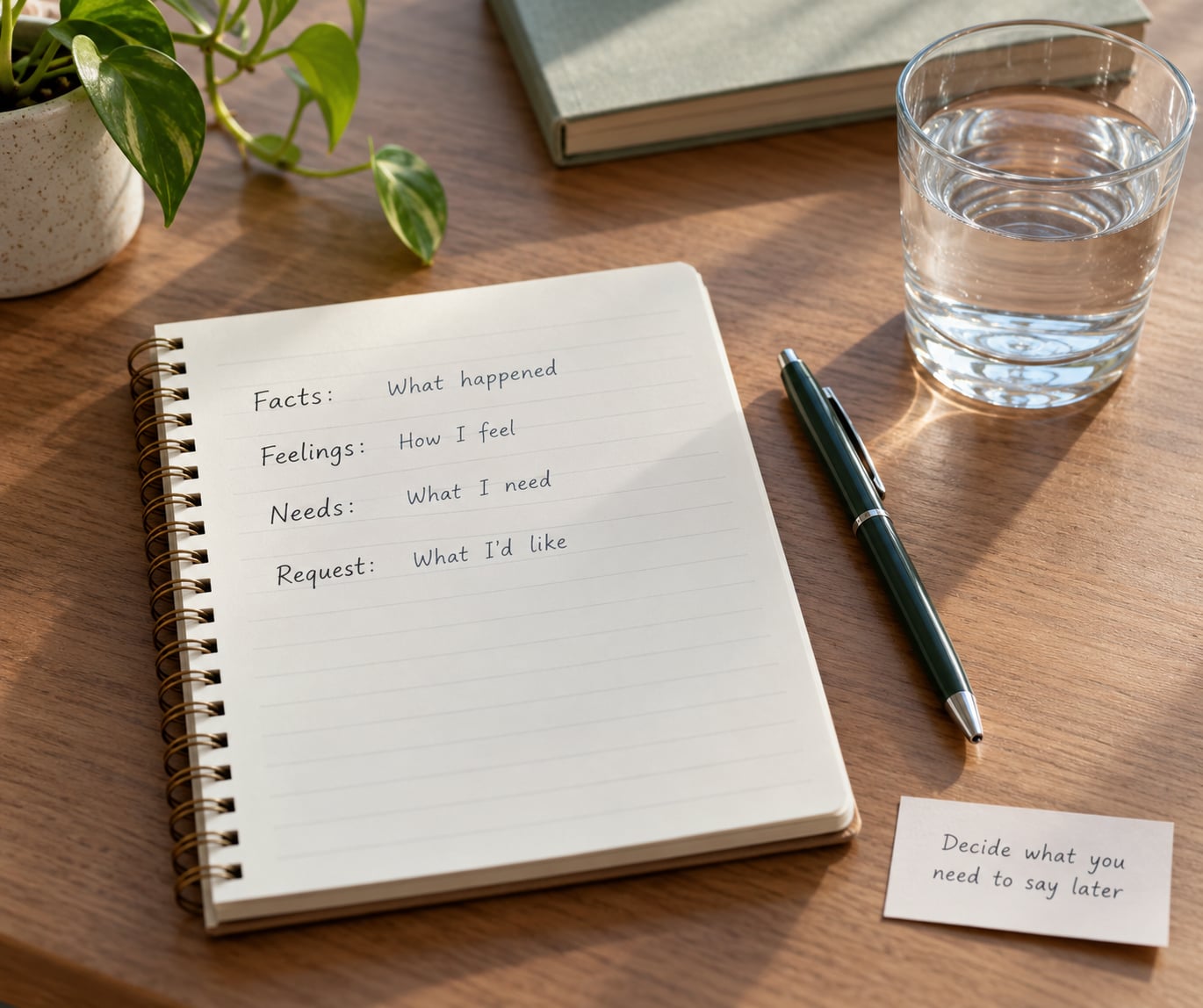
Write four short lines: what happened, what you felt, what you need, what you are asking for. Writing it rather than rehearsing it keeps the loop from running in the background.
Keep the facts line factual. “The report was late twice this week” is a fact. “You never respect my time” is an assumption with a “never” in it. Assumptions are the part that escalates a conversation, and they are easy to spot once you can see them on paper.
Drop threats and ultimatums from the draft entirely. They read as attacks and give the other person nothing to work with.
6. Return and communicate clearly
Come back at the time you named. Open low and plain: “I want to talk about the report, and I do not want to shout about it.”
Use an I-statement, a specific request, and then listen. “I felt let down when the deadline moved and I did not hear about it. I need to know earlier next time.” After the request, stop talking. Most arguments keep going because both people are still filling the silence.
If voices rise again, stop. “I am too heated. I will try again in an hour.” Repeating that once is fine. Going round the same loop three times is not.
Common Mistakes
Sending messages while activated is the most common and most expensive habit. Draft it, do not send it, and read it again after ten minutes. Most things written in the first five minutes of fury are worse than useless.
Suppressing anger rather than processing it feels like control, but pushing it down usually sends it out sideways, as snapping, sarcasm, or a bad mood that lasts an afternoon. Regulation means feeling it and choosing what you do; suppression means pretending it is not there.
Ruminating keeps the argument running without the other person present. If you notice yourself replaying the same exchange for more than about twenty minutes, the productive part is over. Write the four lines from step 5 and stop.
Alcohol is not a calming method. It dulls your judgement while keeping the arousal up, and the next morning it costs you a second round of the same fight.
Threats and ultimatums escalate faster than raised voices do, and they are much harder to walk back.
Silence used as punishment is the one that damages relationships most over time. It is not cooling off if the intention is discomfort.
Prevention is mostly unglamorous: consistent sleep, fewer caffeinated drinks in the afternoon, some movement most days, and not letting small irritations pile up unchecked for weeks. People who are already running on four hours of sleep have far less headroom to work with.
If you were taught that anger is the only emotion you are allowed to show, this is worth knowing: anger carries real information about boundary violations and unfairness. It is a signal, not a character flaw, and it works better when you can read it early rather than at the point of shouting.
Frequently Asked Questions
How can I calm down quickly when I am angry?
Speed comes from the first three moves, not from trying harder to think calmly. Put physical distance between you and the other person, make your out-breath longer than your in-breath, and drop your volume and shoulders. Ten minutes is a realistic window rather than an hour-long reset. After that, write what you want to say and come back to it. If you need help knowing how to calm down when you are angry in the first ten seconds, the pause itself is the whole skill.
Why do I feel physical symptoms when I am angry?
Anger triggers a stress response that prepares your body to act fast. Heart rate rises, breathing gets shallow, muscles tense in the jaw, neck, shoulders and hands, and blood is redirected toward the limbs. That cascade happens automatically, which is why you can notice the racing heart or the heat in your face before you notice the anger itself. The physical signs are also the earliest warning you get, and catching them early is easier than recovering from them.
Is it healthy to suppress anger instead of expressing it?
Holding anger in without any processing is generally less healthy than feeling it and responding deliberately. Suppression often leaks out as sarcasm, fatigue, snapping at people who did nothing, or a low mood that sits with you for hours. Useful anger is information about a boundary, a need, or an unfairness, and it earns its place when you can act on it calmly. The aim is regulation, not elimination: feel it, then decide what you do.
When should I seek help for anger or losing control?
Consider talking to a GP, counsellor or therapist if you regularly damage things or relationships, feel you may hurt someone, have episodes you cannot recall afterwards, or feel angry most days without a clear reason. Anger that shows up with very little sleep, racing thoughts or long mood swings deserves a medical look rather than more self-help. If you are worried about safety at home or at work, contact a support line or your local emergency number straight away. General calm-down techniques are for everyday situations, not a substitute for that conversation.
How do I apologize after I said something hurtful while angry?
Apologise within the hour while you still remember what happened, and own the specific behaviour rather than your character. “I shouted at you and called you names. That was not acceptable and I am sorry” lands better than “I am sorry if you were hurt.” Skip the explanations and the conditions for now, they turn the apology into a negotiation. Then ask what they need from you, and give them time to answer.
What to Do First
Start with the first step, not the last. Say the sentence, leave the room, and give yourself ten minutes before you decide anything. Everything else follows from that.
This is general information rather than medical advice. If anger keeps costing you relationships, work, sleep, or safety, a GP or therapist can help you find what is driving it.
Last reviewed: October 2026