The fastest way to lower car insurance premiums is to get at least three quotes for identical coverage, then change the one or two policy inputs that price your rate: your deductible, your coverage limits, and the discounts you qualify for. Shopping alone is where most of the money is, and the rest comes from a few careful decisions you can make in an afternoon.
That takes maybe two to three hours of paperwork, most of it waiting on quote replies. Rates are not one number you negotiate. They are a formula, and every input you change reprices the whole policy — which also means an input you change carelessly can cost you far more later than the premium you saved.
Two honest warnings before we start. Auto rates vary by hundreds of dollars between carriers for the same driver, the same car, and the same limits, so comparison shopping is not optional. And every tactic below has a trade-off: a lower premium usually means you are absorbing more risk yourself. Rules and rates differ by state and change over time, so treat this as a framework, not personal financial advice.
Table of Contents
- What You Need to Lower Car Insurance Premiums
- Step-by-Step: How to Lower Car Insurance Premiums
- Step 1: Build a baseline before trying to lower car insurance premiums
- Step 2: Compare quotes from multiple insurers
- Step 3: Ask about every eligible discount
- Step 4: Adjust deductibles and coverage thoughtfully
- Step 5: Reduce risk without changing who drives the car
- Step 6: Review the renewal and repeat the process each year
- Common Mistakes
- Frequently Asked Questions
- How much can I realistically save on car insurance?
- Does increasing my deductible always lower my car insurance premium?
- Can I lower my premium without dropping liability coverage?
- What car insurance discounts should I ask about?
- How often should I compare car insurance quotes?
- Will removing a driver from my policy always save money?
- Start With Two Things
What You Need to Lower Car Insurance Premiums
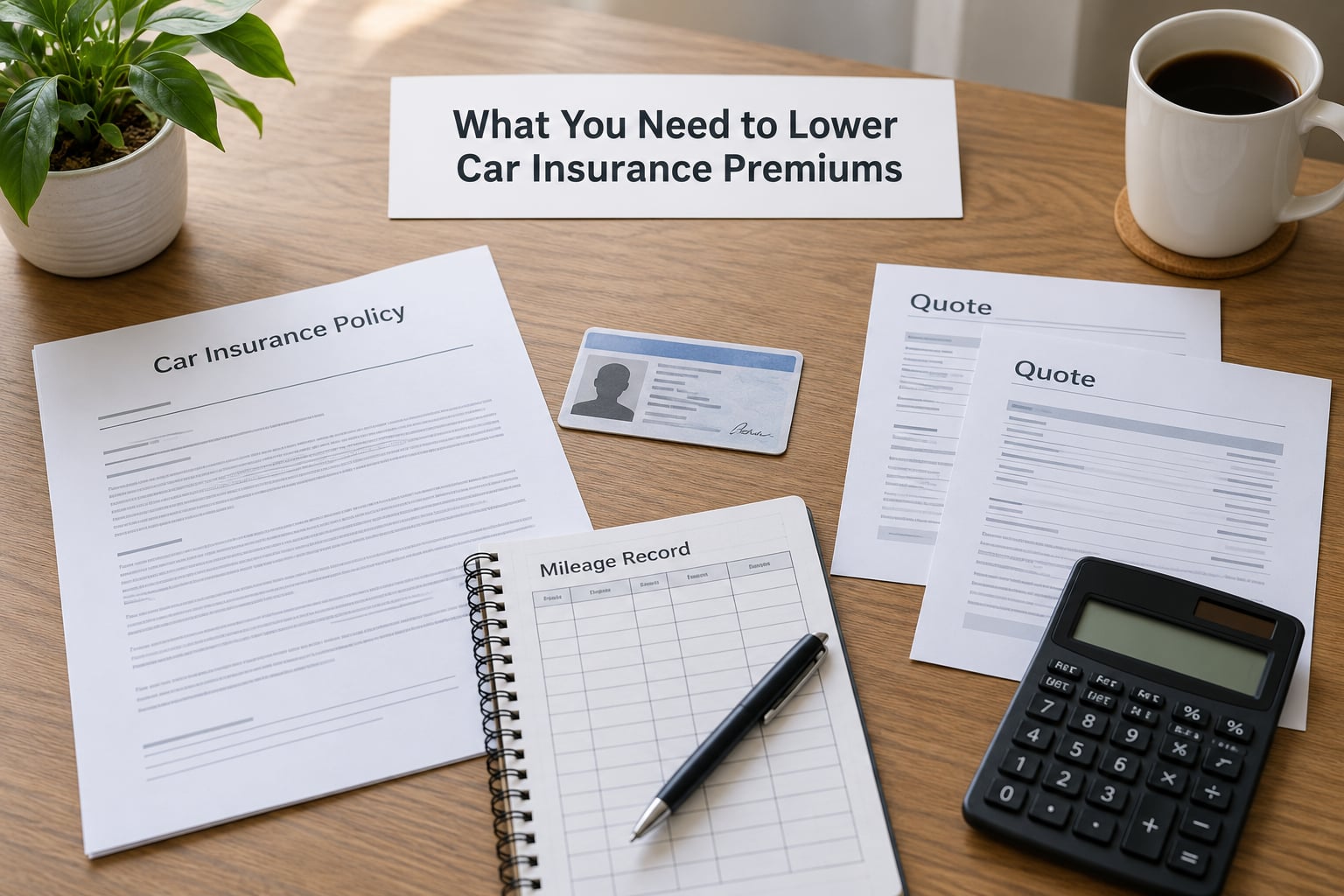
Before you change anything, pull together four things. Without them you cannot tell whether a quote is actually cheaper, because the numbers people compare are rarely the same numbers.
Your declarations page. This one-page summary at the front of your policy is the most useful document most policyholders never read. It lists your liability limits, deductibles, coverage amounts, listed drivers, listed vehicles, and the annual mileage you reported.
Your driving record. Order your own motor vehicle report rather than relying on what an insurer told you. You want to know about violations, points, and any at-fault accidents in the last three to five years before someone else tells you about them.
Your real driving numbers. Your last odometer reading, or an honest estimate of your weekly miles, plus whether anyone else in your household regularly drives the car. Mileage and the driver list are rate factors, and a wrong answer on either is a misrepresentation problem, not a savings opportunity.
A record of recent claims. Note each claim, the year, and whether it was at fault. A single at-fault claim typically affects your rate for several years, so knowing your history tells you whether now is a good year to shop or a bad one.
Have those four ready before you request a single quote. Comparing a new quote against a vague memory of what you pay is the most common way people end up with a policy that looks cheaper and is actually weaker.
Step-by-Step: How to Lower Car Insurance Premiums
The process below runs in a deliberate order for a reason. Each step depends on the one before it, and skipping ahead usually produces a quote you cannot interpret.
Step 1: Build a baseline before trying to lower car insurance premiums
Write down your current annual premium, your liability limits, your collision and comprehensive deductibles, your listed drivers and vehicles, your reported annual mileage, and your claims history. All of it is on the declarations page except the claims history.
This baseline is what makes the rest of the process work. When a new quote comes back, you compare it line by line against this sheet: same limits, same deductibles, same drivers, same vehicles, same mileage. A quote that looks 200 dollars cheaper but carries lower liability limits is not a saving. It is a different policy.
This is also the least glamorous and most repeated piece of good advice in this whole process. Copy the exact limits and deductibles off the declarations page, then make any new quote match or beat those numbers precisely. The people who get the biggest reductions at renewal are usually the ones who walked into the conversation with the paperwork, not the ones who just asked for a better rate.
You will also learn something from the exercise. If you find a coverage line you have never understood or never checked, you are in a good position to price it in step 4.
Step 2: Compare quotes from multiple insurers
Get at least three quotes and set a deadline. Use an independent agent, who can shop several carriers for you, or shop direct with carriers yourself. Either way, the number that matters is how many carriers you actually see, not who you called.
Line the quotes up in a simple grid with the columns from your baseline: limits, deductibles, drivers, vehicles, mileage, discounts applied, and total annual cost. Any quote that does not match your baseline structure gets normalized before you compare it.
Independent agents and captive agents are worth understanding here. A captive agent writes for one company, so their quote is the only quote you get from them. An independent agent can place your business with several carriers and will know which ones fit your record and territory best. Plenty of drivers find that switching to an independent agent produced their single largest annual saving, larger than anything they did on their own.
Watch for the quiet discount. Sometimes the winning quote is the same carrier at a lower price, with a paperless or autopay discount applied that your current policy never picked up. You cannot find those savings by switching companies, only by asking the question.
Best time to shop is before your renewal date, not on it. Quotes are available any time, but switching mid-term usually means starting a new policy and giving up any remaining paid premium, so aim to have a decision in hand about 30 days out.
Step 3: Ask about every eligible discount
Discounts are the easiest savings to get because they reduce the price without reducing your protection. The catch is that many are never applied unless you ask, and eligibility rules are set by each carrier.
Here is the list I would walk through with an agent, with the trade-off stated plainly so you can weigh it yourself.
| Discount | Typical range | How to qualify | Trade-off |
|---|---|---|---|
| Safe driver program | Varies widely by carrier | No violations or at-fault claims for a set period; some use a driving monitor app | Being monitored; some drivers speed up slightly to beat the threshold |
| Usage-based or telematics | Often 5 to 30 percent | Plug in a device or use an app such as Progressive Snapshot or Liberty Mutual RightTrack | You are sharing driving data; the discount depends on real behavior |
| Multiline bundling | Commonly 5 to 20 percent on the auto policy | Home, renters, life, or umbrella policy with the same carrier | Locked in; removing a policy can raise the auto rate at renewal |
| Low mileage or pay per mile | Depends on miles driven | Report accurate annual mileage; some carriers monitor it | Must report a real change each year, not just when you want a discount |
| Defensive driving course | Up to about 10 percent | Complete an approved state or provider course | Takes an afternoon; the discount usually applies at renewal |
| Good student | Often 10 to 25 percent | Full-time enrollment and a qualifying GPA, usually for drivers under 25 | Ends at 25 or when enrollment changes |
| Paperless billing | Small, usually single digits | Opt out of mailed paper and go fully electronic | No real trade-off, but you lose a paper backup |
| Autopay or pay in full | Small to mid single digits | Automatic payments, or paying the annual premium up front | Paying up front ties up cash for the year |
| Accident forgiveness | Premium waiver after one at-fault claim | Sign up with a carrier that offers it, often for a small fee | Does nothing after the second claim |
| Vehicle safety and security | Small | Factory safety systems, anti-theft device, alarm, or tracking | Retrofitting costs more than the discount is worth |
Two practical notes. First, ask for the discount in writing or on the quote, because a verbal assurance at the counter does not always make it to the declarations page. Second, stack them, because most carriers allow several at once, and the combined effect is larger than any single line.
A word on privacy. Telematics programs are the strongest discount on this list for a genuinely careful driver, and they can produce real annual savings. They also hand a detailed map of your driving to a company that may share data. That is a reasonable trade for many people and an unreasonable one for others. Decide before you install anything.
Step 4: Adjust deductibles and coverage thoughtfully
A deductible is the amount you pay out of pocket before your insurer pays on a covered claim. Raising it lowers your premium because your insurer is on the hook for less of each loss. That is the entire mechanism.
Consumer Reports has reported that moving a deductible from 500 dollars to 1,000 dollars can save around 25 percent on the premium. The number is a rough average, and the real test is arithmetic on your own situation. If you expect to go five years without a claim, a 1,000-dollar deductible is a strong candidate. If you are one fender-bender away from a needed repair, or you have no emergency fund, staying at 500 dollars is the smarter call. Drivers who raise deductibles tend to describe the same pattern: the premium savings feel great until the first claim, when the whole saving comes out of pocket in a single afternoon.
Collision and comprehensive coverage work differently from a deductible change, because it removes protection rather than shifting it. The usual rule: if the annual cost of the coverage is more than about 10 percent of what the car is worth, and you could absorb the loss yourself, the coverage may not be worth its price. On an old car worth 4,000 dollars, that threshold is around 400 dollars a year.
There are exceptions. If the car is financed or leased, the lender almost always requires collision and comprehensive, so this is not your decision to make. If the vehicle is new, has a loan, or sits in an area where theft and hail are common, the math is different. Run the numbers rather than applying the rule mechanically.
What you should not trim is liability coverage. It is the only part that protects you when you injure someone else, and buying state minimums is a decision about how much of someone else’s medical bill you are willing to carry personally. Some drivers do it deliberately; many more do it by accident and discover it during an at-fault accident. Raise the deductible instead, keep the limits at or above what you could plausibly pay, and consider umbrella coverage if your limits look thin.
If you raise a deductible, lower it again before a move, a long trip, a new driver in the house, or a season where you drive far more than usual. The same math runs in reverse, and a higher deductible is a temporary decision, not a permanent one.
Step 5: Reduce risk without changing who drives the car
Some of the levers here take months or even years to move your rate, and it is worth knowing which is which before you count on a number.
Report your mileage accurately, and report changes. If you work from home three days a week, most carriers will re-rate you on a new annual estimate, and a lower mileage figure feeds straight into the formula. This is one of the easier wins for anyone whose commute just changed.
Get the household driver list right. List everyone who regularly drives the car, including a spouse, an adult child, or a teenager who borrows it. Adding an unlisted driver can void coverage in a claim. Removing a driver who no longer drives is often the largest single saving available, sometimes cutting a grown child’s impact on the rate by roughly half. But removing someone who does occasionally drive it is misrepresentation, and the exposure is worse than the savings.
Improve the driving record. A defensive driving course helps. So does slowing down in school zones and keeping a buffer in traffic. A single at-fault accident is the most expensive event in your three-year pricing history, far more than any ticket.
Add security and safety features only if the car does not already have them. A factory-installed alarm, anti-theft device, or lane-assist system can earn a small discount at no cost, because the car already qualifies. Retrofitting equipment to chase a few dollars a year rarely pays for itself.
Watch the small claims carefully. If the damage is cheaper than your deductible plus a modest rate increase, paying out of pocket is usually the smarter move. A minor fender-bender claim can raise your rate for three or more years, which makes the repair unclaimable in practice. Know the number before the accident happens, not during.
One more rule that matters more than any tactic on this page: answer every application question truthfully. Do not leave out a household member, guess at mileage, or claim a garaging address you do not use. Insurers compare applications, and a discrepancy discovered later can lead to cancellation or a denied claim at the worst possible moment.
Step 6: Review the renewal and repeat the process each year
Put a reminder in your calendar about 60 days before your renewal date. Thirty days out, request quotes. A week before renewal, make the decision. Sixty days gives you time to act on something odd without panic, and renewal is also the moment your claim history and record have aged enough to help you.
Read the renewal notice line by line. A renewal that raised your rate sharply may reflect a change in your territory rating, a vehicle value update, a new coverage tier, or a claim you did not know was still affecting your record. Ask which factor moved. Insurers are required to state rating changes at renewal, though how clearly they do it varies.
Re-run the whole process annually, and add a review whenever something changes: a move, a new vehicle, a driver added or removed, a marriage or divorce, a change in how much you drive, a job change, or a car paid off. Most of these are rate triggers, and most carriers will not re-rate you unless you tell them.
If a renewal rate looks wrong and your agent will not explain it, escalate. Ask for the agent’s manager, then file a complaint with your state insurance department. If you believe a claim was mishandled or an incorrect rating was applied, your state regulator is the right place, and complaint volume is exactly what regulators use to spot carrier problems.
Common Mistakes
Dropping liability coverage to save money. Minimum limits are cheap for a reason. The correct trade is to raise a deductible and keep limits you could pay, not to insure the least legally allowed amount.
Comparing quotes that are not like for like. This is the expensive mistake. A quote with lower limits, higher deductibles, fewer listed drivers, or a different garaging address is a different policy. Normalize every quote to your baseline before you compare any two of them.
Failing to list household drivers. Unlisted drivers are a claim-coverage problem, not a billing problem. Adding an excluded driver is the fix, and it is usually cheap.
Chasing the monthly payment. A lower monthly charge with a shorter policy term, a higher deductible, or added fees can cost more for the year. Compare annual totals, and check whether paying in full earns a discount.
Assuming discounts are automatic. Most are not. Ask for each one by name, then confirm it appears on the quote or the declarations page before you bind the policy.
Filing small claims. A claim under the deductible is often worth handling yourself, and an at-fault claim affects your rate for years. Know your deductible number in advance so this is a decision rather than a reflex.
Letting coverage lapse. Even a short gap shows up in your history and can complicate the next policy. If you are changing insurers, set the new policy to start the day the old one ends.
Writing something inaccurate on the application. The one thing that never pays off. Guessing at mileage, omitting a driver, or listing an address you do not use in can cancel coverage when you need it most.
Two habits cover most of the list. Re-read the declarations page every time a policy changes, and shop with your baseline sheet in hand. Those two things stop nearly every expensive mistake above.
Frequently Asked Questions
How much can I realistically save on car insurance?
Savings vary widely, so set expectations before you start. Switching carriers for identical coverage is often the largest single change, and the rest comes from discounts, a higher deductible, and coverage adjustments. What you can count on is that carriers price the same driver, car, and limits very differently, which is why comparison shopping tends to produce the most reliable result. Treat any specific figure as a possibility rather than a promise.
Does increasing my deductible always lower my car insurance premium?
Usually yes, but not always, and the amount varies by carrier and coverage line. A higher deductible means your insurer covers less of each loss, so the premium falls. Consumer Reports has reported savings around 25 percent when moving from a 500-dollar to a 1,000-dollar deductible. Some carriers price the change differently across collision and comprehensive, so compare your actual quote before committing.
Can I lower my premium without dropping liability coverage?
Yes, and you should. The realistic levers are shopping multiple carriers, applying every discount you qualify for, bundling with a renters or home policy, paying in full, and raising your collision and comprehensive deductibles. Liability is the coverage that protects your assets when you injure someone else, so cutting it to save a few hundred dollars a year is the one trade most advisors warn against.
What car insurance discounts should I ask about?
Ask by name, because most are not applied automatically. Start with safe driver and usage-based programs, multiline bundling, low-mileage, defensive driving course, and good student discounts, then ask about paperless billing, autopay, paying the annual premium in full, accident forgiveness, and any safety or security feature discount your car already has. Confirm each one appears on the quote or the declarations page before you bind the policy.
How often should I compare car insurance quotes?
Once a year at minimum, about 60 days before your renewal date, and again whenever your life changes. Moves, a new vehicle, a driver added or removed, a marriage, a change in how much you drive, a job change, or paying off a car are all rate triggers. Insurers will not re-rate you for changes you do not report, so review your policy whenever one of those happens rather than waiting for renewal.
Will removing a driver from my policy always save money?
No, and the direction depends on that driver. Removing a driver who no longer drives the car often produces a large cut, because insurers price by the highest-rated driver on the policy. But some carriers recalculate the premium when the last driver leaves, and removing someone who still drives the vehicle counts as misrepresentation, which can void coverage in a claim. Update the household list whenever the real usage changes.
Start With Two Things
Take fifteen minutes tonight and pull your declarations page and your own driving record. From there, get three quotes that match your exact limits and deductibles, and let those two hours decide the answer before you touch anything else. Everything after that, from discounts to deductible math to coverage decisions, gets easier once you know what you are actually paying for now.
Rules and rates vary by state and change over time, so check the details with your insurer and your state insurance department before you make a change.