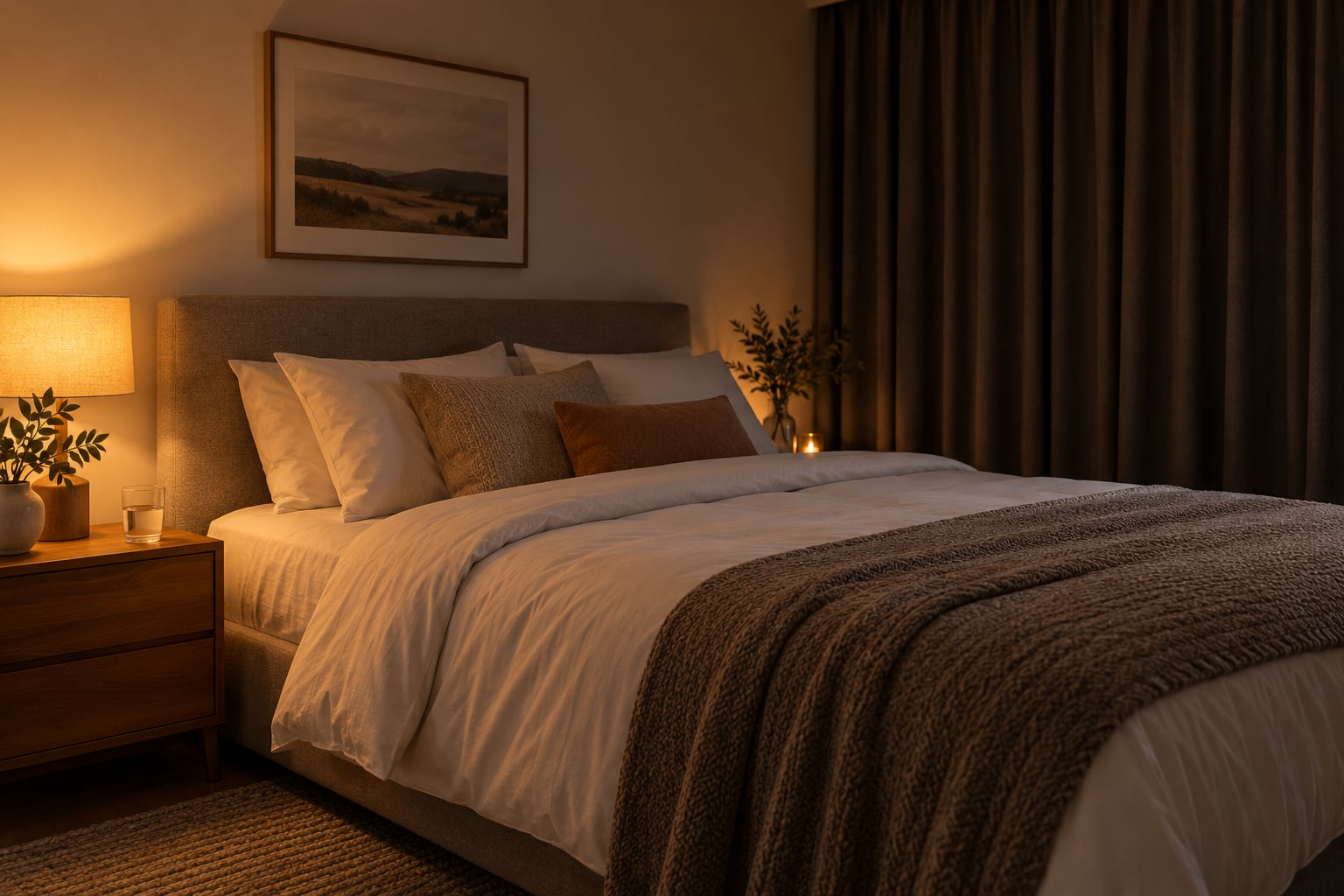
If you want to know how to improve sleep quality naturally, the short answer is three things: keep the same wake time every day, get outside light within an hour of waking, and make the bedroom cool, dark and quiet. Those three anchor your body clock. Everything else in this guide — the wind-down routine, the caffeine cutoff, the nap rules — protects the anchor.
Most people don’t need more equipment or a paid program. They need a sequence, in the right order, that holds up on a week when you are working late, caring for someone, or lying awake worrying about money. That sequence takes about four to six weeks to feel different, and the first week is usually the hardest.
I’ll walk through six steps, then the mistakes that quietly undo them. General information only, not medical advice — if sleep has been broken for months, talk to your doctor before changing anything drastic.
Table of Contents
- What You Need Before You Start
- Step-by-Step: How to Improve Sleep Quality Naturally
- Step 1: Set a Consistent Wake Time
- Step 2: Build a Relaxing Wind-Down Routine
- Step 3: Make the Bedroom Cool, Dark, and Quiet
- Step 4: Adjust Caffeine, Alcohol, and Late Meals
- Step 5: Get Regular Daylight and Movement
- Step 6: Track What Helps
- Common Mistakes That Undo All Six Steps
- Frequently Asked Questions
- How long does it take to improve sleep quality naturally?
- Is it bad to nap during the day if I sleep poorly at night?
- Can screens really affect sleep if I use them before bed?
- What should I do if I feel tired even after getting enough hours in bed?
- Does exercise help me sleep better?
- When should I see a doctor about ongoing sleep problems?
- Start With Two Things This Week
What You Need Before You Start
Almost nothing. Here’s the honest list.
A wake time you can actually keep. Pick one that works on your worst day, not your best. Seven days a week. Bedtime follows the wake time; you don’t get to negotiate it at midnight.
A room you can make dark, cool and quiet. You may need blackout curtains, a fan, or earplugs. You do not need a new mattress to start — though if yours sags and you wake up achy, that’s a separate conversation.
Two minutes of record-keeping. A cheap notebook or notes app works better than a smartwatch for this. What matters is that you write it at the same two points each day.
Two to four weeks of patience. Some changes show up in one night. The schedule and light changes take three to four weeks to lock in, because your circadian rhythm moves slowly.
Step-by-Step: How to Improve Sleep Quality Naturally
Step 1: Set a Consistent Wake Time
A fixed wake time is the single highest-leverage change, and it’s the one people skip. Your internal clock doesn’t read the clock on your wall — it reads light, food and movement cues. Hold the wake time steady and those cues line up behind it.
Keep it the same on weekends, even if that means losing an hour of Saturday. That “social jetlag” — the two-hour-plus shift between your weekday and weekend body clock — is a real driver of Monday misery, and it takes repeated weekends to build.
Within 30 minutes of waking, get outside if you can. Morning light suppresses melatonin and lifts cortisol, which is what tells your body it’s morning. Ten minutes on a balcony, a walk to the car, or standing at a bus stop counts. Overcast skies still deliver plenty; you do not need sunshine.
How you’ll know it’s working: you start feeling sleepy roughly an hour before your old bedtime, and your weekend recovery sleep shrinks from three hours to maybe one.
Step 2: Build a Relaxing Wind-Down Routine
The goal is to lower stimulation, not to perform a ritual. Thirty to sixty minutes is enough, and the content matters more than the length.
Dim the lights an hour out. Overhead and cool bulbs tell your brain it’s still afternoon, so switch to warm lamps low in the room. Put the phone in another room — not face-down on the nightstand, which is what most people try first and why it doesn’t work. A charging station in the hallway does more than any app.
Then get the day out of your head. Write down what’s unresolved and one concrete next step for each item. This is the single most effective thing I know for the 3am wake-up, because a racing mind is usually unpaid tasks, not abstract worry.
Add something slow and physical: five minutes of stretching, a shower, or a body scan where you move attention from your feet to your head and just notice, without changing anything.
A popular version of this is the 10-5-3-2-1 countdown, measured backward from your target bedtime: 10 hours before, no caffeine; 5 hours before, dinner finished; 3 hours before, work finished; 2 hours before, lights dimmed; 1 hour before, screens off. It works because it forces you to plan backward, which is hard to do otherwise.
You’ll also see the 3-3-3 rule online — no vigorous exercise within 3 hours of bed, no food, no work. It’s a popular framing, not a clinical protocol, and the evidence for the exact three-hour version is thin. Gentle stretching fits it fine. Treat the anchor wake time as the real mechanism.
How you’ll know it’s working: the gap between getting into bed and drifting off shortens over two to three weeks.
Step 3: Make the Bedroom Cool, Dark, and Quiet
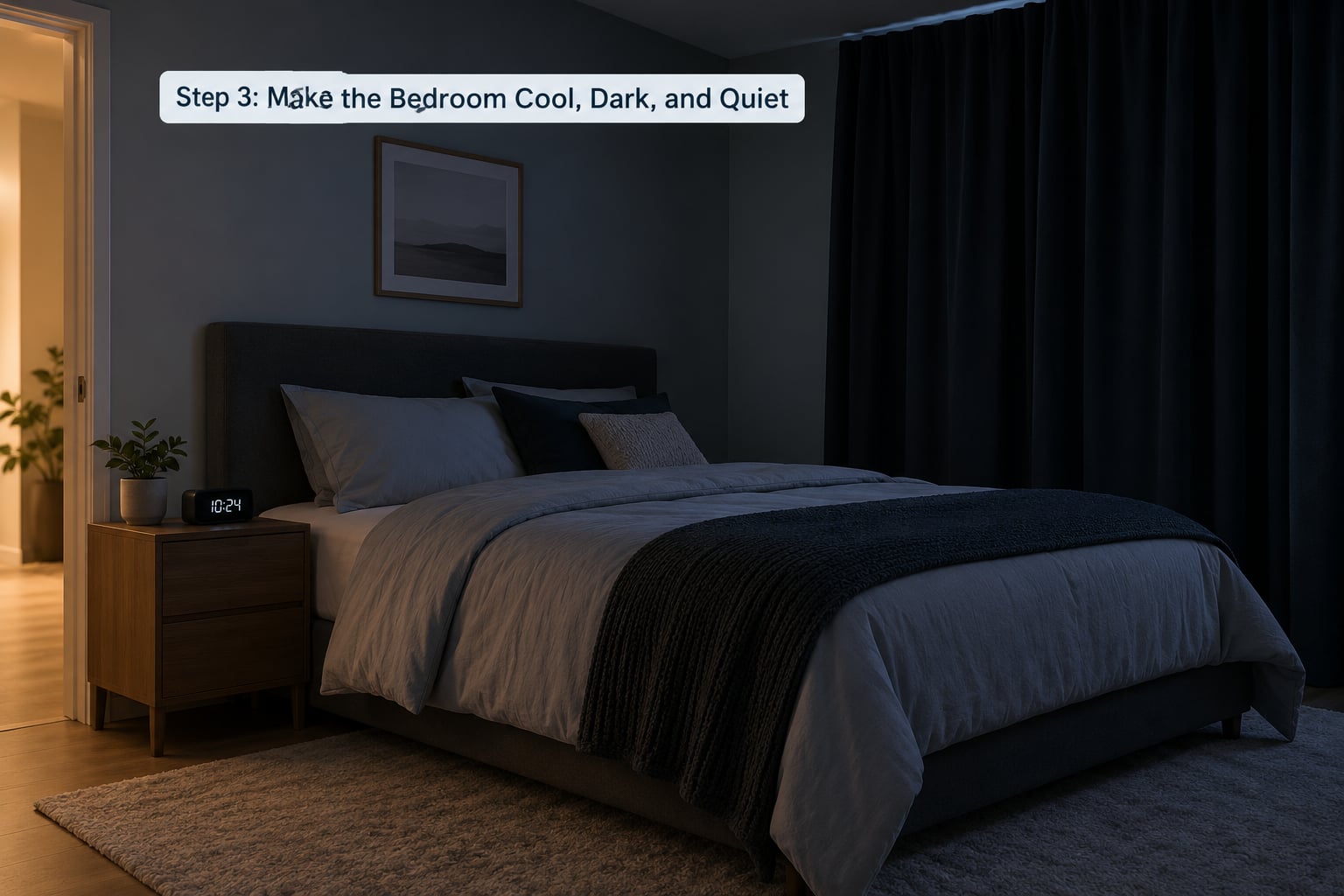
This is where most people get the fastest return, and it’s the step they skip because it feels like a nuisance. Set the thermostat between 65 and 72°F. Your core temperature has to drop for sleep to start, and a warm room blocks that drop.
On the black side: any light that isn’t a problem until it is. Streetlight through a curtain gap, a smoke detector, a standby LED, the glow from a hallway you left on. Cheap blackout panels or a fitted blackout blind fixes more than anything else in this section. A cool amber light source in the room is fine if it stays below eye level.
On noise: silence isn’t the goal, steady is. A fan, a white noise machine, or a fan pointed at the window usually beats earplugs for most people. If noise comes from a partner or a neighbor, the fix is structural — earplugs, a noise machine, a white noise fan, and conversations about phones-in-bed rather than more willpower.
On the bed itself: use it for sleep. Reading a few pages is fine. Working, watching a full series, or arguing on a video call in bed teaches your brain that bed is a place where you’re alert, and that association is hard to undo. If you only change one thing in this whole guide, change this — it’s the cheapest part of how to improve sleep quality naturally and the fastest to feel.
How you’ll know it’s working: fewer night wakings and fewer 3am wake-ups. This often shows up within the first three nights.
Step 4: Adjust Caffeine, Alcohol, and Late Meals
Caffeine has a half-life of roughly five to six hours in most adults, meaning half the dose is still in your system that long after. Four afternoon coffees add up to around 400mg, and about half of that can still be working on you at midnight. Cut caffeine at least 8 to 10 hours before bed, and if you’re sensitive, earlier. The after-midday cutoff is the change people report resolving their sleep fastest, and on r/sleep it’s one of the most repeated fixes.
Alcohol is the one people get wrong. It makes you feel drowsy, but it suppresses REM sleep in the second half of the night and fragments the back end of the night, so you wake more and feel less rested. A nightcap trades falling asleep faster for sleeping worse. A few people describe the r/sleep consensus on this as blunt: the sedative effect is real, the architecture damage is too.
On meals: finish dinner about three hours before bed if reflux or reflux-adjacent discomfort is part of your pattern. Very heavy or high-glycemic meals spike blood sugar then drop it, and that crash is felt. A small, slower snack if you’re genuinely hungry — yogurt, a small handful of nuts, oats, or a glass of milk — is more settling than nothing. Skip the “never eat after 6pm” rule, which does not fit shift work and annoys a lot of people for no gain.
Alcohol-free swaps that work: sparkling water with a squeeze of lime, a small cup of tart cherry juice, or a plain herbal tea like chamomile. None of them knock you out. They just remove the barrier.
How you’ll know it’s working: shorter time to fall asleep and fewer night wakings, typically within a week.
Step 5: Get Regular Daylight and Movement
Outdoor light during the day is what makes the nighttime darkness readable. An hour indoors under electric light gives your system a very different signal than 15 minutes outside, even on a cloudy day. Aim for outdoor light at three points: the first hour after waking, midday, and whenever your work day allows.
Movement during the day helps sleep, and the timing is flexible. Many people find moderate daytime or early-evening exercise best; vigorous sessions in the last hour or two before bed can raise heart rate and body temperature enough to delay sleep onset.
Adapt it honestly rather than dropping it. If you’re on shift work, anchor light and meals to your sleep window rather than the calendar, and keep the wake time as constant as your rota allows. If you’re caring for small children, a 15-minute walk with the stroller counts, and using daylight to mark the end of the day matters more than duration. If you have an injury, a chronic condition, or a disability, gentle movement like stretching, chair yoga, or a short swim is enough — the point is a rhythm, not a workout.
How you’ll know it’s working: you fall asleep faster even on nights when the evening routine was identical.
Step 6: Track What Helps
For two weeks, note six things: bedtime, wake time, estimated time to fall asleep, how rested you feel on a 1 to 10 scale, any nap with its time and length, and what you consumed in the last six hours. Add a line for stress, and one for the previous night’s alcohol. This is the part people skip and the part that tells you which habit is actually carrying your sleep quality.
Don’t track weight, heart rate variability, or anything else the app offers. Sleep trackers estimate stages from movement and heart rate patterns, and they are least accurate on exactly the people reading them — anyone with irregular sleep, disrupted breathing, or a genuinely variable night. Use them as a rough diary, never as a diagnosis.
At the end of two weeks, look for patterns, not numbers. Three questions carry most of the value: Does my wake time hold? On days I got outside light early, did I sleep better? Is there a time of night I reliably wake?
That last one matters more than most people realize. A normal night’s sleep runs in roughly 90-minute cycles through light, deep and REM stages, and brief wake-ups between cycles are common — especially in the last third of the night, when REM dominates and waking feels easy. If you wake at 3am and can’t get back, that’s often the cycle, not a crisis. The response is the same as the response to any wake-up: keep the wake time, stay in bed 20 minutes if you’re frustrated, and get up if you’re not.
How you’ll know it’s working: you’ll know which two changes are yours, and which four to ignore. That’s a real result.
Common Mistakes That Undo All Six Steps
Staying in bed awake for hours. Lying there frustrated trains your brain to associate bed with wakefulness. If you’re awake and frustrated, get up, do something dull in dim light, come back when sleepy.
Treating weekend lie-ins as catch-up. It pays back part of a debt and shifts your clock at the same time. One extra hour is fine. Four is a reset you’ll spend Monday undoing.
Believing alcohol is a sleep aid. Covered above. It’s the most common self-inflicted sleep disruptor on this list.
Sleeping eight-plus hours and calling it fixed. Sleep quality isn’t hours. Waking every two hours for eight hours is a different problem from sleeping six uninterrupted.
Chasing the perfect score. Obsessive tracker-watching increases sleep anxiety in the people already anxious about sleep. A diary, not a verdict.
Stacking every fix at once. Then you can’t tell which one worked. Change two things, hold for two weeks, add two more.
Buying supplements before testing. You cannot diagnose a deficiency from symptoms, and melatonin, magnesium and herbal products interact with medications. Some are also poorly dosed in the bottle itself. Ask your doctor or pharmacist first — and skip anything sold primarily as a sleep cure-all.
Assuming rules alone will fix chronic insomnia. This matters. Sleep-hygiene rules have small effect sizes on their own, and for some people a long bedtime ritual makes insomnia worse by turning bed into a performance. Clinicians who work with insomnia say the same thing: if you’ve tried the rituals for months and nothing moved, the problem is not your effort.
Waiting too long to get proper help. For chronic insomnia, the first-line treatment isn’t a sleeping pill. It’s cognitive behavioral therapy for insomnia, or CBT-I, which the American College of Physicians recommends ahead of any medication. It targets the sleep window, the bed-wake association and the anxious thinking directly, and its effects tend to outlast medication once you stop. It’s also available without a prescription referral, in structured online programs. Ask your doctor about it by name, because many people never hear it mentioned.
Frequently Asked Questions
How long does it take to improve sleep quality naturally?
Environment and alcohol changes often show up within three to seven nights. Morning light and a fixed wake time take longer, usually three to four weeks, because your circadian rhythm shifts gradually. Judge it over four to six weeks, not four nights. If you are still stuck at week six with a stable wake time and a light routine, the issue is probably not effort and it is time to ask a doctor about CBT-I.
Is it bad to nap during the day if I sleep poorly at night?
Short naps are fine and often helpful. Keep them to 10 to 20 minutes and take them before 3pm, before you get groggy rather than asleep. Longer naps and later ones pull your clock backward and are the most common reason a nap night ruins the following night. On r/sleep this rule comes up constantly as the thing people get wrong. If naps are your only decent sleep, that is worth raising with a clinician.
Can screens really affect sleep if I use them before bed?
Yes, but brightness is only part of it. Screens deliver light that suppresses melatonin, and more importantly they deliver stimulation, notifications and a stream of content that keeps you alert and engaged. An amber or night-mode filter addresses the light half. Moving the phone to another room addresses the other half better, and it is the change readers on r/sleep and r/selfimprovement report making the biggest difference.
What should I do if I feel tired even after getting enough hours in bed?
Hours alone don’t determine how restored you feel. What matters is how long you take to fall asleep, how often you wake after sleeping, how much deep and REM sleep you get, and how alert you feel within half an hour of waking. Eight fragmented hours can be worse than six solid ones. Try the six steps for two to four weeks and track how rested you feel, not just time in bed.
Does exercise help me sleep better?
Regular activity helps most people sleep better and deeper, and it also helps mood and stress, which feed back into sleep. Timing is flexible; many people do best with moderate exercise earlier in the day, while vigorous sessions in the final two hours can delay sleep onset by keeping you warm and wired. A 20 to 30 minute walk most days is plenty to see a difference. Movement counts in any form your body and schedule allow.
When should I see a doctor about ongoing sleep problems?
See a doctor if poor sleep has persisted most nights for three months or more, if you snore loudly or gasp during sleep, if you regularly wake gasping, or if sleepiness is affecting your driving or work. Also raise it sooner if you feel low or anxious most of the time, or if sleep changed clearly after an illness. Ask about CBT-I, the recommended first-line treatment for chronic insomnia, rather than starting anything on your own.
Start With Two Things This Week
Set a wake time you’ll still keep next Saturday, and get outside within an hour of waking. Those two do more than any gadget, and everything else on this list is easier once they’re in place. Add the caffeine cutoff in week two, and the room changes the week after that. That’s the honest version of how to improve sleep quality naturally: two habits held for a month, not a dozen tweaks abandoned on Sunday.
If it’s been months of bad sleep despite effort, that’s not a discipline problem. Talk to your doctor and ask specifically about CBT-I. General guidance here comes from mainstream advice published by the Mayo Clinic, Johns Hopkins Medicine, the National Sleep Foundation and the American Academy of Sleep Medicine, updated for 2026.