
If you want to know how to split holidays as co parents without the same argument every December, the answer is short: decide the rule once, write it down, and follow it. Most holiday disputes are not about fairness at all. They happen because nothing was agreed in advance, so every year turns into a fresh negotiation between two tired people.
The process below takes about an hour of prep and one calm conversation. It works whether you alternate weekends, share custody week to week, or your child lives in two states. The order matters, though: gather your facts first, compare models second, and only then talk to your co-parent.
Table of Contents
- What You Need
- How to Split Holidays as Co Parents Step by Step
- Start with the child’s needs and the existing parenting plan
- List the dates and times that must be divided
- Compare possible holiday schedules
- Check the schedule for travel and practical feasibility
- Write the plan in neutral, specific terms when you split holidays as co parents
- Review and adjust the schedule after the holiday
- Common Mistakes
- Frequently Asked Questions
- Should we split holidays exactly equally?
- Can we change the holiday schedule in our existing parenting plan?
- What if my co-parent refuses to let the child travel?
- How do we handle holidays when both sets of grandparents expect time?
- Who pays for holiday trips and gifts?
- Do I need a lawyer to agree a holiday schedule?
- A Schedule Built Around the Child
What You Need
You cannot negotiate from memory, and you cannot negotiate from the calendar your ex keeps in their head. Gather these seven things before you send a single message.
- Your current parenting plan or court order. Read the holiday clause carefully. If one exists, that is the starting point, not a blank page.
- The actual holiday dates. Christmas Eve, Christmas Day, Boxing Day, New Year’s Eve and New Year’s Day are five separate blocks, and that is where most disputes start.
- The school calendar. Winter break, spring break and any early dismissal days change when a child is actually available.
- Travel details. Distance, whether the child flies alone, typical transfer times, and who is licensed to drive them.
- Your child’s preferences. Ask about the things they care about, not the things you assume they care about. A teenager’s answer is usually about the routine, not the presents.
- A communication method. Email, a co-parenting app or a shared calendar. Not the group chat with your extended families in it.
- Any legal or custody constraints. A court order, a relocation question, supervised visitation terms or a religious obligation all limit what you can offer.
How to Split Holidays as Co Parents Step by Step
Start with the child’s needs and the existing parenting plan
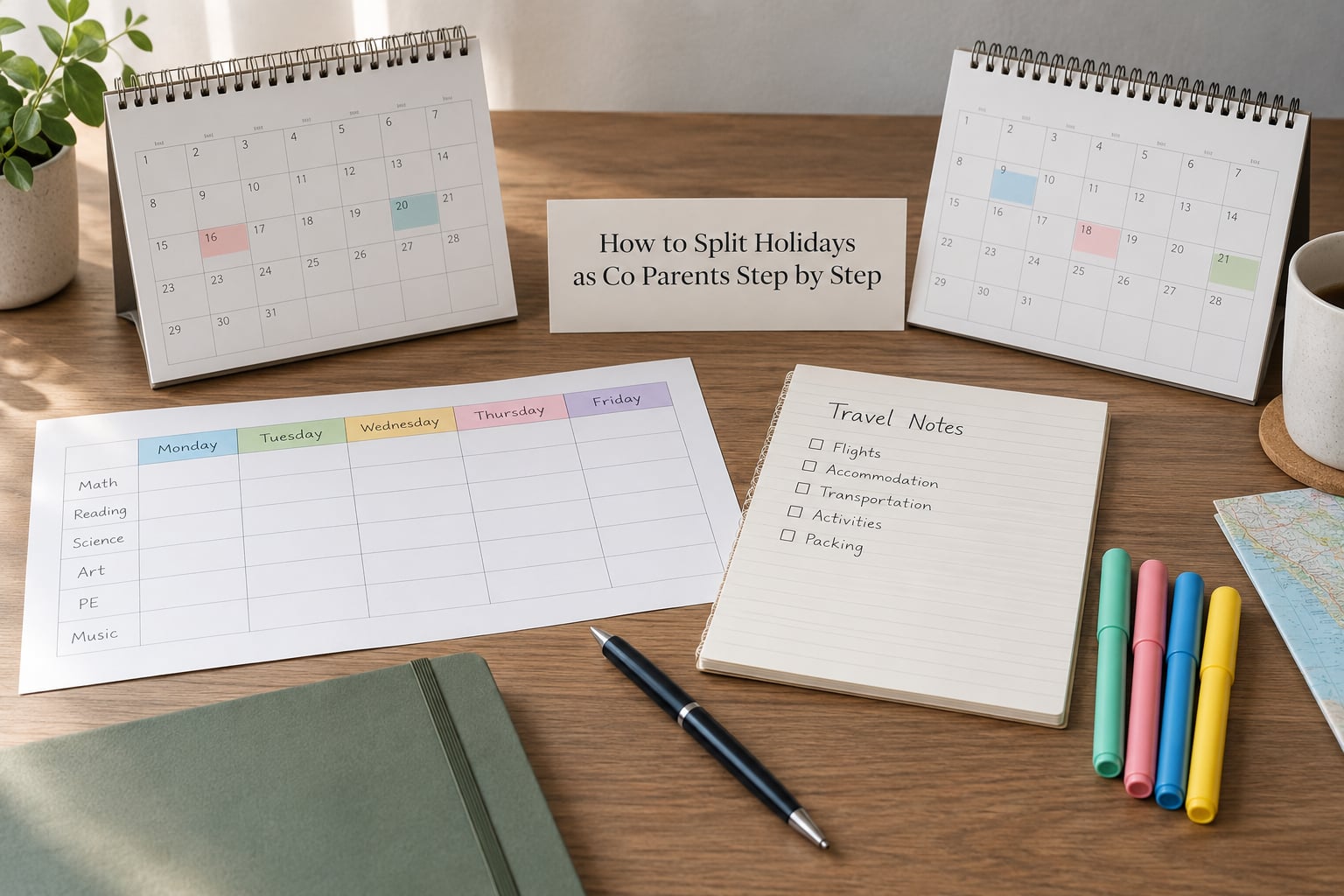
Before you propose a split, work out what the child already has. Mark school breaks, mid-week early finishes, sports finals and any recurring commitments that live on one parent’s calendar only.
Then count the time each household already has. If one parent already gets Christmas Eve because of where the child goes to school that week, that is context, not an accident to correct. Building on the existing pattern usually gets an easier yes than replacing it wholesale.
List the dates and times that must be divided
Put every contested block on one page with an exact time attached. Not “Christmas Day” but “Christmas Day, 8am to 5pm” or “December 24, 6pm pickup, return January 1, 10am”.
This is where most schedules quietly go wrong. Vague dates turn into arguments about what a word like “evening” means, usually at 9pm on the twenty-fourth while one parent is holding a travel bag.
Compare possible holiday schedules
There are four models that cover almost every family situation. Most parents end up blending two of them.
1. Alternate by year. Each parent gets Christmas Day on alternating years, and the same pattern holds for New Year, Thanksgiving and Easter. Simple, easy to remember, and the default in most parenting plans. The catch is that it leaves some years where one family is together on December 25 and the other is not.
2. Rotate major and minor holidays. Christmas, Thanksgiving and a child’s birthday stay fixed each year and alternate. Smaller dates like Mother’s Day, Father’s Day and Halloween rotate on a different cycle, sometimes every year rather than every other. This keeps the big dates fair without touching every date on the calendar.
3. Split the week or the break. One parent takes December 24 to 26, the other takes December 27 through January 1, and it flips each year. It suits long-distance parents because it halves the number of trips a child makes mid-winter, when flights get expensive and cancellations are common.
4. Split the day itself. One parent has Christmas Eve and the morning of December 25, the other has the afternoon onward. Parents on forums call this the works-well-no-drama default. It also produces the most handovers, and a child bouncing between two homes in one day is often tired by the third.
Whichever you pick, check it against a four-year cycle. A rotation that looks balanced in year one can quietly give one parent Christmas and New Year back to back for two years running. Write the full cycle down, not just the current year.
Check the schedule for travel and practical feasibility
Now be honest about distance, weather and work. A four-hour drive on the twenty-fourth with a six-year-old is a different proposition from a flight with a layover, and a schedule that is theoretically fair but physically brutal is not fair in practice.
Three checks catch most of the problems. Look at school attendance, because some families need the child in class on a specific day. Look at transfer times, and build in a buffer rather than planning a handover at the exact minute someone is due back at work. And look at whose work obligations fall in the window, then offer a swap rather than assuming the other parent will just absorb it.
Write the plan in neutral, specific terms when you split holidays as co parents
Neutral wording is the whole trick. A clause that describes behaviour reads as an attack; a clause that describes times reads as administration. Write this:
“The parties shall alternate the following holidays by calendar year, with Parent A receiving odd-numbered years and Parent B receiving even-numbered years: Thanksgiving (the Thursday and Friday), Christmas Eve (from 6:00pm on December 24), Christmas Day (from 8:00am on December 25 until 5:00pm), and New Year’s Eve and New Year’s Day combined from 6:00pm on December 31 through 10:00am on January 1. Each parent shall confirm receipt of the child by text message within two hours of any scheduled exchange. In the event one party is delayed more than two hours, the child shall remain with the scheduled receiving parent and regular contact shall resume as soon as practicable.”
Note what that does: it names the years, it names the times, it confirms the exchange, and it handles the delay without anyone having to improvise. Copy it into your parenting plan as an addendum and both sign it. Language like “reasonable contact” or “as agreed” is what brings you back to this conversation next November.
Review and adjust the schedule after the holiday
Spend fifteen minutes in the first week of January on what worked. Was the pickup time realistic? Did the child dread the handovers? Was there a day in the middle where nobody had plans for them?
Write down any changes you both agree to and update the clause before the next cycle starts. A schedule reviewed annually is a living document. One never reviewed is just the argument you had this year, waiting to happen again.
Common Mistakes
Treating the split as something to win. The moment a parent starts keeping score, hour by hour, the child feels it. Parent after parent on co-parenting forums says the fix that worked was deciding that roughly equal beats exactly equal.
Leaving travel details vague. “The child will spend Christmas with me” says nothing about who drives, when the handoff happens, or what happens if a flight is cancelled. Add the times and the buffer.
Using the child as messenger. Kids should never deliver schedule news to the other household. Send it yourself, in writing, and assume it will be repeated accurately.
Skipping the backups. Illness, weather and a sick child at both houses happen. One sentence about what happens if someone is delayed prevents a crisis conversation.
Renegotiating the whole thing every year. If you agreed a model in writing, honour it. Change the pattern only when the situation genuinely changes, like a move, a new school or a child who asks.
Counting the date as more important than the time. A date is just a date. Two days of real, calm time with both parents is worth more than one packed day with the traditional ceremony. Once a year, loosen the date.
Frequently Asked Questions
Should we split holidays exactly equally?
Aim for roughly equal, not minute-perfect. Parents who obsess over hour-level equality tend to end up trading texts until December. The practical test is whether the child gets similar quality time, similar celebrations and similar access to extended family across a two-year window. If one parent consistently gets Christmas Eve, Christmas Day and New Year, adjust the rotation rather than swapping dates back and forth each year.
Can we change the holiday schedule in our existing parenting plan?
Yes, in most cases, if both parents agree. Read the current clause first, because some orders state that holiday terms can only be changed in writing by both parties or by agreement outside court. Draft a written addendum with the new rotation, have both parents sign it, and keep a copy with your other parenting documents. If the other parent refuses and your order is already specific, that is where legal advice or mediation becomes worthwhile.
What if my co-parent refuses to let the child travel?
Check what your parenting plan or court order already says about travel, mileage limits and notice periods, then use that rather than a new argument. Most plans require a set number of days notice and sometimes prior written consent, and those terms apply over holidays like any other time. Send the request in writing with the dates, the route and the contact number for the other household, then keep the exchange. Do not let the child’s holiday become a stand-off about a clause neither of you wrote recently.
How do we handle holidays when both sets of grandparents expect time?
Decide the calendar first, then let the extended families fill it. If the grandparents on your side see the child from December 24 to 26 and those on the other side see them from December 27 to 30, the child actually gets both families and nobody has to negotiate at the last minute. Agree the split with your co-parent before any grandparent travel is booked, and put the gift plan in writing too so both sides can coordinate without you in the middle.
Who pays for holiday trips and gifts?
Agree this the same way you agree everything else: in writing, before the season starts. Common arrangements are that each parent covers the gifts for their own household, travel costs are shared 50/50, or the cost of a child travel pass is split evenly and gifts are kept roughly equal in value. Whatever you choose, define what roughly equal means, because one parent’s idea of equal and another’s rarely match without a number attached.
Do I need a lawyer to agree a holiday schedule?
Usually not, if both parents are talking and the arrangement is reasonable. A family mediator is often the cheaper middle step when the conversation keeps stalling. A family-law attorney is worth a consultation when your co-parent will not engage, when the schedule touches a court-ordered restriction, or when a move across state lines changes the arrangement. Rules about parenting time vary by state and change, so treat any general schedule as information rather than law.
One caveat before you start: this is general information, not legal advice. Parenting time rules differ by state and change over time, so check your own order or ask a local professional before you treat any schedule here as binding.
A Schedule Built Around the Child
Start with the dates. Get the holiday blocks, the school calendar and the travel details onto one page, then pick the model that fits your family’s distance and your child’s age. Propose it in writing, with times rather than intentions.
The schedules that hold up are the boring ones. Nobody remembers the December where the clause was clear, and everybody remembers the December where it was not.