If you are searching this while your heart is pounding, here is the short version: breathe in gently through your nose for a count of four, breathe out slowly through your mouth for a count of six, and repeat for six rounds without holding your breath. How to do breathwork for panic attacks is less about the perfect technique than about making your out-breath longer than your in-breath and keeping it gentle. About two minutes is enough to start.
That is the whole idea, and it works because a panic attack speeds up your breathing in a way that lowers carbon dioxide and produces the very sensations that frighten you: the tight chest, the tingling, the lightheaded spin. Slowing the breath with a longer exhale nudges your nervous system back toward rest-and-digest, and the sensations usually start to lose their edge.
This guide is written in plain language for anyone who finds the phrase “just breathe” mildly insulting. Nothing here requires equipment, a subscription, or an hour of your evening. What it does require is that you treat the practice as a tool inside a bigger picture, not a cure.
Table of Contents
- What You Need
- Step-by-Step
- How to do breathwork for panic attacks: settle into a slower rhythm
- Step 2: Lengthen the exhale without straining
- Step 3: Add a simple sensory anchor
- Step 4: Keep the practice brief and flexible
- Step 5: End by checking your state
- Common Mistakes
- Frequently Asked Questions
- Can box breathing help with a panic attack?
- Can the 4-7-8 breathing technique help with anxiety?
- Why does deep breathing sometimes make panic worse?
- How can I stop the shortness of breath during a panic attack?
- Is it safe to do 4-7-8 breathing every day?
- How long until breathing exercises actually help during a panic attack?
- Conclusion
What You Need

Nothing, really. Breathwork is one of the few self-help practices that needs no gear at all.
- A safe place to sit or stand. A chair with a back is better than standing if you feel unsteady, because you can lean into it and free your hands.
- Loose clothing. Anything tight around the ribs or waist makes it harder to notice your belly moving.
- Water, within reach. Not because the practice requires it, but because the dry, cotton-mouth feeling after adrenaline passes is unpleasant and having a glass ready makes the recovery window easier.
- Optional: a note on your phone. A timer helps if you are the kind of person who loses count, though most people do better without one.
- Optional: a trusted person nearby. If attacks tend to knock you off balance, having someone within earshot removes a layer of stress before you start.
One thing worth saying plainly: this is general information, not medical advice. If you have asthma, COPD, a heart condition, are pregnant, or are recovering from surgery, talk to your doctor before making breath-holding or deep breathing part of your routine.
Step-by-Step
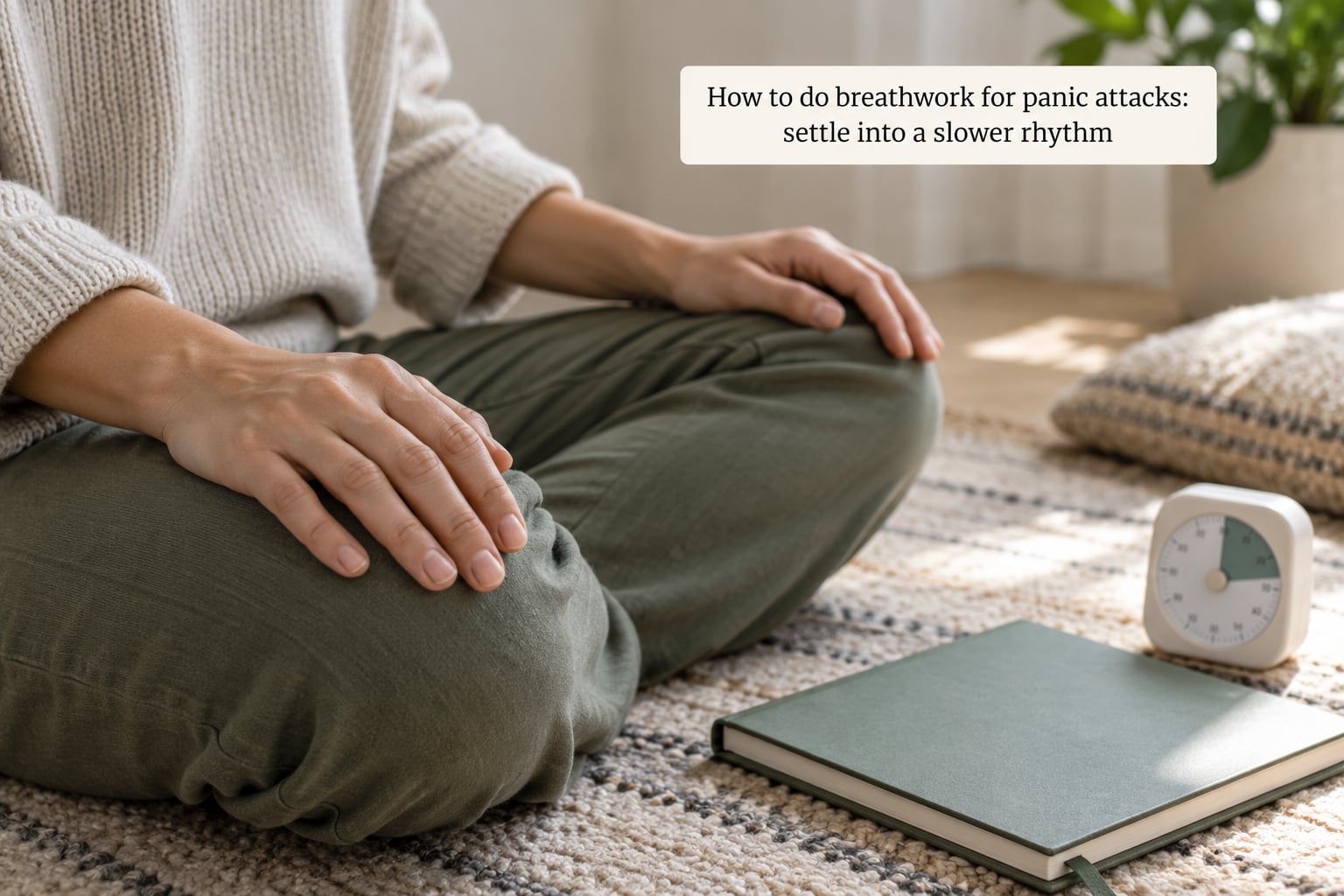
How to do breathwork for panic attacks: settle into a slower rhythm
Start before the panic peaks if you can. Rising anxiety is a much better place to practise than full-blown panic, because you can still choose your posture and your pace.
Sit with both feet flat on the floor and let your shoulders drop. Put one hand on your upper chest and one on your belly, just below your ribs. Breathe in through your nose for a count of four, easy and unforced, like you are smelling something mildly interesting.
Then breathe out slowly for a count of six, with your lips a little loose, as if blowing out through a straw. Your chest hand should barely move. The belly hand should move a little. That is the whole technique.
The count of four and six is a suggestion, not a rule. What matters is that the out-breath is roughly twice as long as the in-breath. If counting feels like extra work, drop the numbers entirely and just make the exhale long and slow. Some people find that counting heightens their awareness of their body during an attack, and for them an uncounted rhythm works better.
Do six rounds. That takes about a minute, which means you can run through it in a car, in a bathroom at work, or in bed with the lights off.
Step 2: Lengthen the exhale without straining
The exhale is where the work happens. Extending it stimulates the vagus nerve, which is the main cable of the parasympathetic nervous system, the branch that slows heart rate and softens adrenaline. One plain sentence to remember: a longer out-breath tells your body the danger has passed.
Keep it easy. Forcing a huge breath in, then squeezing the air out hard, is a common mistake that tends to make people more agitated rather than less. A gentle inhale through the nose and a slow, soft exhale is plenty of signal.
If you feel lightheaded, short of breath, or simply worse, stop the pattern immediately and return to your normal breathing. Then try a gentler version: inhale for three, exhale for six, or even inhale for three and exhale for five.
Clinicians and therapists we hear from often suggest that 3 in / 6 out or 4 in / 8 out is a good default, since it keeps the one-to-two ratio without demanding long holds.
Step 3: Add a simple sensory anchor
Breathing works better when your attention has somewhere else to rest. Pair each breath with something ordinary and dull, which is the opposite of the internal sensations panic feeds on.
Try naming five neutral things you can see without assigning them meaning: a grey cushion, a strip of tape, the edge of a door, a shadow on the floor, a chipped mug. Or press both feet into the floor and notice the contact. Or run your thumb along the edge of your phone case, back and forth, over and over.
Notice that none of these anchors ask you to feel calm. They are just a record of what is true right now, which is a different job entirely.
Step 4: Keep the practice brief and flexible
One to three minutes is a complete session. You do not need to chase a target, and longer is not automatically better. Stop while the breathing still feels manageable, not after you have pushed through discomfort.
If you cannot focus, do a shorter version: three long exhales, one breath each. That is a legitimate round, not a failure of discipline.
Aim for a slow rate where one full breath takes about five seconds. That is roughly six breaths a minute, the pace that tends to produce the most consistent heart rate variability, and it is a comfortable middle ground between normal breathing and the very slow rates that some people find woozy.
Step 5: End by checking your state
When you finish, pause for a few seconds and take an honest reading. Is the chest looser? Is the ringing or tingling fading? Has the urgency to escape dropped at all?
Some people are not helped by breathwork at all, and that is a real outcome rather than a failure of technique. What matters is that you noticed.
Take a few sips of water. Then choose deliberately: stay still, move gently with something easy like a walk around the room, or reach out to someone. In the recovery window after an attack, gentle movement often helps more than sitting rigid and watching your pulse.
Common Mistakes
Nearly every problem I hear about breathwork comes down to one behaviour: doing it too hard. Here are the recurring ones, with the fix for each.
- Breathing too deeply. Big, filling breaths can add to the air hunger and lightheadedness. Fix: aim for a small, comfortable breath that barely moves the upper chest.
- Holding the breath. The 4-7-8 and box breathing patterns both include holds, which can be genuinely uncomfortable or unsafe for people already hyperventilating. Fix: use the no-hold extended exhale instead, 4 in and 6 out.
- Counting too fast. Racing through counts keeps your heart rate up. Fix: aim for a breath every five seconds or so, and slow down if you are counting past a dozen rounds without the chest changing at all.
- Treating breathwork as a cure. It is a coping tool. Fix: keep it alongside whatever else supports you, not instead of therapy, medication, or time with a clinician.
- Pushing through severe symptoms. Forcing the pattern while you are at peak panic tends to escalate symptoms. Fix: return to normal breathing and switch to sensory grounding for a minute.
- Practising only during attacks. An unfamiliar pattern under pressure is an unfamiliar pattern. Fix: five minutes on a calm day, most days, so the breathing is already familiar when you need it.
One more worth naming: the idea that breathlessness during panic is automatically harmless. It usually is, but not always. If the breathlessness arrives without the rush of fear, arrives with chest pain that spreads, or comes with fainting, get medical attention rather than trying to breathe through it.
Frequently Asked Questions
Can box breathing help with a panic attack?
Box breathing uses four equal counts: in for 4, hold for 4, out for 4, hold for 4. It can help because it gives your mind a simple, repeatable shape to follow, which interrupts spiralling thoughts. The catch is the holds. If you are already breathing fast or feeling air-starved, the holds can increase distress, so the no-hold version, 4 in and 6 out, is usually the safer starting point during an acute attack.
Can the 4-7-8 breathing technique help with anxiety?
4-7-8 uses a longer hold than most people can manage comfortably, and its long exhale is genuinely calming for some people. Many find it too much at first, especially during an attack, because holding for seven counts while already short of breath adds tension. If it works for you when calm, it is fine to practise. If you want something for the acute moment, choose the shorter extended exhale instead.
Why does deep breathing sometimes make panic worse?
Pushing for a big, deep breath makes you breathe more than your body needs, which further lowers carbon dioxide and can worsen tingling, dizziness, and that air-hungry feeling. The technique is usually misapplied rather than ineffective. Slow down, shrink the breath, keep it comfortable, and make the exhale longer rather than the inhale bigger. If a pattern keeps escalating your symptoms, stop it and switch to sensory grounding.
How can I stop the shortness of breath during a panic attack?
Drop any breath holds first. Sit down if you can, plant both feet on the floor, and breathe in gently through your nose for a count of three. Exhale slowly for a count of six through pursed lips. Repeat about six times, without straining. If the sensation is severe, new, or comes with chest pain, fainting, or does not settle after an attack, treat it as a medical question and contact a clinician.
Is it safe to do 4-7-8 breathing every day?
For most healthy adults, gentle daily breathing practice is considered safe. It becomes a question worth raising with a doctor if you have asthma, COPD, a heart or blood pressure condition, a history of fainting, or you are pregnant, particularly because of the breath holds. Practise in a position where you could easily sit or lie down, stop if you feel lightheaded, and never practise while driving or in water.
How long until breathing exercises actually help during a panic attack?
That varies a lot, and honest answers are rare. Practising a pattern for a few minutes on a calm day often makes it easier to reach for during an attack, and people commonly report a change over weeks rather than minutes. Some people get very little from it at any point. If attacks are frequent, pushing you to avoid places, or affecting work and relationships, that is a strong reason to talk to a doctor or therapist rather than keep tuning the breathing.
Conclusion
The first thing to do is simple: get somewhere safe, sit or stand with your feet planted, and breathe comfortably through your nose. Make the out-breath longer than the in-breath, six rounds, no holds, nothing forced. If it does not feel helpful within a minute or two, stop and ground yourself instead.
Then make the habit one you practise on ordinary days, so the calm version of you already knows the pattern. And if attacks keep coming or keep you away from things you care about, talk to your doctor or a therapist about the options that fit your life. Breathwork fits inside that conversation rather than replacing it.