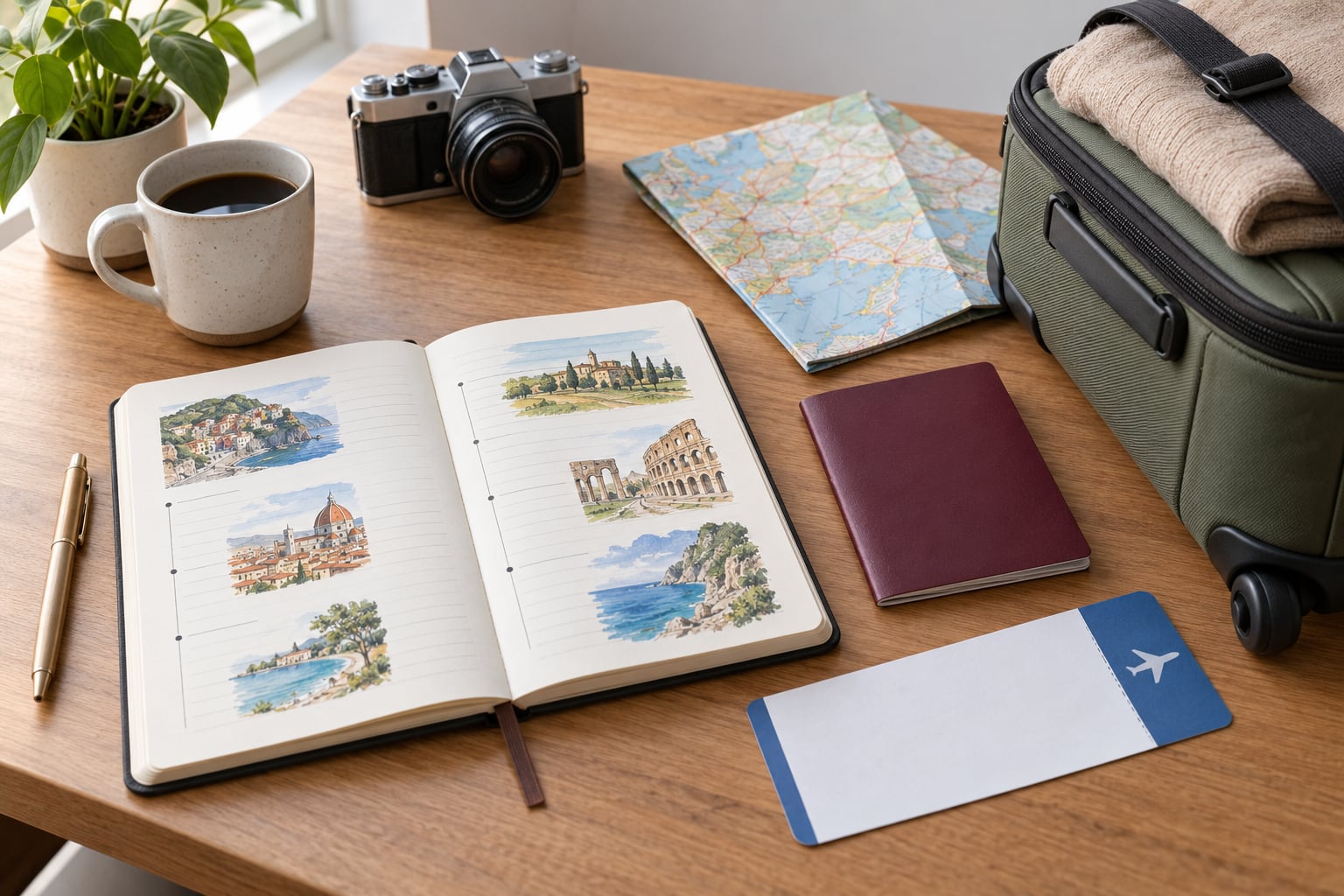
Learning how to plan a solo trip for the first time comes down to eight decisions made in the right order: define what you want, pick a destination that suits your comfort level, set a budget, book the essentials, build a loose plan, pack, set up safety and communication, then rehearse arrival day. Most first-timers get stuck because they try to answer all eight at once.
The good news is that nothing here is complicated. You can do the whole thing over a few evenings, and a trip of four to seven days gives you enough room to settle in without overcommitting. Plan the trip you actually want, not the trip you think you should want.
Before you start booking, one honest self-assessment helps more than any tool: are you choosing this trip because you want it, or because someone expects you to? The nervous feeling that shows up is normal, and it fades fastest when the trip is genuinely yours.
Table of Contents
- What You Need
- Step-by-Step
- 1. Define What You Want From the Trip
- 2. Choose a Beginner-Friendly Destination
- 3. Set a Realistic Solo Travel Budget
- 4. Book the Essentials Early
- 5. Build a Flexible Itinerary
- 6. Pack for Comfort, Safety, and Flexibility
- 7. Create a Safety and Communication Plan
- 8. Rehearse the First Day Before Departure
- Common Mistakes When You Plan a Solo Trip for the First Time
- Frequently Asked Questions
- How do I plan a solo trip for the first time without feeling overwhelmed?
- What is the safest type of destination for a first solo trip?
- Should I book flights and hotels before or after creating an itinerary?
- How much money should I budget for my first solo trip?
- Do I need travel insurance for a solo trip?
- How do I handle loneliness or unexpected problems while traveling alone?
- Conclusion
What You Need
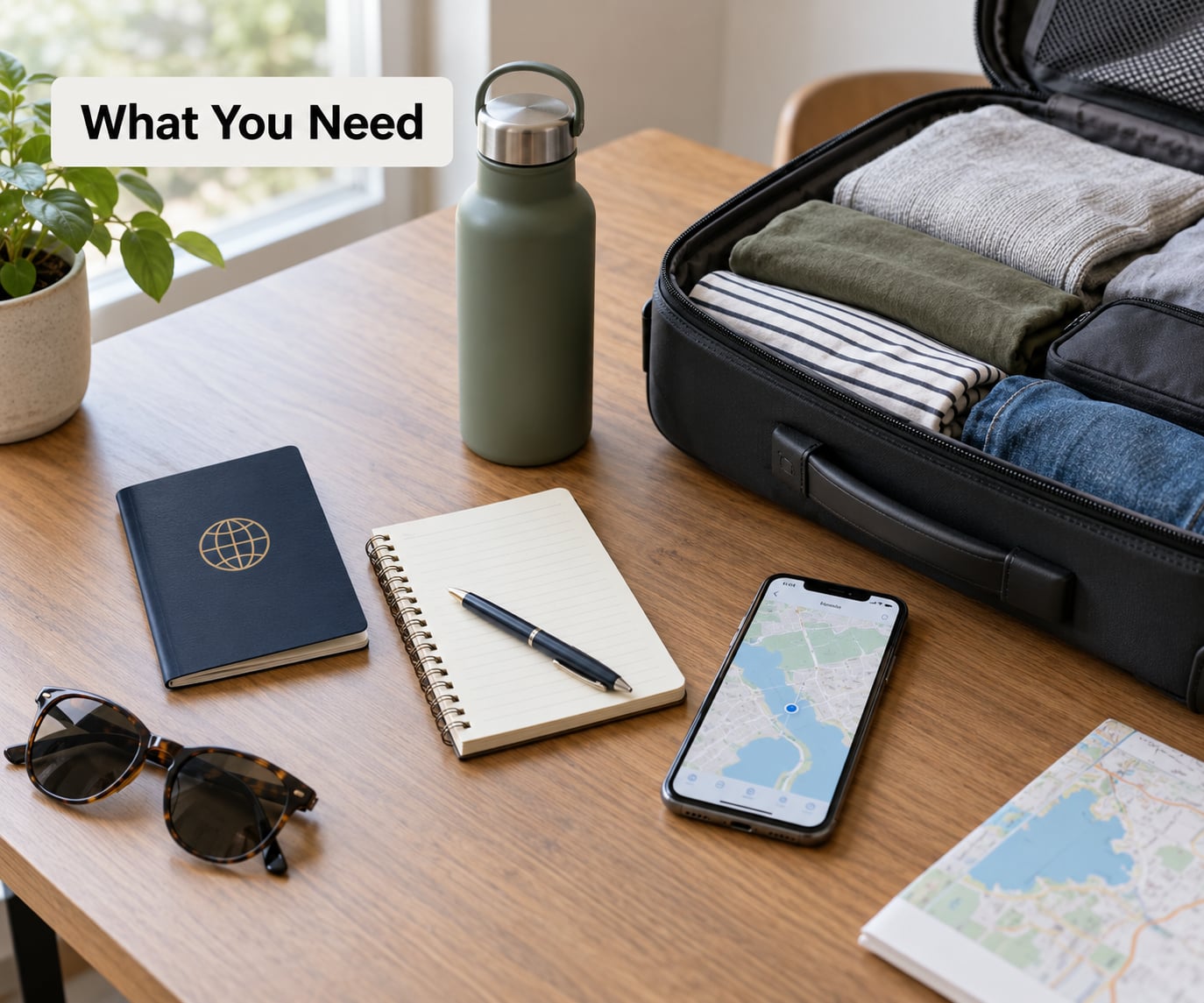
Before you look at flights, gather seven things. Missing any one of them tends to surface as stress at the worst possible moment, usually at an airport counter.
- Valid travel documents. Passport with at least six months validity beyond your return date, plus any visa or entry rules for your nationality and destination.
- A real budget number. A total you can commit to, plus a separate contingency you will not touch.
- Accommodation secured for the first two nights. Arriving somewhere unfamiliar with no room booked is the single most common beginner mistake.
- Communication tools. A working phone plan abroad, translated offline copies of your key documents, and emergency numbers written down on paper.
- Payment access. Two payment methods from different networks, so a declined card or a frozen card account does not strand you.
- A rough itinerary. Rough is the operative word. Anchor plans plus open space, not hour-by-hour scheduling.
- A named human at home. Someone who has your itinerary and your check-in schedule.
Add a printed copy of your first-night address, the local emergency number, and your insurance details. Paper matters more than people expect, because phones die at exactly the wrong moment.
Step-by-Step
Work through these in sequence. Each one shortens the next, and each has a completion test so you know it is done.
1. Define What You Want From the Trip
Start with a three-sentence answer to this: on the last evening of your first solo trip, what do you want to say you did? Not what looks impressive on social media, what you would genuinely enjoy.
Most people are carrying a mix of priorities without knowing it. Write each one down, then rank them. Rest. Food. Culture. Nature. Nightlife. Self-care. Whatever lands in your top two is what you build the trip around and what you are allowed to say no to.
Two other answers make the rest easier. Decide your energy level honestly, because a packed eight-day itinerary wears out a lot of people by day three. And pick a length: four to seven days is the sweet spot for a first solo trip. Long enough to stop counting hours, short enough that a bad weather stretch does not sink the whole thing.
Done when: you have a ranked priority list, a trip length, and an honest energy read on yourself.
One question people search for a lot: is there an age where solo travel stops working? No. Travelers in their twenties, thirties, forties and beyond all do this, and the practical constraints barely change with age. What changes is your own confidence, and that you build rather than wait for.
2. Choose a Beginner-Friendly Destination
Your first destination should be easy, not impressive. You are testing a new skill, so remove friction wherever you can.
Score candidates on six things: transport connections, language, safety, cost, attractions, and social atmosphere. Then match the winner to your experience level, mobility, budget and comfort with being alone.
- Transport. A city with a working metro or frequent buses beats three bus changes. Direct flights beat layovers.
- Language. English widely spoken removes a whole layer of anxiety. Learning five local phrases helps even there.
- Safety. Check your own government’s travel advisory, not only blog lists. Read it with your actual profile in mind.
- Cost. Shoulder season and weekday travel change cost far more than which city you pick.
- Attractions. Somewhere with things to do in bad weather removes your biggest contingency headache.
- Social atmosphere. Hostels, classes and walking tours give you built-in chances to meet people without forcing it.
A weekend trip in a city you can reach by car or train is a legitimate first solo trip. Plenty of people build confidence that way and move to a longer international trip next. Check flight forums and Reddit r/solotravel threads for honest recent reports on a shortlist, since firsthand accounts beat guidebooks on the details that matter.
Done when: you have one destination and one backup, and you can say in one sentence why the first one fits your priorities.
3. Set a Realistic Solo Travel Budget
Work out your total, then split it into shares rather than guessing line items. For most first solo trips in the US, a common split is roughly a third for flights and local transport, a third for lodging, a fifth for food, and the remainder for activities, insurance, and a contingency you do not plan to spend.
Build the number from your own history, not from an average someone published. Look at three months of your actual spending and decide what that trip replaces. Then check the costs that rise in peak season: flights and lodging climb during school holidays and local festivals, while shoulder weeks often cost noticeably less and come with thinner crowds.
Keep your contingency separate, ideally in a second account or card. Solo travelers who track spending from day one tend to come home without the post-trip financial stress that ruins the afterglow. Reviewers on travel forums repeat this constantly: the trip you cannot afford is worse than the trip you take.
Finally, price in the solo-specific costs nobody mentions: single supplements on cruises and group tours, rideshare home from late venues, laundry, and tips in places where tipping is expected.
Done when: you have a total, a category split, and a contingency you have physically separated.
4. Book the Essentials Early
Compare flights, accommodation, transit passes and activities. Timing depends on destination and season, so there is no universal booking window, only habits that reduce regret.
- Set fare alerts on a flight search tool and wait for a fare that fits your number, then book directly with the airline.
- Compare multi-city and open-jaw itineraries, which let you arrive in one city and leave from another without backtracking.
- For lodging, read recent reviews filtered for solo travelers and check the neighborhood on a map at the hour you will actually be there.
- Note the cancellation policy, the deposit, and what happens if your flight is cancelled.
- Save every confirmation email offline, including the property’s address and phone number.
You can also use AI assistants to draft a shortlist or pressure-test an itinerary, and travelers ask about it constantly. Treat the output as a draft to check, not a fact source. Verify opening hours, visa rules, prices and transport details against official sources before you act on anything.
Done when: flights, the first two nights, and onward transport are booked, and every confirmation is saved offline.
5. Build a Flexible Itinerary
A good first solo itinerary has one anchor activity per day, one optional second thing, a meal plan, transit time between them, and honest downtime. Two or three anchor days plus a couple of half-days is plenty.
Leave gaps on purpose. Jet lag, weather, a museum that is closed, a train strike, a slow lunch you liked too much to leave, these all happen. Travelers who over-plan describe the same feeling: running behind schedule all day and enjoying nothing.
Block a low-effort first morning and a low-effort last day. Both ends of a trip run on a different clock than the middle, and your energy knows it. Download offline maps before you land, and download them for the whole trip rather than city by city.
Done when: every day has one anchor and one optional item, and at least two days have real free space.
6. Pack for Comfort, Safety, and Flexibility
Pack for the trip you planned, then adjust for the actual forecast, airline rules and local conditions. A generic list copied off the internet is worse than useless when it ignores your shoes or the season.
A working framework for a first solo trip: one carry-on plus a personal item, five days of base clothing and laundry in between, two pairs of broken-in shoes at most, and layers you can add or remove in a day.
- Documents, plus two separate sets of digital copies and one printed set.
- Health items and any medication in original packaging, with a prescription copy.
- Chargers, a power bank, a universal adapter, and offline copies of maps and bookings.
- Small security measures: a crossbody bag that zips or fastens, a luggage lock, and a discreet money pouch worn under clothing.
- Comfort items for the first 24 hours, because settling in is harder than it should be.
Leave the third pair of shoes and the full-size toiletries behind. Travelers almost never regret packing less, and they regularly regret carrying a bag they cannot lift onto a rack alone.
Done when: you can lift and manage every bag by yourself, and nothing important sits in checked luggage if you fly carry-on only.
7. Create a Safety and Communication Plan
Safety planning is preparation, not paranoia. It is also the piece beginners most often skip and most often wish they had.
- Share your itinerary, accommodation addresses and flight numbers with your named contact at home.
- Set daily check-in times, and define what triggers concern if a check-in is missed.
- Save local emergency numbers, your embassy or consulate contact, and your insurer’s help line offline.
- Turn on two-factor authentication before you travel, and store a backup of your phone’s authentication method somewhere other than the phone.
- Know the backup plan for a missed train or cancelled flight: the next departure, a refund process, and where you sleep if you are stuck overnight.
Awareness helps every traveler, and different travelers carry different risks that they have practised responding to. Women, Black travelers, LGBTQ+ travelers, disabled travelers and anyone with a specific medical condition all have well-documented situations where local advice and local community knowledge beat generic checklists. Ask people who have been, and check whether your government offers an enrollment program for travelers.
Trust your gut. The recurring thread across solo travel forums is that your own discomfort signal is the most reliable safety tool you carry. A quick glance back, a change of route, or leaving a venue early is always allowed, and nobody owes you an explanation.
Done when: one person at home knows where you are, and you can name your plan for a missed connection without panicking.
8. Rehearse the First Day Before Departure
Write out arrival day as a script, because the first 24 hours are consistently the hardest. Travelers describe them as the settling-in stretch that everyone survives and nobody enjoys.
Cover the whole chain in writing: how you get from the airport or station to your accommodation, how long transit usually takes, the check-in process, where your first payment method lives, and what you will eat. Then plan the first evening as something small and easy, close to where you are staying.
One genuinely good first-day trick is a booked guided walking tour or a class on day two. It gives you structure and one conversation, then leaves you free afterward. You do not have to be social on arrival; you just have to get oriented.
If your nerves are running high in the days before departure, do a solo practice day at home. Take yourself to an unfamiliar neighborhood, eat at a counter-service place alone, book something small, and get home by yourself. It sounds trivial, and it works exactly as well as it sounds for people who have never eaten a meal alone in public.
Done when: you could get from the arrival gate to a bed and a meal with no improvising.
Common Mistakes When You Plan a Solo Trip for the First Time
Almost every first solo trip mistake has a cheap fix.
- Over-planning every hour. Fix: one anchor per day, one optional, plenty of gap. Flexibility is what makes the trip enjoyable.
- Choosing an ambitious destination. Fix: somewhere with easy transport, familiar language or wide English use, and things to do indoors.
- Booking without confirming details. Fix: read the address, cancellation terms and deposit before paying, then save the confirmation offline.
- Spending the entire budget upfront. Fix: keep a live balance and a separate contingency you do not tap.
- Packing for every possibility. Fix: carry-on only, layers, one extra pair of shoes maximum.
- Ignoring local conditions. Fix: check the forecast, the advisory, local transit, and what is actually open in your travel week.
- Skipping the social support. Fix: tell someone your itinerary, set check-ins, and say clearly when you expect to be reachable.
- Treating loneliness as failure. Fix: build one low-effort social anchor per day, and accept that quiet evenings are part of the trip, not a sign something went wrong.
A few final habits. Track spending from the first day. Carry a small paper notebook for things you want to remember rather than posting. And talk to someone who has been to your destination recently, because firsthand detail beats any guide.
Frequently Asked Questions
How do I plan a solo trip for the first time without feeling overwhelmed?
Break it into eight decisions and take them one at a time: trip style, destination, budget, bookings, itinerary, packing, safety plan, and arrival day rehearsal. Do not research all eight in one sitting. Travelers on solo travel forums consistently say the overwhelm comes from starting with flights and forums instead of finishing one step before opening the next.
What is the safest type of destination for a first solo trip?
A mid-size city with easy public transport, frequent flights or train links, widely spoken English or English signage, and plenty to do indoors. Safety matters more than excitement on a first trip, because a bad day needs somewhere easy to retreat to. Check your own government’s travel advisory, then read recent firsthand accounts for your specific traveler profile.
Should I book flights and hotels before or after creating an itinerary?
Book flights first, because they set your dates and the shape of the trip. Book the first two nights of accommodation immediately after, so you have a confirmed address on arrival. Build the full itinerary after both are locked, and keep it loose with one anchor activity per day rather than scheduling every hour.
How much money should I budget for my first solo trip?
Build a total from your own spending rather than an average, then split it: roughly a third for flights and transport, a third for lodging, a fifth for food, and the rest for activities, insurance and a contingency. Add solo-specific costs like single supplements, late rideshares and laundry. Keep the contingency in a separate account you do not plan to tap.
Do I need travel insurance for a solo trip?
It is worth considering, because solo travelers handle problems alone and some incidents get expensive fast. Look for medical and evacuation coverage, trip delay and interruption, and activity cover if you plan anything adventurous. Check whether your health insurance already covers you abroad, and read the excess carefully. Buy before you travel, not after something goes wrong.
How do I handle loneliness or unexpected problems while traveling alone?
Loneliness usually peaks in the first 24 hours and eases once you have a routine, so plan one low-effort social anchor per day, such as a walking tour, a class or a hostel event. For real problems, message your contact at home, use your insurer’s help line, and ask a local host or venue for help. Solo travelers say the practical support is usually better than it felt in advance.
Conclusion
If you take three actions this week, take these: choose one beginner-friendly destination and one backup, set a real budget number with a separate contingency, and build a loose itinerary with one anchor activity per day. Everything else, packing, safety plan, arrival day, follows from those three.
Start with a trip you can comfortably manage, not the trip that looks best from the outside. Comfort and preparation beat perfection every time, and your first solo trip should end with a plan for the second one already forming in your head.