
To maintain friendships after becoming a parent, be the one who keeps the door open: send the message, propose a plan that fits around your child’s day, and aim for a rhythm you can keep on a tired week. Most friendships fade because capacity changed, not because feelings did, and a small number of reliable connections beats a large circle of occasional ones.
This guide breaks that down into six steps you can start this week, whatever your situation. It works for stay-at-home parents, working parents, fathers, adopters, co-parents and solo parents, because the mechanics are the same even when the details are not.
A word on expectations first. Losing touch with someone is not evidence that they stopped caring about you, and drifting rarely happens to just one side. Both people assume the other lost interest, and the gap sits there until someone breaks it.
Table of Contents
- How to Maintain Friendships After Becoming a Parent: Step by Step
- 1. Reassess What Meaningful Connection Looks Like
- 2. Tell Your Friends About the Changes Without Apologizing
- 3. Create a Contact Rhythm You Can Keep
- 4. Make Low-Effort Ways to Spend Time Together
- 5. Ask for Specific Support When You Need It
- 6. Keep the Friendship Two-Way After Becoming a Parent
- Common Mistakes New Parents Make With Friendships
- Frequently Asked Questions
- How often should I contact my friends after becoming a parent?
- What if I no longer have time to meet with my friends?
- How do I tell my friends that parenting has changed my availability?
- How can I maintain friendships when I have little energy?
- What if my friends do not understand how tired and overwhelmed I am?
- How do I keep a friendship two-way after becoming a parent?
- Conclusion
How to Maintain Friendships After Becoming a Parent: Step by Step
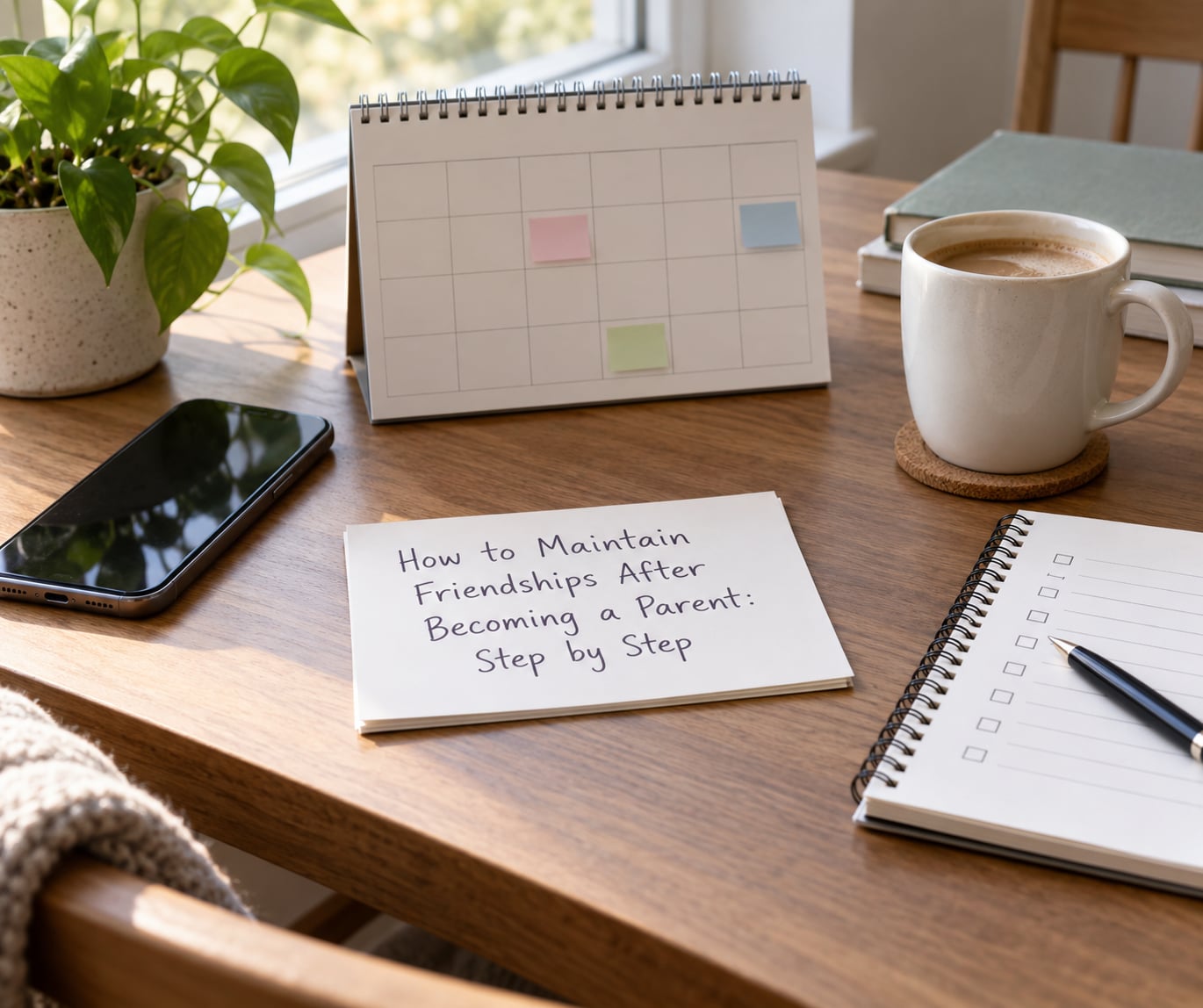
Each step below builds on the last. Skipping ahead is fine, but the first two do most of the work because they set expectations before anyone has to be disappointed.
1. Reassess What Meaningful Connection Looks Like
Most new parents assume they need to keep everything the same, so they end up maintaining nothing well. Instead, decide what kind of contact actually keeps you steady, and drop the rest for now.
There are five common versions. Someone for honesty at 9pm when the day went sideways. Someone for practical help, like a spare pair of hands or a meal. Someone for fun, where the point is laughing rather than talking about anything heavy. Someone for the long view, who has known you for decades and needs no maintenance. And someone new, built around the current season of your life.
Most people can sustain two or three of those. Write down which two, because that list is your real target for the year.
2. Tell Your Friends About the Changes Without Apologizing
The fastest way to lose friends as a new parent is to go quiet and let them assume the worst. A short, honest message costs you two minutes and does more than three cancelled plans in a row.
Say what changed, name one thing you can still do, and skip the apology. Something like: things have been full since the baby came, and I have less in me for late nights, but I am free on Sunday mornings and I would love to see you. That version gives your friend a real opening instead of a polite rejection.
Parents on parenting forums describe the same pattern repeatedly: the friendships that survived were the ones where somebody said out loud what had changed. The silent ones got misread as disinterest, and by the time the parent had capacity again, months had passed.
3. Create a Contact Rhythm You Can Keep
Pick a frequency based on your worst week, not your best one. If a weekly call only happens when things go well, it is not a rhythm, it is a wish.
- Weekly: one call, one walk, or one short visit with a close friend. Thirty minutes counts.
- Twice a month: a standing slot, like a Sunday coffee or a Thursday evening phone call, so nobody has to negotiate.
- Monthly: one longer plan with a wider group, ideally something with a built-in activity so conversation is not the whole job.
- Seasonal: a few times a year for the friends who share history but not daily life. Holidays, birthdays, a big match.
Write the rhythm down and tell your friends what it is. A stated low bar gets met; an unstated one gets disappointed.
4. Make Low-Effort Ways to Spend Time Together
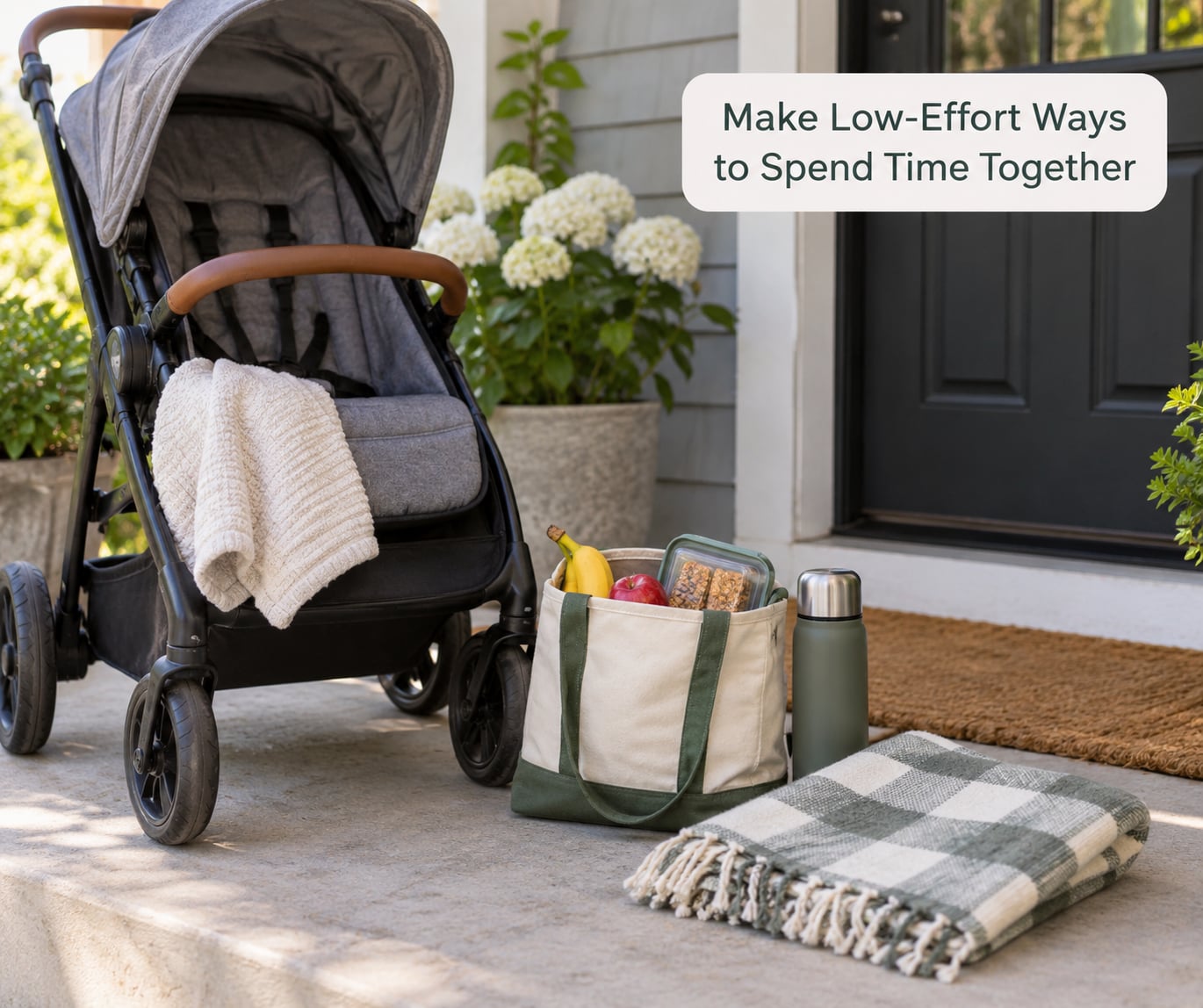
Build the activity around your child’s schedule instead of against it. The plans that survive infancy are short, repeatable and close to home, and the plans that do not survive are the ones that need a restaurant booking and a babysitter.
Some that work: coffee on the porch while the baby naps, a stroller walk with a friend who walks slowly enough to talk, a shared meal at your house where the kids eat something messy and you eat last, a phone walk where you both walk and never have to look at each other, or a ten-minute visit with a clear ending time.
The ten-minute visit is underrated. People decline an open-ended afternoon and accept ten minutes with no obligation, so you get contact without a negotiation.
Whatever you choose, make the plan specific. “Let us hang out soon” gets no reply. “Thursday at 10, coffee outside the library, twenty minutes” gets a yes.
5. Ask for Specific Support When You Need It
General offers rarely survive. Parents report that the requests that got answered asked for one concrete thing with a date attached.
Try a named ask: could you bring dinner Thursday and drop it at the door, so I do not have to host. Could you take my daughter for an hour on Saturday so I can sleep. Could you tell me what to do about the feeding, because I have run out of ideas.
Add the one sentence that keeps it from becoming a debt: I know you have your own life, and I am asking because I genuinely cannot do this one alone right now. That phrasing leaves room for a no, which is exactly why it usually gets a yes.
Keep a list of who gave you what. Reciprocity does not have to be immediate, but it does have to exist eventually, and most parents are far better at receiving than they think.
6. Keep the Friendship Two-Way After Becoming a Parent
The most common way friendships quietly end is not a fight. It is months of one person listening while the other talks about their own life.
Track your friend’s news the way they used to and respond to it: the job they hated, the sibling drama, the move, the thing they were proud of. You do not need a long reply. A question about the thing they mentioned last month does more than a weekly thumbs-up.
Ask about their children by name. Remember the school play they mentioned, or the difficult colleague they mentioned twice. These details are the proof that you are still paying attention, and attention is the whole mechanism of adult friendship.
Once a year, ask each friend one question you genuinely want the answer to. It keeps the relationship from becoming only logistics.
Common Mistakes New Parents Make With Friendships
Nearly every problem new parents have with their friends traces back to one of five habits. Each has a simple fix.
Cancelling repeatedly without offering an alternative. A cancellation with no replacement feels like a rejection, and after two or three in a row most people stop offering. Fix it by attaching a new date in the same message: cannot make Saturday, but Sunday at ten works, want to?
Letting resentment build until contact stops entirely. When a friend never asks how you are coping, the disappointment accumulates until you find an excuse not to reply. Fix it by naming it once, calmly: I have noticed nobody has asked how we are doing, and I have been reading it as not caring. Most people adjust immediately.
Overexplaining why you cannot come. A long apology reads like you did something wrong. Fix it with one sentence and one alternative.
Treating every missed plan as evidence about the friendship. Sometimes a person is dealing with their own move, illness, or new baby. One dead weekend means nothing on its own.
Becoming only useful to each other. A circle that has collapsed into childcare swaps and meal trains can feel like a service agreement. Parents who report feeling lonely even inside a busy mom group usually mean there is nobody in the room they could just enjoy.
A few more habits that help: put yourself in repeated situations with adults rather than waiting to be noticed, since that advice comes up more than anything else on parenting forums. Decouple your adult friendships from your children’s social circle, so a kids’ falling-out cannot end the friendship. Consider fading one person while keeping the wider group, which is what the best advice in a long dcurbanmom thread settles on. And if you are a father or a non-mother caregiver, put yourself in your own regular rooms, because parent groups tend to assume a mom audience and quietly exclude everyone else.
Frequently Asked Questions
How often should I contact my friends after becoming a parent?
Pick a rhythm you could keep on your worst week. Weekly contact suits one or two close friends, twice a month works for a standing call or coffee, and monthly suits a wider group. Tell your friends what the rhythm is so nobody is guessing, and treat a missed week as normal rather than as a failure on either side.
What if I no longer have time to meet with my friends?
Change what meeting looks like rather than dropping the friendship. A ten-minute visit, a stroller walk, a phone call while cooking, or a shared meal at your house takes a fraction of the time an evening out does. Send the message, name a day, and keep it short. Contact frequency can drop a lot before the friendship actually breaks.
How do I tell my friends that parenting has changed my availability?
Say what changed, name one thing you can still do, and skip the apology. Try: things have been full since the baby came, I have less in me for late nights, but Sunday mornings work well for me. Announcing the new season is what keeps friendships intact, because silence gets read as disinterest and neither side wants to be the one who stopped caring.
How can I maintain friendships when I have little energy?
Use lower-cost rituals when your energy is low, not only when it is plentiful. A standing weekly voice note, a group chat that stays active, a shared playlist, or a rotating dinner once a month all count as contact. The goal is reliability, not quality: a friend who hears from you every week in some small form keeps the relationship alive through the exhausting stretches.
What if my friends do not understand how tired and overwhelmed I am?
Say it plainly once, then show them what helps. Many friends want to support you and simply do not know what useful looks like, so tell them directly: I am exhausted, and I need a meal and an hour of sleep rather than advice. If someone hears you and keeps treating you the same way, that is information about the friendship, not a failure on your part.
How do I keep a friendship two-way after becoming a parent?
Stay curious about their life, not just yours. Ask about the specific things they mentioned, remember names and dates, and celebrate their wins even when you are tired. Aim to listen as much as you tell. The friendships that last through parenthood tend to be the ones where both people still show up in small ways, rather than one becoming a permanent support desk.
Conclusion
Start with one friend and one honest message. Tell them what has changed, name the time you actually have free, and agree on a rhythm you could keep through a bad week rather than a good one. That single conversation is usually the whole gap between drifting and staying close, and it takes five minutes.