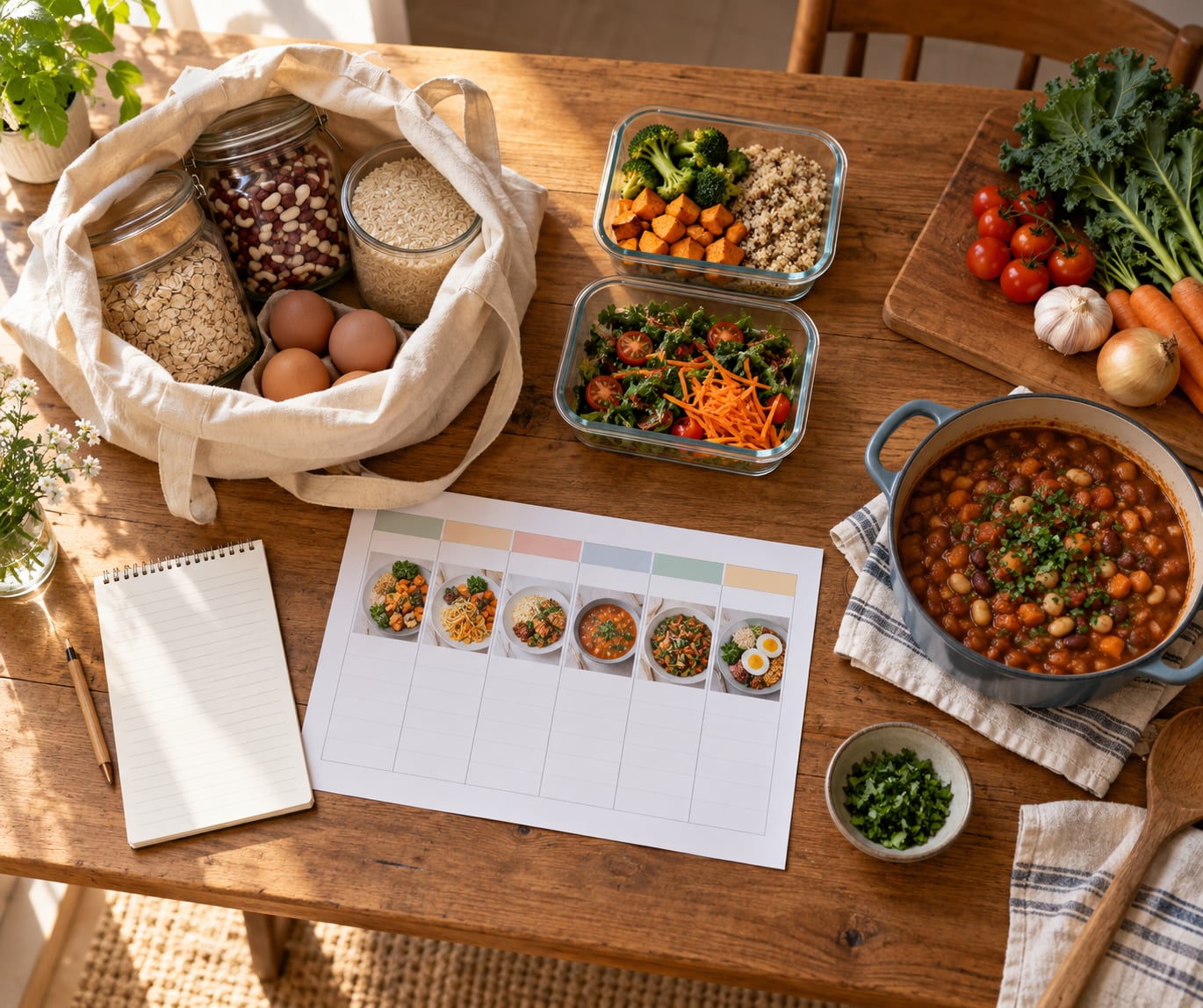
How to eat healthy on a tight budget comes down to four habits: buy the cheap staples — dried beans and lentils, rice and oats, eggs, frozen vegetables — shop once a week from a written list, cook in one pot, and eat the results before you make anything new. That is the whole method. Set aside about an hour on a Sunday and it will carry five or six days of meals.
The honest part is that it takes planning, and most of us skip that planning. Nobody feels like writing a list when they’re tired. Then the list gets made in the aisle instead, and the aisle always wins.
What follows is a seven-step system I hand to people who tell me the grocery bill has gotten out of hand. It leans on the USDA’s MyPlate pattern — a bit of protein, a quarter of vegetables and fruit, a quarter of grains, and a dairy or fortified alternative — and on the one piece of kitchen wisdom nobody argues with: food cooked at home from basic ingredients is almost always cheaper and more nourishing than the packaged version. For anything involving your own health conditions or medications, talk to a doctor or registered dietitian rather than a website.
Table of Contents
- What You Need
- Step-by-Step: How to Eat Healthy on a Tight Budget
- Step 1: Set the weekly food number before you plan a single meal
- Step 2: Take a pantry inventory on the kitchen floor
- Step 3: Plan seven dinners around what you already own
- Step 4: Write the list by aisle, then shop the perimeter
- Step 5: Cook one big pot and stretch it across the week
- Step 6: Portion before you sit down, not after
- Step 7: Work through the oldest food first
- Cheapest complete meals, in order of what they cost you
- Common Mistakes
- Buying the processed option because it looks cheap
- Skipping produce entirely because it spoils
- Shopping with no list, and shopping hungry
- Letting cooked food die in the back of the fridge
- Buying name brand for pantry staples
- Buying fresh produce that is out of season
- Treating a slow cooker or chest freezer as a requirement
- Leaving food assistance on the table
- Frequently Asked Questions
- How can I eat healthy when I have very little money for groceries?
- What are the cheapest healthy foods I can buy at a regular grocery store?
- Are frozen fruits and vegetables healthy when money is tight?
- How can I feed my family healthy meals on a small budget?
- Do I need to cook every meal to eat healthy on a tight budget?
- Start With One Pot This Weekend
What You Need
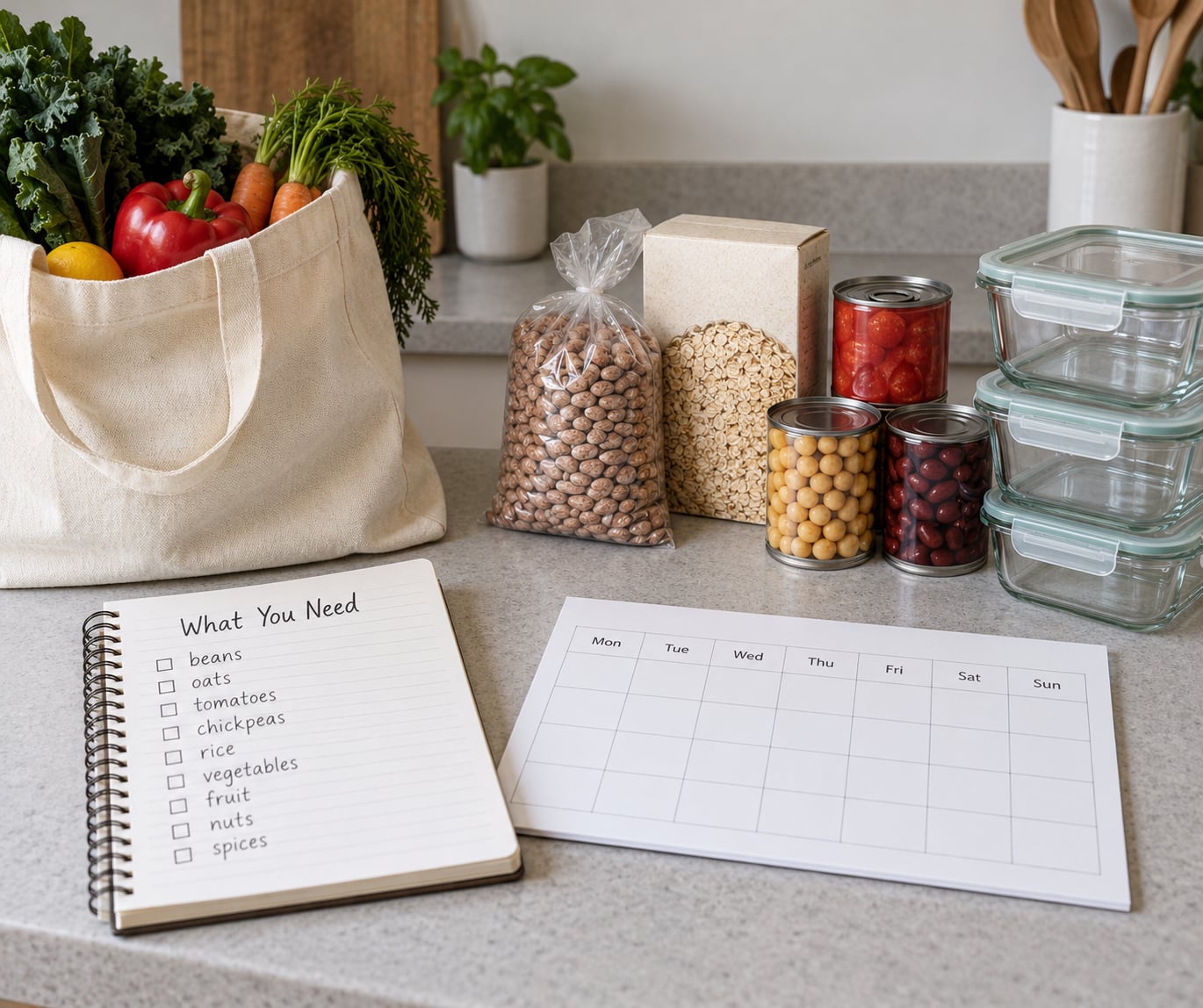
You need almost nothing to start. Everything below is either free, already in your kitchen, or used for years.
- A weekly number. Decide what your household can spend on groceries for one week and write it on the front of the notebook. A number you have decided in advance is the only real budget tool. Vague intentions last one trip.
- A list that lives somewhere. A notebook, a phone note, an index card on the fridge. The medium does not matter; writing it down does.
- Twelve pantry staples. Dried beans, lentils, rice, oats, pasta, canned tomatoes, peanut butter, eggs, frozen vegetables, onions, garlic, and a small spice shelf of salt, black pepper, garlic powder, paprika and cumin. With those twelve you can make stews, chili, rice bowls, oatmeal, pasta sauces and stir-fries all week.
- Storage that fits a refrigerator. A set of glass or plastic containers, a stack of freezer bags, and a dedicated “eat me first” shelf or bin in the fridge. That bin is where cooked food goes, and nothing else does.
- Nothing else. A slow cooker, rice cooker or chest freezer are useful, not required. If buying one means cutting food money, skip it and use a pot and your oven.
Two affordable substitutions cover almost every gap. When fresh produce spoils before you get to it, swap in frozen — frozen spinach, broccoli, green beans and berries are picked and frozen at peak and lose very little. When a recipe calls for an ingredient you never finish, swap in the canned or frozen version and use it within a few weeks.
Step-by-Step: How to Eat Healthy on a Tight Budget
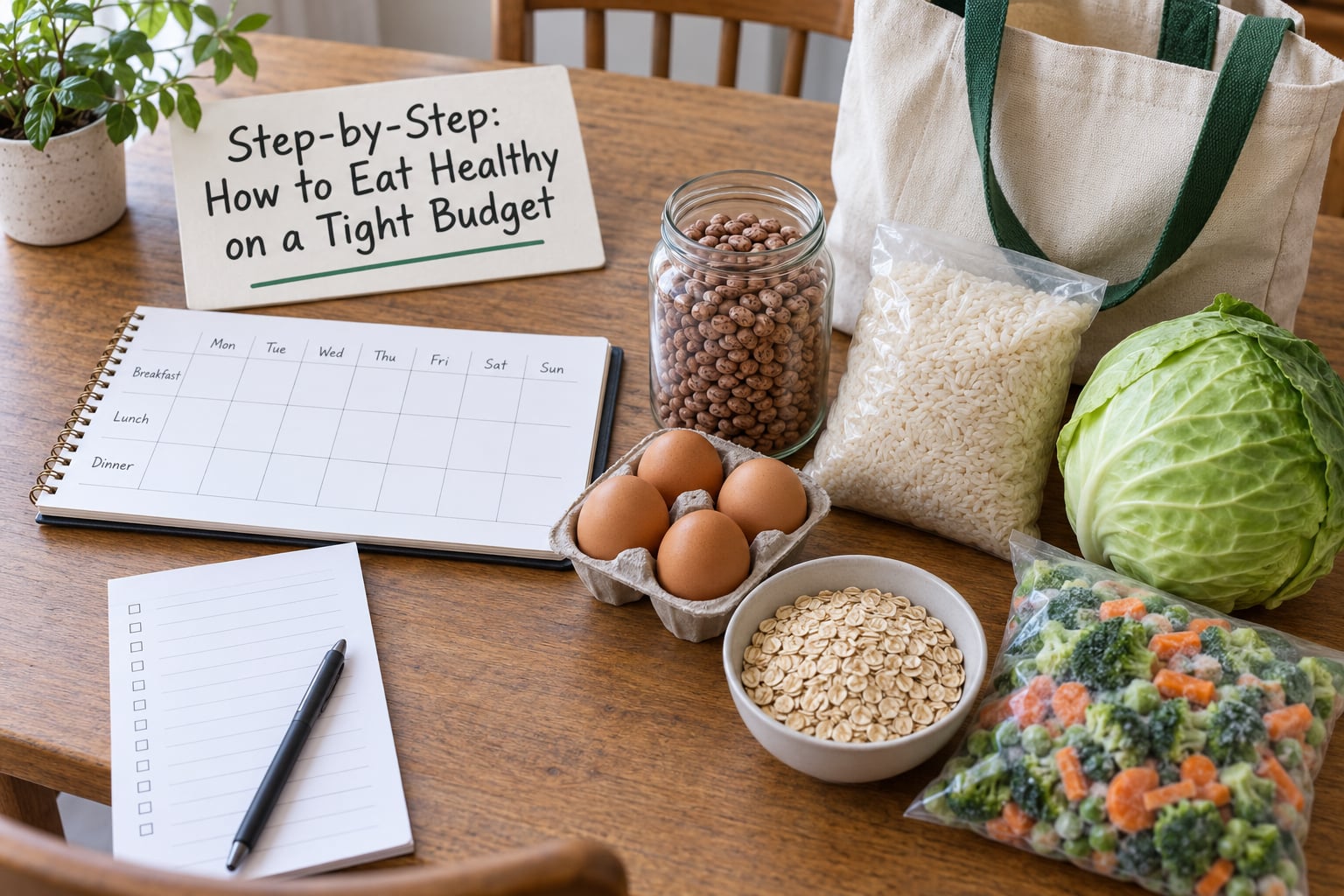
Step 1: Set the weekly food number before you plan a single meal
Write down what the household can spend on food for the next seven days and treat it as fixed. Not a target, a ceiling. Then decide who cooks and on which days, because a plan that assumes you’re free every evening fails by Wednesday.
How to know it worked: you can say the number out loud without flinching, and you know which days of the week your own cooking happens.
Step 2: Take a pantry inventory on the kitchen floor
Pull out the bottom three shelves and make two piles: what you have and what is nearly gone. Count the cans. Find the rice and the beans behind the oil. This takes about fifteen minutes and it stops you from buying a fourth bag of rice you already own.
How to know it worked: you have a written list of what is on hand, plus a short list of the five items that will run out this week.
Step 3: Plan seven dinners around what you already own
Fill in meals starting with the items on your nearly-gone list. One bag of beans can become three different dinners depending on what you add: a pot of beans and rice with onion and pepper, a bean chili with canned tomatoes, or lentil soup with whatever frozen vegetables are in the freezer. One roast chicken bought on a sale feeds two or three meals rather than one.
Anchor every evening to a grain and a protein so nobody is scrambling at 6pm. Rotate a second vegetable in at least twice a week, and use fresh fruit for the easy meals.
How to know it worked: each evening has a named dish, and at least four of the seven reuse something you already had.
Step 4: Write the list by aisle, then shop the perimeter
Group the list by where things live: produce, meat and protein, dairy, canned and dry goods, frozen, household. When you get to the store, walk the perimeter first — produce, meat, dairy, bread — before you ever enter the middle aisles where the impulse buys live.
Compare the unit price, not the shelf price. A large container that costs more can cost less per serving. Eat a small meal or snack before you shop, not a large one, and go once.
How to know it worked: you came back with what was on the list and nothing that wasn’t on it, and you bought store brands on the dry goods.
Step 5: Cook one big pot and stretch it across the week
Sunday is the anchor: one pot of bean stew, curry, chili or a sheet pan of chicken and vegetables. Make more than you think you need, because the leftovers are the entire point. If you have a slow cooker, this is the 15-minute morning job it was made for. If you don’t, a stovetop pot and a low oven do the same work.
Keep food safety in mind: cook poultry to an internal temperature of 165°F (74°C), ground meat to 160°F (71°C), and whole cuts of meat and fish to 145°F (63°C). Refrigerate cooked food within two hours and eat refrigerated leftovers within three to four days, or freeze them the day you cook.
How to know it worked: you have at least four portions in the fridge or freezer by Sunday evening, and Monday’s dinner is already made.
Step 6: Portion before you sit down, not after
Put the intended portion in a container and put the rest away before the meal starts. That’s the whole discipline, and it takes five seconds. Leftovers that live at the back of the fridge get thrown out, and thrown-out food is the same money spent twice.
How to know it worked: you have containers stacked in the “eat me first” bin that you will actually open this week.
Step 7: Work through the oldest food first
Every week, check the “eat me first” bin before you plan. Anything there becomes tonight’s dinner or tomorrow’s lunch. A hard-boiled egg, a scoop of rice and beans, a bowl of leftover stew — that is a meal, not a compromise.
People in budget-eating communities such as r/EatCheapAndHealthy and r/povertykitchen describe the same pattern: buy the staples, cook a large pot on Sunday, and stop letting food sit until it goes bad. The waste is usually bigger than the grocery bill difference people are trying to save.
How to know it worked: at the end of the week the bin is empty and nothing was thrown out.
Cheapest complete meals, in order of what they cost you
Each of these is a full meal, not a snack, and each is built from the staples above.
| Meal | What it is built from | Time |
|---|---|---|
| Beans, rice and eggs | Canned or dried beans, rice, egg, onion, hot sauce or pepper | 20 minutes |
| Bean and vegetable soup | Beans, canned tomatoes, frozen mixed vegetables, broth powder | 30 minutes |
| Rice and bean bowls | Brown or white rice, black beans, salsa, shredded cabbage or frozen corn | 25 minutes |
| Pasta with canned tomato sauce | Pasta, canned tomatoes, jarred sauce, frozen spinach or grated store-brand cheese | 20 minutes |
| Oats with banana and peanut butter | Oats, banana, peanut butter, handful of any nut or seed | 10 minutes |
That table is also the answer to a question people search constantly: what is the cheapest healthiest thing to eat? It is a bowl of rice and beans with a vegetable, not a specific branded product. Nothing in that list requires a special shop, a membership or a health-food aisle.
Common Mistakes
Buying the processed option because it looks cheap
Fix it by comparing what the package actually gives you. A shelf-stable stew that lists vegetables and beans in the first three ingredients costs more than the can of beans and the can of tomatoes beside it, and it feeds you the same number of meals. Ultra-processed snacks are cheap per item and expensive per week because you keep eating them.
Skipping produce entirely because it spoils
Fix it by switching half your fresh produce to frozen, and by buying small amounts more often. Two bags of frozen broccoli a week get eaten. A head of broccoli bought on Sunday is still wrapped on Friday. Frozen spinach, green beans, peas and berries are picked ripe and frozen at peak, so they hold their nutrients well.
Shopping with no list, and shopping hungry
Fix it by writing the list before you leave the house and having a snack first. Budget eaters call this one the most boring and most effective tip in the category, and they are right. No list means the store picks your dinner, and the store’s picks are not cheap.
Letting cooked food die in the back of the fridge
Fix it with one bin, one rule and one date. Everything cooked goes into the bin. At the end of the week, anything in it becomes tomorrow’s meal. When you know you’ll eat leftovers, you cook less the next time — which makes the budget stretch further than any coupon.
Buying name brand for pantry staples
Fix it by moving staples to store brands, one category at a time. Start with rice, oats, canned tomatoes, peanut butter, pasta and soap. Most people cannot tell the difference blind, and the difference at checkout is real every single time. Save name brand for the one or two things your household actually prefers.
Buying fresh produce that is out of season
Fix it by treating the season as a guide rather than a rule. In-season items are cheaper and generally better, but frozen versions of off-season produce solve the same problem at a fraction of the cost — and in some cases for less.
Treating a slow cooker or chest freezer as a requirement
Fix it by going back to the pot, the oven and the freezer compartment you already own. Budget cooking runs on heat and time, not appliances. If a device ever shows up, it should come out of a surplus, not out of the food money.
Leaving food assistance on the table
If money is genuinely the barrier, programs exist that many eligible households never apply for: SNAP for groceries, WIC for pregnant people and young children, school meal programs, and local food banks. Eligibility rules and benefits vary by state and change, so go to the official SNAP and WIC sites rather than a blog, ask your local health department, or call 211 for the food assistance line in your area. Doubling your SNAP benefits at farmers markets through incentive programs like Double Up Food Bucks is worth looking into where it’s offered.
Frequently Asked Questions
How can I eat healthy when I have very little money for groceries?
Start with the staples that stretch furthest: dried beans and lentils, rice, oats, eggs, frozen vegetables and canned tomatoes. Plan seven dinners before you shop, cook one large pot on a Sunday, and eat the leftovers before cooking again. Shop once a week with a written list, and choose store brands on dry goods. Buy produce in small amounts or frozen so nothing spoils. Write down what you can spend before the trip and treat it as a ceiling.
What are the cheapest healthy foods I can buy at a regular grocery store?
The best value per serving comes from a short list: beans and lentils for protein and fiber, eggs, whole chickens or chicken thighs, canned fish, milk or fortified plant milk, oats, brown rice, pasta, whole wheat tortillas, canned tomatoes and frozen vegetables and fruit. Store brands on these cut the cost further with no change in nutrition. Cheap does not mean unhealthy here; it means unprocessed.
Are frozen fruits and vegetables healthy when money is tight?
Yes. Most frozen produce is blanched and frozen shortly after harvest, so it can hold as many nutrients as fresh produce that has sat in a fridge for a week. Frozen vegetables like spinach, broccoli, green beans and peas are often cheaper than fresh out of season, last longer, and waste nothing because you only cook what you need. Buy plain frozen rather than sauced or buttered varieties, and check that there is no added salt in the ingredient list.
How can I feed my family healthy meals on a small budget?
Cook one large pot of a family meal such as bean stew, chili or rice and bean bowls, then let family members assemble their own bowls with whatever they like. That costs the same as one meal but scales to any number of people. Use the same base for three different dinners by changing one ingredient, buy proteins in bulk, and buy frozen vegetables so nothing goes to waste. Kids will eat what the pot already contains if they can serve themselves.
Do I need to cook every meal to eat healthy on a tight budget?
No, but you need to cook most of them. Eating healthy on a tight budget depends on turning cheap ingredients into meals, and that requires heat and time rather than specialty skills. A one-pot stew, a rice and bean bowl or an oat breakfast takes twenty minutes and one pot. Keep a few no-cook defaults on hand for nights when nobody has energy: canned beans, whole-grain crackers, fruit, peanut butter on toast, and yogurt or milk.
Start With One Pot This Weekend
If you take one thing from this, make one big pot on Sunday, portion it into containers, and let that pot cover four or five of the week’s dinners. Everything else in how to eat healthy on a tight budget — the list, the store brands, the frozen vegetables, the weekly number — exists to make that pot possible. The money gets saved by planning and leftovers, not by buying a different product.