
To use PTO strategically at work, pick the dates first and take them in blocks instead of scattering single days across the year. Most people lose value twice: they request too late to get good dates, and they spend the day they are off still answering Slack. Neither is a policy problem. Both are planning problems, and the fix takes about twenty minutes.
The core idea is simple. Weekends and public holidays are free leverage you never have to spend a day on, so a few PTO days placed next to a holiday turn a short break into a real one. People who take short, scattered days often report coming back exactly as tired as they left, because three-day weekends never reach the point where your head actually clears. Consecutive days do.
This guide covers 2026 planning, but the method works in any year. You check what your policy actually allows, map your balance against the calendar, ask early, and then protect the break you took.
Table of Contents
- What You Need
- Your real PTO balance, not the headline number
- The written policy, not the rumour
- The team calendar
- A realistic answer on coverage
- The outcome you want
- Step-by-Step: How to Use PTO Strategically at Work
- 1. Define the purpose before choosing the dates
- 2. Check your balance, rules, and realistic workload
- 3. Map PTO around deadlines and team coverage
- 4. Build a coverage and handoff plan
- 5. Use smaller PTO blocks when they fit the goal
- 6. Disconnect fully so using PTO strategically actually pays off
- 7. Review the result and plan the next break early
- Common Mistakes
- Saving every day for one trip in December
- Asking for time off with no coverage plan
- Answering Slack from the beach
- Waiting for a crisis before taking any time off
- Taking the days but staying mentally checked in
- Booking late and blaming the calendar
- Frequently Asked Questions
- How much PTO is normal to take each year?
- Does two weeks of PTO mean 10 working days or 14 calendar days?
- How long after starting a new job is it acceptable to take vacation?
- How do I know whether I actually need a day off?
- What happens if I never use my PTO?
- Should I feel guilty about calling in sick when I am not sick?
- Conclusion
What You Need
Before you pick dates, gather five things. Skipping this step is how people end up requesting time off during quarter close and wondering why the conversation went badly.
Your real PTO balance, not the headline number
Your balance is whatever you have accrued and not yet used, which is often far lower than the annual figure printed in your handbook. Many policies accrue monthly or per pay period, and some cap what you can carry over into the new year. Log into the HR system or read the latest payslip line item before you build a plan around numbers that do not exist yet.
The written policy, not the rumour
Find four things in writing: how much notice is expected, who approves, whether consecutive days need extra sign-off, and whether there is a minimum staffing rule on certain dates. Policies live in the handbook, the intranet, or an email from HR. If none of those exist at your company, ask HR directly and keep the reply.
The team calendar
You need to see when the busy stretches are. Look at the last two quarters and mark quarter close, product launches, audit season, open enrollment, big client renewals, and the weeks when several people are already out. You are not asking to avoid every one of these; you are asking to know where they sit.
A realistic answer on coverage
Ask yourself honestly whether someone can carry your work for the length of the break, and whether they would say yes if you asked directly. Some roles genuinely cannot be covered, and pretending otherwise is what creates the coverage crisis that makes a break stressful.
The outcome you want
Decide what the time is for before you pick the dates: recovery, a family event, a health appointment, a project at home, travel, or a transition around a job change. Different outcomes need different shapes. Recovery needs consecutive days. Appointments need a half-day here and there. Trying to do all of it in one trip is how people end up with a holiday that feels like an extension of work.
Step-by-Step: How to Use PTO Strategically at Work
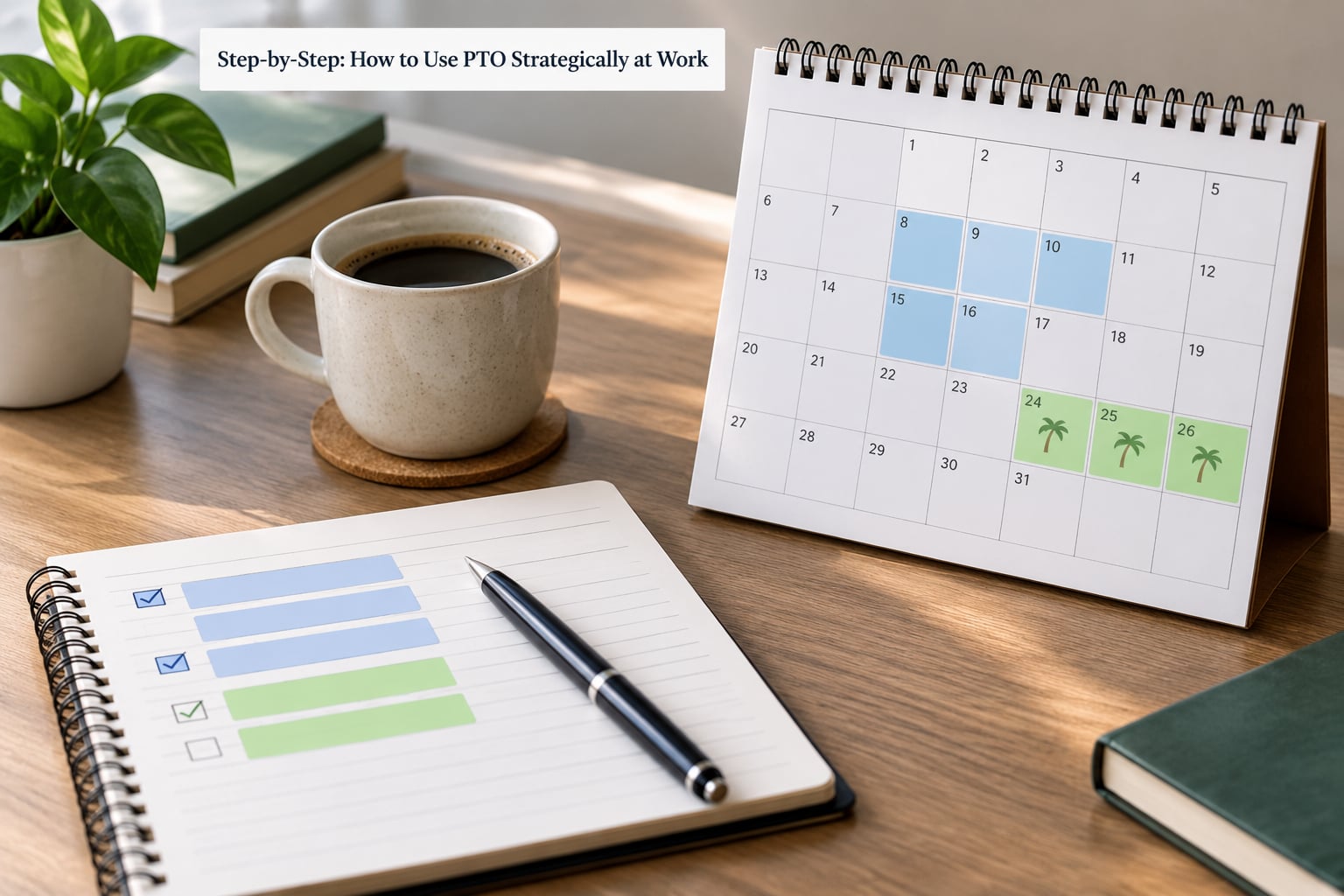
Seven steps, in order. The first two take ten minutes and decide whether the rest works.
1. Define the purpose before choosing the dates
Write one sentence naming what the break is for. “I am exhausted and need sleep” points you toward consecutive days. “I need the orthodontist in the morning” points you toward a half-day in March. “My parents are having an anniversary” points you toward a specific weekend you cannot move. Purpose first means your dates get chosen for a reason instead of drifting to whatever Saturday is nearest.
2. Check your balance, rules, and realistic workload
Confirm how many days you actually have, when they accrue, and what happens to unused days at year end. Some employers roll a balance over, some cap it, and a few pay it out on separation; the rules differ by company and by state, so read yours rather than assuming. Then take the number you have and divide it. If you have eleven days and you want a real recovery week plus a family trip, you now know it fits before you start negotiating.
3. Map PTO around deadlines and team coverage
This is where the calendar math happens. Work out which public holidays your employer observes, since many companies shift a holiday that falls on a weekend to the nearest weekday. Then check what sits next to each one. The rule of thumb is simple: each PTO day placed next to a weekend or an observed holiday buys you more consecutive days off than the same day spent randomly.
| Window | PTO days used | Consecutive days off |
|---|---|---|
| Tuesday to Friday before Memorial Day | 4 | 9 |
| Friday before Labor Day, plus the Tuesday after | 2 | 5 |
| Wednesday and Friday around Thanksgiving | 2 | 5 |
| A mid-December week that contains two observed holidays | 4 | 9 to 11 |
The dates shift each year, but the pattern holds: run the same arithmetic on your own calendar before you request anything. While you are there, note the weeks to steer around, which are quarter close, launch weeks, audit season, and any rotation where you are on call.
4. Build a coverage and handoff plan
Four parts, and it takes less time than most people fear. First, a short handoff note listing what is live, what is blocked, and who owns each item. Second, a named person with actual decision authority for your area, agreed with them in advance rather than announced on your last day. Third, an out-of-office message with an automatic reply and a named contact for real emergencies. Fourth, a clear line about what can wait, because most of it can.
One thing worth doing: ask the person covering you whether the dates work for them. It removes the most common source of last-minute anxiety, and asking early costs nothing.
5. Use smaller PTO blocks when they fit the goal
One long break is not automatically better than several short ones. A ten-day trip resets some people and exhausts others. Three or four separate blocks spread across the year often protect more, because burnout arrives in waves rather than in one annual cliff.
Some combinations that work well: one longer break for genuine rest, a couple of single days for appointments, one block placed on a holiday for a long weekend, and one day near the end of a hard quarter so you are not still running on empty in week ten. Whatever you pick, the only version that helps is the one that actually happens.
6. Disconnect fully so using PTO strategically actually pays off
The break stops working the moment you start monitoring it. Set notifications off, not just muted. Do not check email on the first or last day, because those two checks are what pull you back into the shape of working. Tell your team the boundary in writing when you hand off, so nobody expects an answer from you.
Guilt is the thing that ruins the recovery, and it is mostly a prediction. You are imagining a colleague noticing, a deadline slipping, a promotion passing you by. In practice most people barely track who is out, and the work you handed over properly gets handled. If your employer offers a mental health day or a personal day as a separate category, use it for the day you need to not perform, rather than saving those categories for genuine emergencies.
7. Review the result and plan the next break early
After the first day back, write down one line: did this improve my energy, focus, or sleep, and did it cost me anything at work? That answer tells you whether the length was right and whether the timing was safe. Then put the next break in the calendar before the current one fades out. PTO you have not booked is PTO you will find in December with three days left and no plan.
Common Mistakes
Saving every day for one trip in December
The fix is to spread your balance across the year. Book one meaningful block early, then place the remainder in smaller pieces through the year. If your employer offers a carryover cap or a payout at separation, check it, because that changes the calculation completely.
Asking for time off with no coverage plan
A request that starts with a coverage problem is a request that gets pushed to next quarter. Send the handoff note with the request, or at least say who is covering. Managers are not trying to block you; they are trying to avoid being handed an unowned problem.
Answering Slack from the beach
This is the most common way a good break turns into a bad one. Silence on day one and day five costs far less than being quietly online all ten days, because nobody checks. Set the boundary before you leave, not the morning of.
Waiting for a crisis before taking any time off
Saving every day as an emergency fund means it is never used, and burnout arrives anyway. Treating PTO as a workplace tool rather than a medical reserve is the whole point of planning it. If you want a diagnostic test: if you cannot name a single day in the last three months when you were glad to have it, that is the signal.
Taking the days but staying mentally checked in
Days taken while you work through the list are days spent twice with nothing to show for it. If you keep a private to-do list of work, leave it at the office for the length of the break.
Booking late and blaming the calendar
The best weeks around holidays go early, usually by mid-year for the following summer. Request the dates you actually want a season before, even if approval is same-day. A late request on a booked week usually moves you, it does not conjure a free one.
Frequently Asked Questions
How much PTO is normal to take each year?
In the US, a common full-time salaried range is around 15 to 25 days a year, which is three to five weeks. Hourly and part-time employees often get less, and some employers offer unlimited or flexible policies instead. There is no legal US minimum for private-sector PTO, so your handbook is the authority. Whatever your number, taking most of it across the year in planned blocks is the point.
Does two weeks of PTO mean 10 working days or 14 calendar days?
Almost always 10 working days, counting only weekdays. Policies rarely pay out weekends and public holidays, so a two-week vacation is normally 10 days off your balance plus any weekend that happens to sit inside the window. Some employers pay holidays on top, some treat them as part of the balance, and some offer half-day or hourly accrual, so read how your own policy counts.
How long after starting a new job is it acceptable to take vacation?
There is no universal waiting period, but many probationary periods run 60 to 90 days and some employers ask new hires to hold off until they have finished one full quarter. The practical test is whether the work is covered and whether you understand the approval norms. Ask your manager directly what the expectation is, book early in the year, and take something small before you plan a long trip.
How do I know whether I actually need a day off?
A useful signal is irritation that does not go away after sleep, dread that builds on Sunday night, or the need to work through lunch to keep up. One slow week is noise; a pattern over a month or two is information. If you cannot remember the last day you were glad to have off, that is a strong signal. Book one day, see what the next week looks like, and judge from there rather than from the calendar.
What happens if I never use my PTO?
It depends entirely on your policy and your state. Some employers cap how many days you can carry into the new year, some pay out unused balances when you leave, and some run unlimited policies where the real limit is culture rather than rules. Whatever the policy says, unused time off is linked in workplace research to burnout and turnover, so treat the expiry date as a real deadline rather than a formality.
Should I feel guilty about calling in sick when I am not sick?
No, but do not file a false sick claim either. Sick leave and PTO are usually separate categories with different rules, and misuse can put your job at risk. If you need a day for yourself, book it as PTO or as a personal or mental health day if your employer offers one. Those categories exist for exactly this. The guilt is worth naming out loud, because it is what keeps people working through exhaustion.
Conclusion
Start with the two things that cost you nothing: open the HR system and read your actual balance, then read the policy and find the notice rule and the year-end cut-off. Both answers are usually sitting in a document you already have access to.
Then book one break with a purpose behind it, stacked against a weekend or holiday so it turns into real consecutive days, and put the handoff note in the same message as the request. Doing that once changes how the rest of the year feels, because the hardest part of time off was never the time off. It was the asking, and it is a ten-minute job.