
Yes, you can be assertive without being aggressive. Assertiveness means stating what you need, what you think and where your boundaries are, clearly and respectfully, while accepting that the other person is allowed to disagree. Aggression means trying to force, dominate or control the outcome. The whole difference sits in one line: you state your position and then let the other person choose what they do about it.
If you have been holding your breath for years, the fix is rarely a personality transplant. It is a small, repeatable process you can practise in low-stakes situations first. Most people who land here are not shy. They are polite, competent and tired of being the one who always bends, and they are worried that speaking up will make them the difficult person in the room.
That worry is real and it is the reason so many people default to silence. A question on r/selfimprovement and a few on r/AskReddit use almost the same wording: how do I speak up without coming across as rude, bossy or aggressive. The answer below takes about two minutes of prep per conversation and gets easier every time you use it. This version reflects current guidance as of 2026.
Table of Contents
- What You Need
- Step-by-Step: How to Be More Assertive Without Being Aggressive
- Identify the specific behavior or need
- Use a calm, direct communication format
- State your request or boundary clearly, not aggressively
- Listen without surrendering your position
- Stay steady when the other person pushes back
- Follow through and review the result
- Common Mistakes
- Frequently Asked Questions
- Can you be assertive without being aggressive?
- How can I become more assertive?
- How can I be direct without being rude?
- What are the three C’s of assertive communication?
- How do I practise saying no without feeling guilty?
- How can I be a nice person but not a pushover?
- Conclusion
What You Need
Before the six steps, five things make the difference between a request that lands and one that turns into a fight.
- One specific situation. Not a personality overhaul. A single conversation with a named person about a named thing.
- Two minutes of writing. Jot down what you observed, how it affects you, and what you want instead. People who script the first sentence deliver it far more calmly than people who wing it.
- A calm delivery. Slower pace, lower volume, an exhale before you start. Volume is read as threat even when the words are fine.
- Tolerance for a no. Assertiveness is not a technique for getting your way. It is a way of being heard. If you need compliance, you will unconsciously turn the volume up, and that is the aggression people can hear.
- A record. A few lines afterwards about what you said, how they responded, and what you will do next. This is what turns one brave moment into a habit.
One note on safety. If you are dealing with someone who controls your money, your housing, your immigration status or your physical safety, assertive communication is not the first step. Get support from someone qualified before you practise on that person.
Step-by-Step: How to Be More Assertive Without Being Aggressive
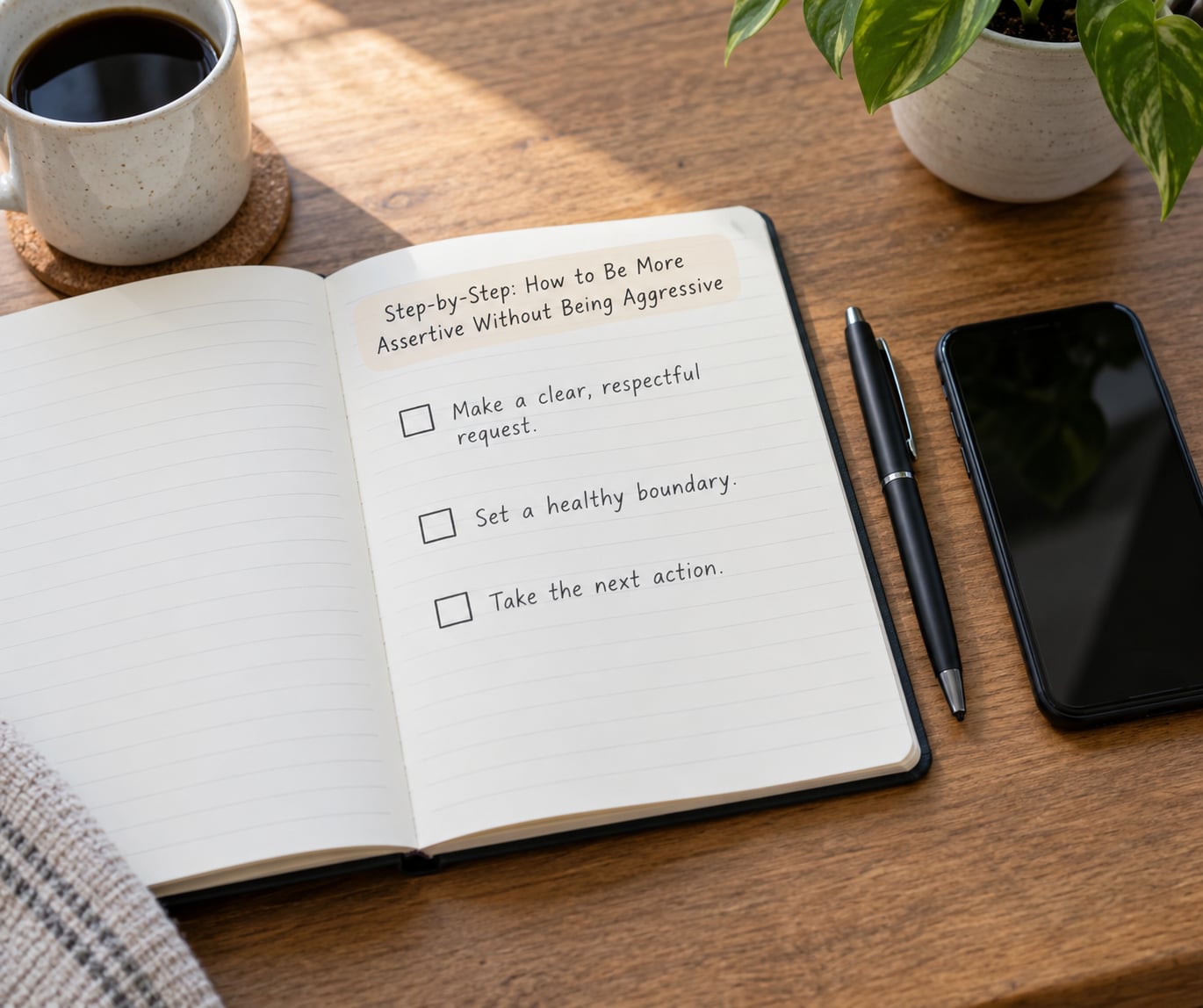
The process below is the version I give clients who want to learn how to be more assertive without being aggressive. It works in a two-minute hallway exchange and in a longer conversation with a partner or a parent. The order matters less than the pieces, but the pieces are what most advice leaves out.
Identify the specific behavior or need
Naming the issue precisely is most of the battle, because vague complaints sound like attacks. A complaint about someone’s attitude gives them nothing to fix. A complaint about a specific repeated action gives them something to change.
Use the camera test: if it would not be visible on a recording, it is probably a guess about their motives, and guesses are where fights start. Write down the observable behaviour, its effect on you or the work, and the outcome you want.
Weak: “You never respect my time.” Strong: “In the last three planning meetings, decisions were made without asking the team, and the ones I had researched got overwritten. In the next meeting, can we agree on who confirms decisions before the meeting ends?”
Use a calm, direct communication format
A four-part format keeps you out of accusation territory. Neutral opening, the facts, the impact, the specific request. Counsellors have taught versions of this for decades, and the best-known workplace version is the DESC script: Describe the situation, Express your feelings, Specify what you want, and state the Consequences.
Marshall Rosenberg’s Nonviolent Communication uses a similar shape, with observation kept strictly separate from evaluation. “In the last month you have replied to my messages after two days” is an observation. “You are disrespecting me” is an evaluation, and evaluations are where people start defending their character instead of your point.
The words do most of the work. Here is the swap list I give people:
- “You always” or “you never” becomes “the last three times”.
- “You don’t care” becomes “the effect on me is”.
- “You have to” becomes “what I need is, and here’s what I’ll do”.
- “It’s your fault” becomes “what happened, and what I want next”.
- “Fine. Whatever.” becomes a short honest no, delivered without sarcasm.
State your request or boundary clearly, not aggressively
Understanding the difference between a request and a boundary removes most of the anxiety. A request asks the other person to choose. A boundary tells them what you will do, and leaves their choice to them. Boundaries describe your own behaviour, never theirs.
Request: “Could you send me the figures by Thursday?” Boundary: “I will send my report Friday morning if the figures are not with me by Thursday afternoon.” One of those depends on them. The other does not, which is why boundaries hold and requests fail when you are dealing with a yes-or-no person.
Saying no without guilt follows the same rule. Give a short reason if one is owed, skip the invented excuse, and do not hand over a paragraph explaining yourself.
“I can’t help with the move this weekend. I’m at my limit with my own schedule.” That is the whole thing. Assertiveness training, developed by Joseph Wolpe and Arnold Lazarus decades ago, is built on this idea: you hold the right to be treated with respect, and a right you never use is not a right you have.
Listen without surrendering your position
Listening here is not agreeing. It is a move that makes agreement more likely, because most people who feel contradicted stop listening within about ten seconds. Ask a clarifying question, check what you heard, then restate your request.
“Help me understand. You are saying the deadline is fixed, but the scope can move. That works for me if we drop the competitive analysis. Otherwise, Friday is tight. Which of those two can you commit to?”
That question does three things at once. It shows you listened, it offers a real option, and it asks for a commitment instead of a vague promise.
Stay steady when the other person pushes back
Most people think this is the hard part, and it is the part they script least. Pushback comes in familiar shapes, and each one has a short answer.
- Dismissal: “You’re overreacting.” Answer: “It might feel that way from your side. I’m still asking for the change.”
- Deflection: “Why are you bringing this up now?” Answer: “Because it keeps happening, and I’d rather solve it than carry it.”
- Counter-offer: “What if we did this instead?” Answer: “That’s a real option. Let me think it over and come back tomorrow.”
- Guilt: “After everything I’ve done for you.” Answer: “I know, and I’m not questioning that. I’m saying no to this one.”
- Anger: a raised voice and a hard stare. Answer: lower your volume and shorten. “I’m not going to have this conversation at this volume. I’m available later.”
Two techniques help here. The broken record is saying the same clear sentence again, without adding new material each time, so the other person runs out of things to argue with. Fogging, borrowed from anger-management work, means accepting the part of their complaint that is fair without accepting the frame: “You’re right that deadlines have slipped. That doesn’t change the scope conversation we need to have.”
With someone more powerful, change the tactics rather than the message. Ask instead of accuse, put the request in writing, name the impact on the work rather than on your feelings, and pick your moment when the other person is not rushed. On Workplace Stack Exchange, confident professionals describe exactly this fear of being called rude or offensive, and the pattern that works for them is a calm, specific, documented request rather than a louder complaint.
Follow through and review the result
Closeness is what makes assertiveness stick, so decide what you will do next and say it out loud: “If this doesn’t change by Friday, I’ll raise it with HR” or “if it happens again, I won’t stay on this project.” Then do what you said. A boundary you never enforce teaches everyone that your words are decoration.
When nothing changes, there are usually three explanations. They cannot, they will not, or they did not hear you. Each one needs a different next step, and guessing wastes months. Write down the date, the words you used, the response, and what you will do. If a pattern repeats three or four times, you are not having a communication problem any more, you have a decision to make about how much you will keep investing in that person or that job.
Common Mistakes
Most attempts at being more assertive fail on mechanics, not courage. These are the ones I see again and again.
- Over-apologising. “Sorry to bother you, but I just wondered if maybe, only if you have time, could you possibly…” Every hedge strips the request. Drop the apology unless you actually did something wrong.
- Attacking character instead of behaviour. “You’re so lazy.” Nothing to negotiate with. Name the action: “The dishes have been sitting since Tuesday.”
- Ultimatums dressed as boundaries. “Do this or we’re done.” That is a threat, and people respond to threats defensively, not cooperatively.
- Accusing someone of being passive-aggressive when you are guessing. “Are you being sarcastic?” rarely works. Describe what you observed and ask about it.
- Confronting someone in public. Praise, correction and blame delivered in front of colleagues puts the other person on the defensive. Pull it aside.
- Stacking requests. Five asks in one message reads as an ambush. Make one request, wait for the answer, then make the next.
- Waiting until the moment of no return. Assertiveness that only shows up in the argument is heard as aggression, because that is the only data anyone has.
- Warming up first, then not following through. Three friendly meetings followed by silence teaches everyone that your requests are optional.
One framework covers most of the fixes. The three C’s of assertive communication are clear, confident and courteous. Clear means one issue and one request. Confident means a steady tone and a willingness to hear no. Courteous means you are still treating the person as someone you like, even while disagreeing.
And the trade-off readers worry about is not real. Warmth and firmness can sit in the same sentence. “I care about this team and I need the decision to go through me before Thursday” is a warm, firm statement. Choosing one or the other is a habit, not a rule.
Frequently Asked Questions
Can you be assertive without being aggressive?
Yes. Assertiveness means expressing your needs, opinions and boundaries clearly and directly while respecting the other person’s rights and perspective. Aggression involves blaming, attacking, dominating or trying to control. The difference is not how loudly you speak. It is whether you state your position and then let the other person decide what they do with it.
How can I become more assertive?
Start small and specific. Pick one low-stakes situation, write down what you observed, how it affected you, and one clear request. Say it in a calm tone, then let the other person respond without filling the silence. Write down what happened the same day. Practising in situations where the stakes are low builds the habit far faster than saving your first attempt for the moment you are already angry.
How can I be direct without being rude?
Be specific rather than general, and describe effects rather than character. Say the last three meetings ended without a decision being confirmed, not that people disrespect your time. Keep one issue per conversation, drop words like always and never, and finish with a concrete request. Directness comes from the precision of the message, not from its bluntness.
What are the three C’s of assertive communication?
The three C’s are clear, confident and courteous. Clear means you raise one issue and make one specific request. Confident means a steady tone, relaxed body language and the ability to hear no without escalating. Courteous means you still treat the person with respect. Other courses group them slightly differently, often as confidence, consideration and candour, but the underlying test is the same.
How do I practise saying no without feeling guilty?
Practise in writing first, because writing is where hedging hides. Write a two-sentence no: a short reason, or none at all. Then use it in a low-stakes setting, such as declining an invitation or a small favour, before you try it with anyone important. Guilt usually fades once you see that the relationship survives the no. Many people-pleasers find the discomfort drops sharply after the fifth no.
How can I be a nice person but not a pushover?
You do not have to choose. Kindness is about how you treat someone, and assertiveness is about whether you state what you actually want. Say the kind thing and the real thing in the same breath, and offer an alternative you can live with. A warm no followed by an honest reason protects both the relationship and your time, which is what people who appear nice most often forget to do.
Conclusion
Do not start with the person who hurt you most. Start with a request so small that being ignored would not ruin your week, and make it cleanly: what you observed, how it lands, what you want, and what you will do next. Say it in a calm tone and stop talking. The habit of stating a position and letting the other person respond freely is the whole skill, and it is learned one short conversation at a time, not in one dramatic confrontation.