
If you are searching for how to end a friendship that drains you, you can do it without a fight, a dramatic confession, or a reason good enough to satisfy everybody. The method that works is simple: name the pattern out loud once, choose between a gradual fade, a stated boundary, or a single honest conversation, then stop negotiating. Most people feel real relief within a few weeks, and the guilt fades faster than they expect.
I have watched friends handle this three different ways, and the ones who handled it best were not the ones who said the most. They said the least, clearly, and then got quiet. The ones who struggled were the ones who built a case, wrote a long message, and waited for a permission slip that was never coming.
Nothing here requires your friend to agree that they are the problem. You are not filing a verdict. You are changing what you give, and that is something you control completely on your own.
Table of Contents
- What You Need
- How to End a Friendship That Drains You Step by Step
- How to End a Friendship That Drains You Without Guilt
- When to Reduce Contact Instead of Ending the Friendship
- How to Prepare for the Conversation or Final Message
- How to Respond If the Friend Pushes Back
- How to Move On After Ending the Friendship
- Common Mistakes
- Frequently Asked Questions
- How do I know when a friendship has run its course?
- Can I end a friendship without telling them?
- Is my friend toxic or am I overreacting?
- What is the 11-3-6 rule of friendship?
- How do I end a friendship when we have mutual friends?
- What if my friend has no other friends?
What You Need

Before you say anything, you need to decide what you actually want. Not what feels fairest, not what keeps the peace longest. What is the outcome you can live with six months from now? A steady low-contact version of the friendship, a clean stop, or one honest conversation followed by distance all count as endings, and they cost you different things.
The second thing you need is honest data. The most reliable measure of a draining friendship is not how the person behaves but how you feel afterward. Write down, for the last two months, who initiated, who listened, who travelled, who celebrated, and who always absorbed the crisis call. That ledger is usually more persuasive than any argument you could have with her.
| What a mutual friendship looks like | What you are actually experiencing |
|---|---|
| You reach out, and they reach back | You are almost always the one sending the first text |
| You share the good stuff too | Every conversation is a crisis, a complaint, or a rehashed fight |
| Plans are mutual and roughly even | You do the organising, the driving, and the hosting |
| You leave feeling steadied | You leave tired, wired, or moody for hours afterwards |
| They ask about your life | Reassurance seeking runs one direction only |
| You can say no without a consequence | Saying no brings sulking, guilt, or punishment by silence |
| Effort settles without a tally | You keep an internal balance sheet and it never clears |
A popular heuristic from a 2012 study of a large phone network, often called the 11-3-6 rule, suggests it takes around 11 calls to establish a friendship, 6 calls a year to maintain a moderate one, and 3 to maintain a weak one. Nobody reaches those numbers by accident. When you are consistently the one calling, the imbalance is usually not in your imagination.
Third, you need to know which of three endings you are going for. Pick one before you open your mouth, because the person you are dealing with will absolutely try to renegotiate if you seem undecided.
| Method | Best when | Effort | Drama risk | Reversible |
|---|---|---|---|---|
| Gentle fade out | The friendship is low-stakes, long-distance, or already loosening on its own | Low | Low | Yes, for a few months |
| Clear boundary | You want the friendship but not the current pattern, and they have shown they can hear a no | Medium | Medium | Yes, if they change the pattern |
| Honest conversation | The friendship is close, long-standing, and the ambiguity is what is keeping you stuck | High | Medium to high | Hard, once said out loud |
One more thing to prepare for: the person you are closest to may not be the person you are most depleted by. If a friend is pulling at your partner’s attention or making you choose between the friendship and your relationship, say that plainly to yourself first. Your partner is not the bad guy in that scenario, and you do not have to keep a friendship to keep everyone else happy.
How to End a Friendship That Drains You Step by Step
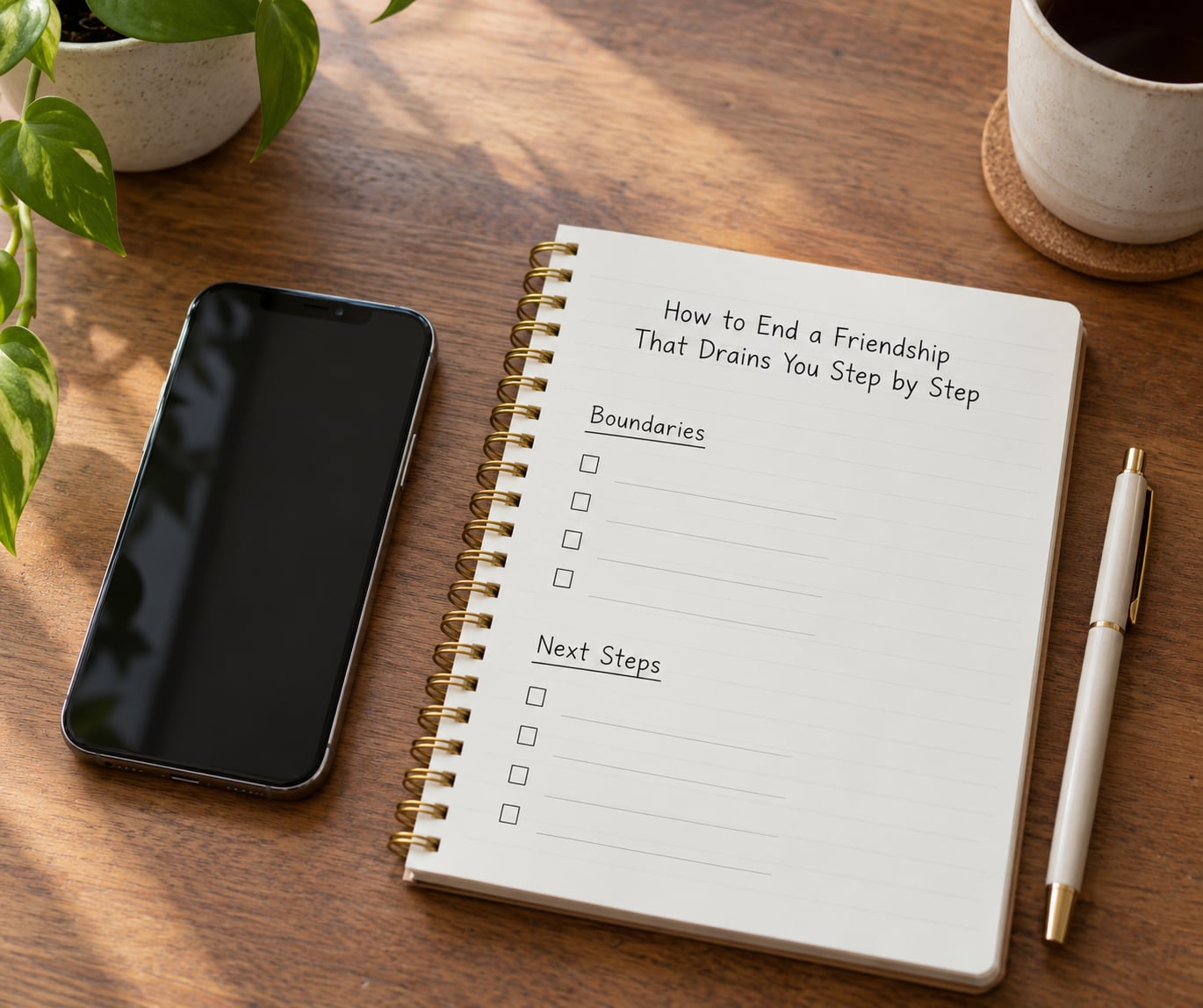
Whichever method you choose, the process runs in the same order. Decide first, get your facts down, say one clear thing, then protect the decision. Most people do these out of order and end up negotiating their own way back into a friendship they already left.
Before any of it, answer four questions honestly. Are you exhausted by their behaviour, or by how much of yourself you give up to avoid disappointing them? Have you actually asked for a change in plain words, or are you resentful about a boundary they never knew existed? Are you depleted on the day you hear from them, or only after you spend time with them? And is the relationship genuinely one-sided, or are you carrying emotional labour that a therapist could help you redistribute?
If the answer to the third question is no, send that ask first. It costs one conversation and it is the single thing most people skip. If the answer to the fourth is that you are doing more lifting than anyone, fixing the friendship will not fix the exhaustion, and that is worth knowing before you decide anything permanent.
How to End a Friendship That Drains You Without Guilt
The guilt almost always comes from over-explaining. The fix is to say the true thing in a short sentence and stop talking.
Describe the pattern rather than the character. Instead of “you are exhausting and you never think about me,” try something like: “I care about you, and this level of contact has become too much for me to keep doing well.” That version names your limit without alleging wrongdoing, which means there is nothing to argue about.
Keep it to three parts. What you feel, what you need, and what you are changing. Example: “After we spend time together I usually feel worse, so I am going to keep my calendar fuller for a while.” One sentence of feeling, one of decision.
Do not invite debate. If you say “but you always do this,” you have just agreed to a debate you will lose, because they have more evidence and fewer limits than you do. The goal is not to be understood. The goal is to be clear.
Skip the apology for existing in your life. You do not need to say sorry for wanting to be okay. A short acknowledgment of good times is kind; a mea culpa is not required.
When to Reduce Contact Instead of Ending the Friendship
Sometimes the answer is not an ending at all, and forcing one makes things worse. Reduce contact first when the pattern is a habit rather than a character trait, when the friendship is long-distance or already drifting, when they have shown they can change when given a clear ask, or when you are in a season where you have nothing left to give.
A boundary reset sounds like this: “I can do one call a month and nothing spontaneous for now.” Then keep it. A reset only works if the pattern actually changes, so watch for one or two months before you decide anything permanent.
Note the difference between reducing contact and avoiding the person. Reducing contact is a decision you are making and can say out loud. Avoidance is a drift you are pretending is a boundary. If you would be uncomfortable if they asked why you have been distant, you are drifting.
A short pause works too. Two or three weeks of genuinely low contact will tell you a lot. If you feel lighter and calmer, the problem was frequency. If you feel constant low-level dread about being caught, the problem is the relationship itself.
How to Prepare for the Conversation or Final Message
Use this as a checklist the day before, whether the conversation is in person, by phone, or in writing.
Choose a time that is not rushed and not emotional. Not a Sunday evening, not during their worst week, not right after they upset you. Midweek, unhurried, and when you are the one with the steadier footing.
Write your three sentences on paper and read them once. People who write the message out send something calm. People who wing it deliver a lecture.
Decide what is off limits. Not listing past incidents, not litigating old arguments, not asking them to admit what they did. Listing old grievances converts a boundary into a trial, and you already know how the verdict goes.
Line up support. Tell one person you trust what you are doing and when. Guilt hits hardest in the two hours after, and saying it out loud to someone who is on your side shortens that window considerably.
Know what comes next. Before you speak, decide what you will do if they cry, argue, threaten, or go silent. Usually it is the same thing: you repeat the decision once, you do not add new information, and you leave the conversation when you said you would.
How to Respond If the Friend Pushes Back
Pushback is not a reason to reopen the decision. It is the reason people stay stuck for another three years. Use short, calm, repeatable answers.
If they get defensive or blame you: “I understand you see it differently. My decision is still the same.” No explanation, no rebuttal.
If they guilt trip: “I know this hurts you, and I am not taking that back. I would rather be honest with you than slowly disappear.” Then stop talking.
If they get angry: “I am not going to keep talking while it is like this. I will check in next week.” Ending the conversation early is not cruelty. It is the only way to avoid a fight you did not start.
If they beg or promise to change: “I hear you, and nothing in my decision has changed.” Promise is cheap in the moment and expensive later. Do not wait to see whether they keep it.
If they return months later, which is common when their life gets hard again, you get the same sentence: “I am glad you reached out, but my decision has not changed.” People often come back not because they have grown but because they are alone. Both things can be true at once, and you are still allowed to say no.
If they go to mutual friends about it, resist the urge to defend yourself in detail. A short, calm version to anyone who asks, once, is enough: “The friendship wasn’t working for me and I stepped back from it.” People fill silence with drama. Give them a boring sentence and nothing to work with.
How to Move On After Ending the Friendship
The first few weeks are the loudest. Expect to feel worse before you feel better, especially if the friendship was long and the good years were real.
In the first 30 days, remove the hooks that keep the pull strong. Mute the chat, unfollow the account, leave the group thread, delete the number from the favourites list. Do not scroll through their life. Watching them from a distance keeps the wound open because you get partial information that lets you imagine the worst.
Between 30 and 60 days, replace the habit instead of just removing it. Friendship is mostly repetition: a standing call, a shared walk, a weekly check-in. Put that slot somewhere else. If you have nothing, put it with your partner, a sibling, or a hobby group, because an unfilled slot gets filled by whoever asks hardest.
By 90 days, the thing you are really deciding is whether to leave a light door open. You are allowed to. A mutual birthday text once a year, a like on the good news, no private conversations. Decide this on purpose rather than drifting into it, because drifting leaves you unable to tell whether you are being friendly or being slowly pulled back in.
Grief is a normal part of this even when nobody did anything wrong. Some friendships end because two people grew at different speeds, and that is a loss worth mourning. If the emptiness sits with you for months, talking to a therapist or counsellor is a reasonable next step rather than an admission that you handled it badly.
Common Mistakes
Over-explaining. Every extra reason is an opening for negotiation. Fix: one sentence about how you feel, one sentence about what you are doing, then stop.
Delivering a fake reason. Inventing a busy schedule sounds kind and lasts six weeks, then the friendship continues on the same terms and you feel foolish. Fix: give the real reason in plain, neutral language.
Disappearing with no signal. A silent vanish punishes the other person and leaves you with the story, because they will write the version where you were cruel. Fix: one short message, then distance.
Arguing through every old incident. A full trial is unwinnable and it hands them weeks of attention, which is the exact resource you were trying to reclaim. Fix: refuse the case. Say the decision and leave.
Threatening the friendship. Statements like “I have other friends now” invite a competition you do not need to enter. Fix: describe your own behaviour, never their character or their future.
Expecting immediate relief. Many readers feel worse for a few weeks first, because grief and the unknown are heavier than a familiar drain. Fix: expect a hard month, then look for the lighter months.
Treating the other person as the only problem. Sometimes the question is whether you have been doing a lot of emotional labour that a therapist or a firmer boundary could address. Fix: run the honest self-check before you decide the friendship is the whole story.
One last caution. If your friend may be in genuine danger, this is not a friendship-ending question. Depression and anxiety can look like draining patterns, and a person in crisis needs support routed to a professional rather than a boundary statement. Encourage a therapist or doctor, share the 988 Suicide and Crisis Lifeline in the US and Canada, or local emergency services elsewhere, and stay involved as a friend without absorbing what is not yours to carry.
Frequently Asked Questions
How do I know when a friendship has run its course?
Notice whether you feel relief instead of grief when you do not hear from them, whether you are always the one initiating, and whether you leave every conversation needing recovery time. If contact leaves you consistently worse off and nothing changes after you ask for something different, the friendship has usually run its course. It can end without anyone doing anything wrong.
Can I end a friendship without telling them?
You can, and adults let friendships lapse more often than we admit. A silent fade works best when the contact is already infrequent, long-distance, or clearly cooling. The risk is that a quiet fade reads as rejection, and some people respond with months of guilt-laden messages. One honest sentence costs you little and protects you from that, so use it even if you plan to keep your distance.
Is my friend toxic or am I overreacting?
Overreacting is possible, so check your own contribution first: are you over-explaining, rescuing, or saying yes when you mean no? Those patterns create real exhaustion inside an otherwise fine friendship. If you have asked plainly for a change and nothing has shifted after a few weeks, the drain is real. Naming the behaviour as a boundary is safer than labelling the person, and both approaches are valid.
What is the 11-3-6 rule of friendship?
It comes from 2012 research on a large phone network that mapped how long it takes to build and maintain social ties. The rough finding was that about 11 calls are needed to establish a friendship, 6 calls a year to maintain a moderate friendship, and 3 a year to keep a weak one. It is a useful yardstick for spotting one-sidedness, not a rule anyone should follow on purpose.
How do I end a friendship when we have mutual friends?
Keep showing up to the group and let the change be about the one relationship. Do not explain your reasons to each mutual friend separately, because a short consistent sentence repeated a few times beats a long story that changes every time. Give one calm version, then stop discussing it. Most friend groups adjust quickly, and the ones who take your side consistently are the ones worth keeping.
What if my friend has no other friends?
That is real concern, and it is worth weighing honestly, but it is not a reason to keep absorbing harm you have already decided against. You can step back without disappearing: keep a light door open with occasional check-ins and genuine care, without taking on the role of sole emotional support. If you are worried about their mental state, point them toward a therapist or support group, not just yourself.
Start tonight, not with a decision. Write down what has changed over the last few months and how you feel afterward, and put it somewhere you can see in the morning. That list is usually the only permission you need for how to end a friendship that drains you, and choosing the method comes one step after that.